
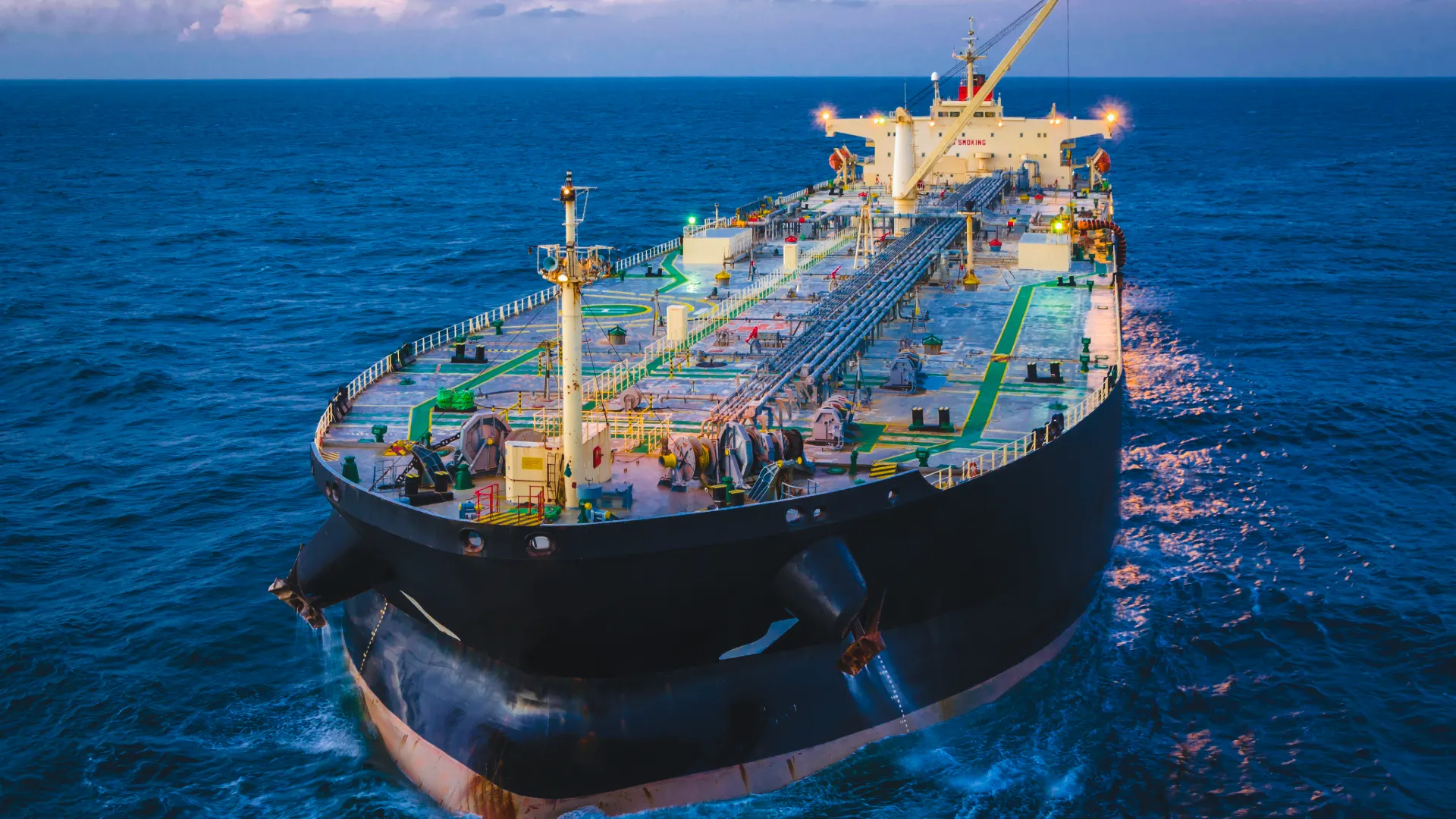
Romania has confirmed that a grain ship burned and sank in the Black Sea on 5 October, killing two of its crew. It has not confirmed the Black Sea drone strike that Ukraine’s president describes. The gap matters in New Delhi, because three of the 13 people aboard the MV Royad Mammadov were Indian, and the sinking is the latest in a run of attacks on merchant ships that has cost Indian seafarers their lives since July.
The incident would be a footnote in a war with daily headlines were it not for where it happened and who was aboard. It occurred inside the exclusive economic zone of a NATO member, on a route that carries Ukrainian corn towards Europe. And it injured an Indian seafarer in a war India is not fighting.
What makes it instructive is the distance between what Ukraine says and what Romania has established, and the way India has answered earlier incidents of the same kind.
Key takeaways
- On 5 October 2026 the Turkish-operated, Saint Kitts and Nevis-flagged cargo ship MV Royad Mammadov caught fire and sank off Romania, killing two foreign nationals. All three Indian crew survived; one was injured.
- Romania confirmed the fire and the two deaths but has not confirmed a Black Sea drone strike or named an attacker. Ukraine’s President Volodymyr Zelenskyy says two Russian drones hit the ship in neutral waters.
- India summoned Russia’s chargé d’affaires on 21 July and Ukraine’s ambassador on 27 July over earlier attacks that killed Indian seafarers. Its 6 October statement on this ship named no party.
- Ukrainian government data cited by the industry tracker ShipUniverse show 57 attacks on vessels in port or at sea in July 2026, against 14 in all of 2025.
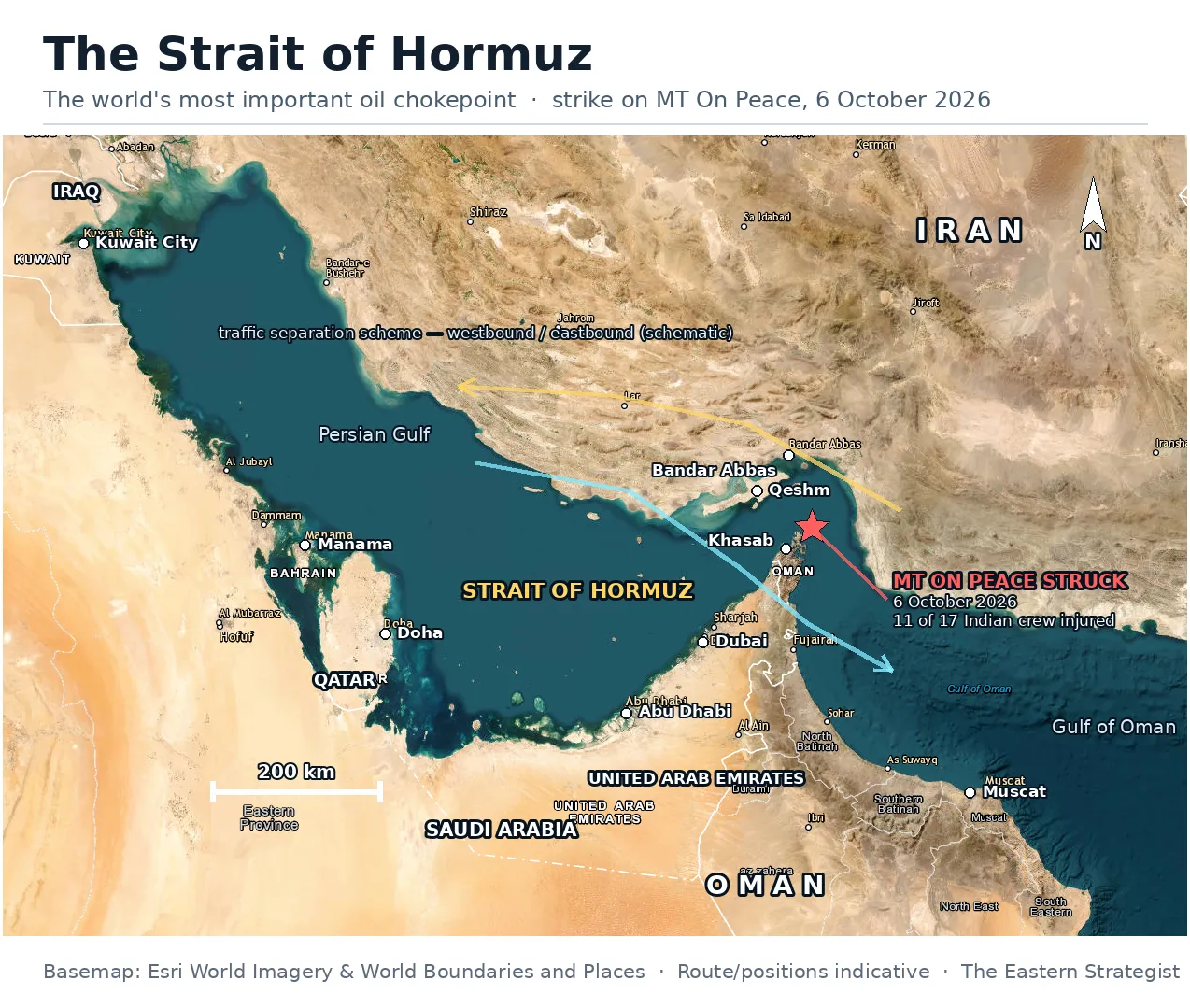
- On 6 October, a day later, the MEA said 11 Indians were among 12 crew injured when the tanker MT On Peace was struck off Oman in the Strait of Hormuz.
What happened to the Royad Mammadov off Romania on 5 October
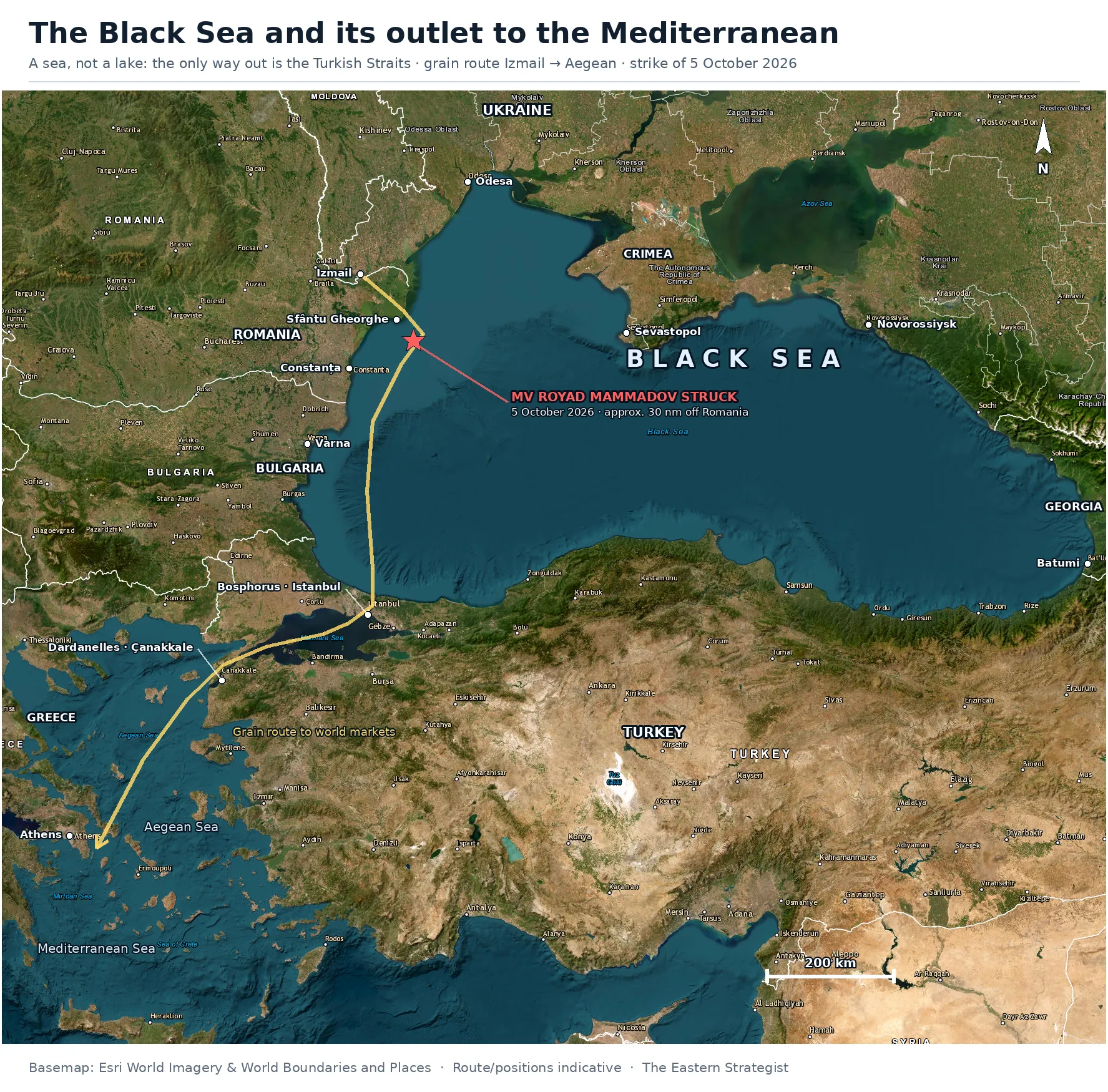
The Royad Mammadov, a 139-metre general cargo ship flagged in Saint Kitts and Nevis, caught fire and sank on 5 October about 30 nautical miles south of Sfântu Gheorghe, according to Romania’s Interior Ministry. The position lies inside Romania’s exclusive economic zone but outside its territorial waters. Eleven of the 13 crew were rescued and two died. The ship had left Izmail, on Ukraine’s Danube, with corn for Ravenna, Italy.
Zelenskyy said the crew were Azerbaijani and Indian nationals. The Romanian Naval Authority said three of the rescued were injured and eight were in good condition.
The Indian Embassy in Romania said all three Indians were safe and that one, injured, was being treated at Constanța County Hospital. Ambassador Manoj Mohapatra spoke to the three at the hospital. India’s Ministry of External Affairs (MEA) condemned the attack on 6 October, thanked Romanian authorities for their swift action and repeated its call for dialogue and diplomacy.
Black Sea drone strike: what Romania confirmed and what only Kyiv claims
Romanian authorities have confirmed a fire, a sinking and two deaths. They have not said what started the fire, and they have not identified the dead. The drone attribution comes from Zelenskyy, who said two Russian drones struck a civilian vessel in neutral waters. Russia’s defence ministry did not comment specifically on this ship. Romanian media reported a possible drone hit, but officials have not formally named a cause.
Zelenskyy also said the captain was killed. With the dead unidentified, that claim stands unconfirmed too.
Even the position is disputed. Romanian officials put the ship about 30 nautical miles south of Sfântu Gheorghe; the coast guard reported it roughly nine nautical miles south-east of the Pescăruș gas platform; Romanian media said about 20 nautical miles offshore. These are the ordinary frictions of a fast-moving maritime casualty, and they argue for treating every figure as provisional until the investigation reports.
Bucharest has handled similar cases this year. On 21 July President Nicușor Dan said a Liberian-flagged LPG tanker bound for Ukraine had been struck about 20 nautical miles off the coast, an attack he linked to Russia’s war on Ukraine. On 27 August a merchant ship burned and sank in the same economic zone; Dan said it appeared to have been hit and that it was “not good for us to start speculating”, according to Reuters.
The three ships share a geography. The tanker was heading for the Danube port of Reni, the August casualty had left Sulina in the Danube delta a week earlier, according to ship-tracking data reported by the Ukrainian outlet Liga, and the Royad Mammadov had sailed from Izmail. TES assessment: the delta approaches have become a risk zone in their own right. That matters because shipowners paused calls at Odesa-area ports in July, according to ShipUniverse, which leaves the Danube outlets more important to Ukraine’s exports.
Why Indian seafarers keep appearing on casualty lists
India supplies a large share of the world’s merchant seafarers, so Indian crews serve on foreign-flagged ships wherever commercial traffic meets conflict. India’s shipping ministry recorded more than 320,000 active Indian seafarers in 2025, as cited by AP. Indian names recur on these lists because of where Indian crews work, since India is a party to neither war.
The record since July runs across two theatres. In the Black Sea, the MEA said one Indian national died when the MV Omorfi was attacked on 18 July, reportedly in Russian territorial waters; the Forward Seamen’s Union of India identified him as chief officer Sagar Gupta. On 19 July four Indians died aboard the MV Golden Leo as it left Odesa, and a fifth was critically injured.
Off Oman, the MEA said on 13 September that 13 of the 14 Indian crew on the tanker El Gaia had been rescued and one was missing. On 23 September one Indian, wiper Suraj Yadav, died when the bulk carrier MV Cape Dao was attacked off Oman’s east coast; 19 of the 20 Indians aboard were rescued, according to the MEA.
The largest single toll came a day after the Royad Mammadov sank. On 6 October the MEA said the Panama-flagged MT On Peace was struck by a projectile off Oman while transiting the Strait of Hormuz. Of its 19 crew, 17 were Indian; 12 crew were injured, including 11 Indians. With Omani help the injured were evacuated and are being treated in Khasab.
Counts differ by source and date. The Wire counted five Indian seafarers killed in the Ukraine war by 18 July, and coverage of the Cape Dao attack cited MEA data given to Parliament that put Indian seafarer deaths in the West Asia conflict at ten.
The attacks belong to two separate wars: the US–Iran conflict around Hormuz and Russia’s war on Ukraine. The common factor is the crew list. TES has tracked the Gulf side in its coverage of Strait of Hormuz oil flows.
Why India has summoned both Russia’s and Ukraine’s envoys this year
India has treated attacks on its seafarers as a consular and legal matter, with no alliance question attached. On 21 July it summoned Russia’s chargé d’affaires after four Indians died on the Golden Leo, which Ukraine’s navy said Russian missiles struck. On 27 July it summoned Ukraine’s ambassador after the Omorfi death, which Indian seafarers’ unions attributed to a Ukrainian drone.
The MEA’s wording shifted with what it could establish. To the Russian envoy it conveyed “unequivocal condemnation”, according to AP and ANI. On the Omorfi it said only that the ship was attacked “reportedly in Russian territorial waters”. For the Royad Mammadov it condemned the attack and named no one.
| Incident | Indian casualties | Who attributes the strike | India’s step |
|---|---|---|---|
| MV Omorfi, 18 July | One killed; two safe | Seafarers’ unions: Ukrainian drone. MEA gave no weapon detail | Summoned Ukraine’s ambassador, 27 July |
| MV Golden Leo, 19 July | Four killed; one critical | Ukraine’s navy: Russian missiles | Summoned Russia’s chargé d’affaires, 21 July |
| MV Royad Mammadov, 5 October | Three aboard; one injured | Ukraine’s president: Russian drones. Romania has not confirmed | Condemned attack and thanked Romania; named no party, 6 October |
TES assessment: this is consistent practice. India registers a formal protest with the government whose conduct or territory is directly involved, and otherwise calls for dialogue. It sits with the stance TES traced in India’s shifting position on the Russia–Ukraine war, and it leaves room to talk to both capitals. On 5 October, at the Kautilya Economic Conclave in New Delhi, External Affairs Minister S. Jaishankar said India was engaging both Russia and Ukraine on safe passage for grain and fuel shipments, according to Business Standard.
What the strikes off Romania mean for grain freight and war-risk costs
Each drone or missile attack on a ship near Ukraine’s ports raises the cost of moving grain, and the attacks have multiplied this year. ShipUniverse, citing Ukrainian government data, counted 57 attacks on vessels in port or at sea in July alone, against 14 in all of 2025. It reports war-risk premiums of roughly 1% to 2% of vessel value for Black Sea port calls and says Odesa-area ports normally handle more than 90% of Ukraine’s agricultural exports.
How a Black Sea drone strike reprices the Danube route
Prices already carry a war premium. Bloomberg reported on 1 October that wheat futures reached a three-year high in August as Russia and Ukraine escalated attacks on each other’s Black Sea port facilities. The two countries together account for more than a quarter of global wheat shipments.
The Royad Mammadov carried corn. No verified post-strike move in corn futures or Black Sea war-risk quotes was available when this article was published, and TES will update it when figures can be sourced. The mechanism is easier to describe than the number. A lost ship, cargo and two crew resets underwriters’ view of the delta approaches, and TES assessment: the cost falls first on Danube cargoes, which are the alternative to Odesa.
Can India’s shipping-safety group succeed where the UN has not?
Not alone, and not yet. On 25 September India and Liberia launched the Group of Friends on Safety and Security of Shipping and Seafarers on the sidelines of the 81st UN General Assembly, with 25 countries at the inaugural meeting. Jaishankar called attacks on commercial shipping “legally and morally indefensible”, according to Outlook, and described the group as inclusive, voluntary and action-oriented. It shares experience and builds practical cooperation. It has no powers of enforcement.
Separately, Turkey and the United Nations are arranging fresh talks between Russia and Ukraine on a Black Sea ceasefire, planned for early October, according to Bloomberg. A closed-door preparatory meeting at the UN General Assembly in late September included India, according to Ukrainian agricultural-news outlet UkrAgroConsult. The prospects are poor: Moscow has rejected a reciprocal halt to strikes, and Foreign Minister Sergey Lavrov called a return to the 2022 format “unrealistic”.
History explains why India cares. The Black Sea Grain Initiative, brokered by Turkey and the UN in July 2022, moved Ukrainian grain under inspection until Russia withdrew in 2023. When Russia suspended its participation in late October 2022, India backed the Secretary-General’s effort to renew it, calling the arrangement a “glimmer of hope”, according to Deccan Herald.
India’s tools differ by theatre. In the Gulf of Oman the Indian Navy has run Operation Sankalp since 2019. In the Black Sea the Montreux Convention restricts the passage of warships belonging to non-littoral powers, so naval protection is not a ready option. TES assessment: diplomacy, crew advisories and coalition-building are the instruments India can use there, and the Group of Friends will be tested against them. India’s parallel push for Security Council reform with the G4 reflects the same frustration with the institutions that should enforce maritime safety.
The reported Black Sea drone strike does not change the course of the war. It adds an entry to a record India has good reason to keep in public, and it shows how much of global shipping depends on crews whose governments have no part in the quarrel that endangers them. The measure of the Group of Friends will be the next casualty list.
What to watch next
- The investigation. Romania’s findings on any Black Sea drone strike, and independent corroboration of Kyiv’s account.
- The Turkey–UN talks. Whether the early-October meetings produce anything beyond a restatement of positions.
- Prices. Corn and wheat futures and Black Sea war-risk quotes over the coming days.
- India’s next step. Any further MEA advisory for seafarers or a first working meeting of the Group of Friends.
- The next casualty list. Where Indian crews appear on it, and under which flag.
Questions on the Royad Mammadov incident
What happened to the MV Royad Mammadov?
On 5 October 2026 the Turkish-operated, Saint Kitts and Nevis-flagged cargo ship caught fire and sank about 30 nautical miles off Romania, inside its exclusive economic zone. Two crew died and eleven of the thirteen aboard were rescued. It was carrying corn from Izmail, Ukraine, to Ravenna, Italy.
Has Romania confirmed a Black Sea drone strike?
No. Romanian authorities confirmed the fire and the two deaths but have not identified the cause. Ukraine’s president says two Russian drones hit the ship in neutral waters. Russia’s defence ministry did not comment specifically on this vessel.
Were Indian seafarers hurt?
Three Indian nationals were among the crew. All three are safe; one was injured and is being treated at Constanța County Hospital. India’s Ministry of External Affairs condemned the attack on 6 October without naming a party.
What is India’s Group of Friends on shipping safety?
India and Liberia launched the Group of Friends on Safety and Security of Shipping and Seafarers on 25 September 2026 at the 81st UN General Assembly. Twenty-five countries took part in the inaugural meeting. It is a voluntary forum for sharing experience and cooperation, with no enforcement powers.
Source transparency. Verified fact: the vessel’s identity, route, flag and operator; the fire and sinking; the two deaths and eleven rescues; the status of the three Indian nationals; and the Indian and Romanian official statements, including the MEA statements of 6 October 2026 on the Royad Mammadov and the MT On Peace. Attributed claim: the drone strike and the captain’s death, which Ukraine’s president asserts and Romanian authorities have not confirmed; the attacker in the Omorfi and Golden Leo cases, which seafarers’ unions and Ukraine’s navy assert; and the vessel-attack and war-risk figures, which come from ShipUniverse citing Ukrainian government data. Reasoned assessment: the routing pattern off the Danube delta, the reading of India’s diplomatic practice, and the economic and naval implications are this publication’s analysis.