
Beijing accepts that the Natuna Islands belong to Indonesia. It disputes the sea around them. That gap defines Natuna Islands strategic importance: the archipelago sits on the southern edge of China’s nine-dash line, above one of Southeast Asia’s largest undeveloped gas fields, and for years it was the place where Indonesia confronted China’s coast guard. In 2026 the confrontation has turned into cooperation, and the shift deserves as much scrutiny as the standoff did.
On 21, 24 and 25 October 2024, Indonesia’s coast guard said it expelled the same Chinese vessel three times. Less than two years later, the two navies exercised together east of Taiwan.
What gives the Natuna Islands strategic importance?
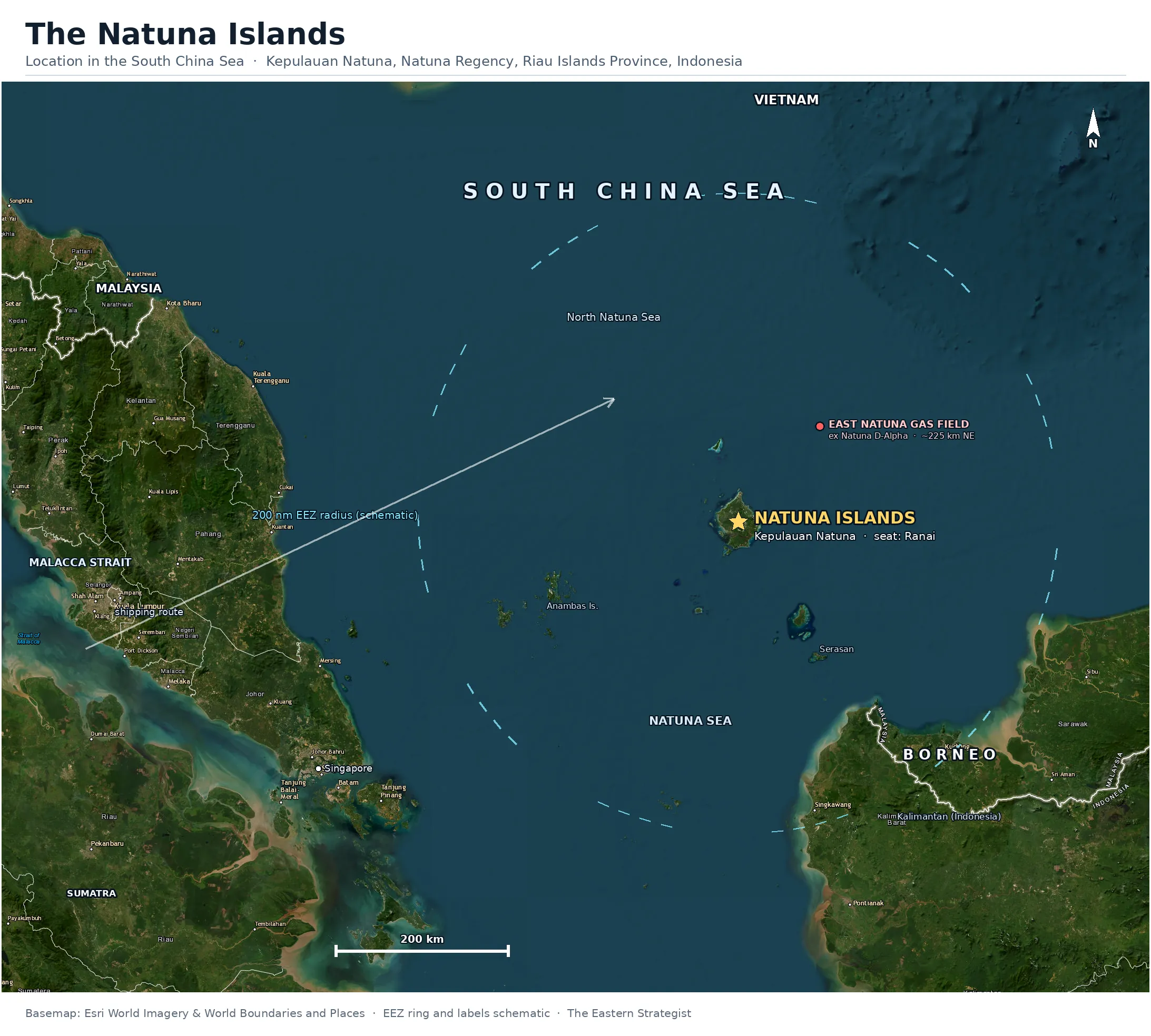
The Natuna Islands are an Indonesian archipelago in the southern reaches of the South China Sea, administered from Riau Islands province, to the northwest of Borneo. Their value comes from position, sea space and resources: they anchor a 200-nautical-mile exclusive economic zone (EEZ), overlook regional shipping, and sit above major offshore gas blocks.
Distance is the weakness. East Asia Forum noted in 2015 that the islands lie more than a thousand kilometres from Jakarta, scattered across roughly 262,000 square kilometres of water, more than ten times their land area. A journal study traces the islands’ standing as Indonesia’s northern outer point to the Djuanda Declaration of 1957, the document that established the archipelagic principle.
Indonesia has spent a decade turning the outpost into a defended and developed one. Presidential Regulation 40/2022 set a Natuna zoning plan that aims to make the islands a hub for fisheries, maritime tourism and defence capability, according to analysis published by the Australian Institute of International Affairs (AIIA).
Why do the Natuna Islands matter to Indonesia’s maritime sovereignty?
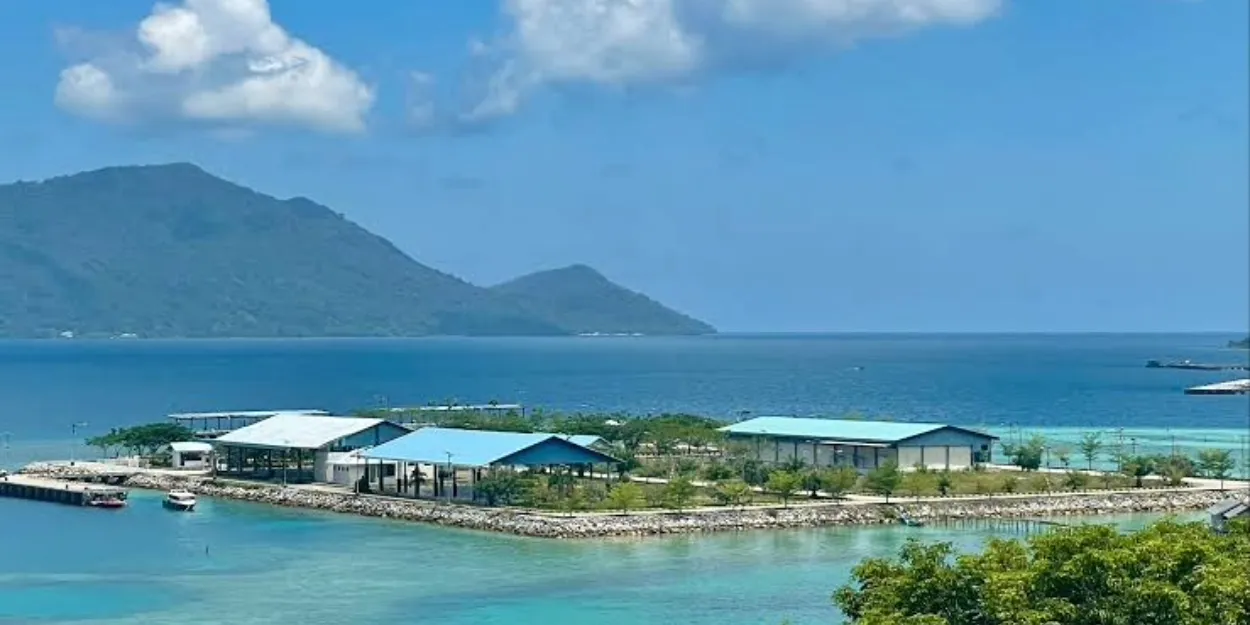
They are the practical test of whether Jakarta can enforce its EEZ against a much larger neighbour. Ranai, on the main island of Natuna Besar, hosts an Indonesian Air Force radar unit, according to the Air Force’s published unit list, and Lowy Institute analysis records that Indonesia inaugurated a new military unit in the Natunas in 2019.
Indonesia is not a claimant in the wider South China Sea territorial disputes, which is why its handling of Natuna draws attention. Scholars Halimah Dewi Irawan and Paul Carnegie describe Chinese incursions here as a litmus test of broader bilateral relations.
Why does China contest waters around islands it accepts are Indonesian?
China does not claim the Natuna Islands themselves, but its nine-dash line overlaps Indonesia’s EEZ and continental shelf north of them, and Beijing argues that the two sides have overlapping maritime rights, including traditional fishing grounds. Indonesia says it has no overlapping claim, and the 2016 Hague arbitral tribunal rejected the legal basis of China’s expansive claim.
The legal positions have hardened over time. Indonesia renamed the waters north of the islands the “North Natuna Sea” on a new map published on 14 July 2017, which angered Beijing. A Lowy Institute analysis notes that China began answering Indonesia’s UNCLOS arguments with its own legal language after mid-2016, which turned friction at sea into a formal argument over fishing and resource rights.
China’s foreign ministry spokesperson Lin Jian said in October 2024 that coast guard vessels carry out routine patrols in waters under Chinese jurisdiction, according to VOA. Indonesia’s coast guard said the opposite: that the vessel had entered Indonesian waters and disrupted a seismic survey.
What lies beneath the North Natuna Sea?
The seabed holds gas on two very different scales: a giant field that has never been developed, and a mid-sized project that has changed hands. East Natuna holds about 46 trillion cubic feet of proven gas, but with a carbon dioxide content above 60 percent. The Tuna block holds a modest 54 million barrels of oil equivalent in contingent resources.
| Asset | Status (as of 5 October 2026) | Key fact |
|---|---|---|
| East Natuna (formerly D-Alpha) | Undeveloped since discovery in 1973 | About 46 tcf proven; gas in place up to 222 tcf; CO2 above 60% (Wood Mackenzie) |
| Tuna block | Development stalled, restart reported | Harbour sold its 50% stake; Russia’s Zarubezhneft holds the other 50% |
| Natuna Sea Block A | Producing | About 4,000 barrels of oil equivalent a day in the nine months to 30 September 2025 |
Harbour Energy completed the sale of its Natuna Block A and Tuna stakes to Prime Group for $215 million on 29 May 2026. Western sanctions on Harbour’s Russian partner, Zarubezhneft, had stalled Tuna, and Indonesia’s deputy energy minister said Zarubezhneft intended to resume development in June 2026. TES found no confirmation yet that work has physically restarted, and one University of Melbourne analysis describes Zarubezhneft as taking over the project fully, which conflicts with Harbour’s disclosure that its 50 percent went to Prime Group. TES follows the company filing.
The gas matters to the story because it explains why Beijing protests. On 30 June 2021, the Noble Clyde Boudreaux rig reached the Tuna block, and within days a Chinese coast guard vessel arrived, according to Reuters. Reuters also reported that China told Indonesia to stop drilling, and VOA reported that Chinese diplomats’ letter described the rig as sitting in Chinese territory.
How did a loud standoff go quiet?
Indonesia’s response moved from expulsion to engagement in two stages: a presidential meeting in Beijing in November 2024, and a run of defence and strategic agreements in 2026. The reasons are economic and political, and the evidence on whether coast guard pressure has stopped is incomplete.
The November 2024 statement was the sharp turn. The Diplomat reported that the statement used the phrase “overlapping claims”, and IISS analyst Evan Laksmana told This Week in Asia that it was the first time Indonesia had inadvertently or implicitly accepted an overlapping claim. Indonesia’s foreign ministry said the cooperation had no effect on its sovereignty and that China’s claim has no basis in international law.
The 2026 steps went further. Indonesia’s defence ministry called the August exercise a “passing exercise” and said it would not be a war-fighting drill, and AFP reported that the Indonesian frigate was returning from Vladivostok. Defence Minister Sjafrie Sjamsoeddin said after the 21 August talks that China would transfer technology for a joint munitions factory in Indonesia, expected to operate by 2027, according to Reuters. Indonesian government figures cited by Reuters show Chinese foreign direct investment of $3.9 billion in the first half of 2026.
The October 2024 episode was also longer than the expulsion dates suggest. The Asia Maritime Transparency Initiative (AMTI) at CSIS reported the Chinese coast guard still facing Indonesian vessels on the twelfth day of the standoff, with CCG 5402 leaving for about eight hours on 24 October before returning and being shadowed at the survey site.
One caution applies to the word “quiet”. TES found no confirmed Chinese coast guard incursion in the North Natuna Sea reported for 2025 or 2026. That finding is limited to the sources reviewed.
What does Jakarta gain and risk?
A University of Melbourne analysis notes that Indonesia’s Tuna partner is a Russian firm with no Chinese company involved, which suggests the 2024 joint development idea has not yet produced a project. Jakarta gains investment, technology and calmer waters around the Natuna Islands. It risks turning a legal position it held for a decade into a negotiable one. Analysts hold both readings, and the evidence supports each in part: the critics point to wording and precedent, while the hedging case points to Indonesia’s parallel deals with Japan, India and France.
Critics raise two main concerns. Aristyo Darmawan of the University of Indonesia argues in a 30 September 2026 analysis for the Australian Strategic Policy Institute (ASPI) that joint development in the North Natuna Sea should run under Indonesian investment law, because China has no legitimate claim under UNCLOS there. A 2025 East Asia Forum analysis made a related warning: accepting a joint development proposal inside the nine-dash line risks implicitly recognising it.
Darmawan also notes that the Chinese research vessel Haiyang Dizhi 10 has operated near the islands without Indonesian consent and that unauthorised Chinese uncrewed underwater craft are turning up in Indonesian waters.
The counter-reading is hedging. Pieter Pandie of the CSIS think tank told AFP that Jakarta still leans “much more” towards Washington than Beijing and that the August talks should not be read as realignment. Indonesia has received six of the 42 Rafale fighters ordered in a 2022 contract worth about $8.1 billion, three in January and three on 18 May 2026, and President Prabowo Subianto cited deterrence as the aim.
Indonesia’s other major strategic asset is the Lombok Strait, the deep passage between the Indian and Pacific Oceans that Beijing, Washington and Tokyo also watch. Both the islands and the strait show the same pattern: Indonesia’s geography gives it leverage that outside powers want to manage.
Where do Japan, India and the United States fit?
Japan is the most visible new actor, India the steadiest partner, and the United States the one whose Natuna role is least documented in the sources TES reviewed. This section separates what has been announced from what is TES analysis.
Japan. Kyodo News reported in early September 2026, citing Japanese government sources, that Tokyo plans to use official development assistance, possibly yen loans, to upgrade Indonesian fishing ports so that coast guard vessels can operate from more locations.
The Japan International Cooperation Agency began a preliminary study in September 2025 covering seven locations including the Natuna Islands, and two sites are to be chosen first. Natuna is therefore a candidate, and no site has been confirmed. AIIA analysis notes that China has not yet objected publicly but is likely to, given the state of Japan–China relations.
India. India’s links with Indonesia are maritime and growing, but TES found no documented Indian role at the Natuna Islands themselves.
The Indian Navy and Indonesian Navy held the fifth Samudra Shakti exercise at Visakhapatnam from 14 to 17 October 2025, according to the Ministry of Defence, and the July 2026 Jakarta joint statement committed both sides to deeper cooperation on maritime domain awareness and coastal surveillance. Business Standard reported a BrahMos and Astra missile deal worth over $600 million. TES covered the Jakarta visit in its Indo-Pacific tour analysis.
TES assesses that Indian defence exporters gain a customer that wants non-Chinese options, a point TES also examined in its analysis of the India–Vietnam BrahMos deal.
India’s navy has also reached Chinese-built Cambodian facilities, which TES reported in its INS Kulish analysis. For the wider regional picture, see TES’s Indo-Pacific and China–Taiwan strategic hub and its report on the Taiwan–China coast guard standoff, which covers the Chinese coast guard activity near Taiwan that formed the backdrop to the August exercise.
What should readers watch next?
Five developments would show whether Natuna’s quiet is a settlement or a pause, and each would come from a different capital: Tokyo, Jakarta, Beijing or the companies drilling in the Tuna block. All are future possibilities, and only the 2027 factory target carries a date.
- Japan’s site selection. Whether the Natuna Islands are among the first two ports chosen, and how Beijing responds.
- Tuna block restart. Evidence that Zarubezhneft has resumed development, and whether Chinese coast guard presence follows.
- The joint factory. Progress on the munitions plant targeted for 2027.
- Joint development terms. Any published location or legal framework for fisheries or energy cooperation in the North Natuna Sea.
- The first incursion since October 2024. A new coast guard encounter would show how the 2026 agreements behave under pressure.
The takeaway: a quiet sea can still be an open question
The Natuna Islands strategic importance did not change in 2026. The islands are still Indonesian, the gas is still undeveloped, and the legal map is the same as in 2016. What changed is the tone, and tone is how disputes get redefined without anyone signing a treaty.
Indonesia once answered Beijing with a map and a patrol ship. On 8 January 2020, President Joko Widodo flew to Natuna Besar and told reporters: “De facto, de jure, Natuna is Indonesia.” The question for 2027 is whether a quieter Jakarta can say the same sentence in the same way.
Common questions about the Natuna Islands
Why are the Natuna Islands strategically important?
They sit in the southern South China Sea, anchor a 200-nautical-mile exclusive economic zone, overlap China’s nine-dash line, and lie above large undeveloped gas resources, including the East Natuna field.
Does China claim the Natuna Islands?
No. China recognises Indonesian sovereignty over the islands themselves but disputes the waters around them, citing overlapping maritime rights. Indonesia says it has no overlapping claim with China.
What is the North Natuna Sea?
It is the name Indonesia gave on 14 July 2017 to the part of its exclusive economic zone north of the Natuna Islands, in a new official map.
Is Japan building a port in the Natuna Islands?
Not yet confirmed. Kyodo reported that Japan plans development assistance for Indonesian fishing ports, with a study covering seven locations including Natuna. Two sites are to be selected first.
Source transparency note
Verified or officially stated: The October 2024 expulsions (Indonesian coast guard, via Antara); the 9 November 2024 joint statement and Indonesia’s clarification (reported by The Diplomat); the Harbour Energy sale (company release); Samudra Shakti 2025 (Ministry of Defence); the July 2026 India–Indonesia joint statement.
Third-party or single-source: The 21 August 2026 factory and FDI figures (Reuters and AFP reporting); the Japan port plan (Kyodo, citing unnamed Japanese government sources); East Natuna reserve figures (Wood Mackenzie, via trade press); reserves and contingent resources for Tuna (Harbour Energy disclosure).
TES analytical assessment: The reading of 2026 as hedging versus realignment; the market and industrial implications for Indian defence exporters; the 2027 watch list.
Not verified in this research round: Island counts and precise distances; any 2025–26 coast guard incursion; current force levels at Natuna; whether Tuna development has restarted.
Disclaimer: This article is analysis, not investment advice. Company names appear only as project operators or equipment suppliers.