
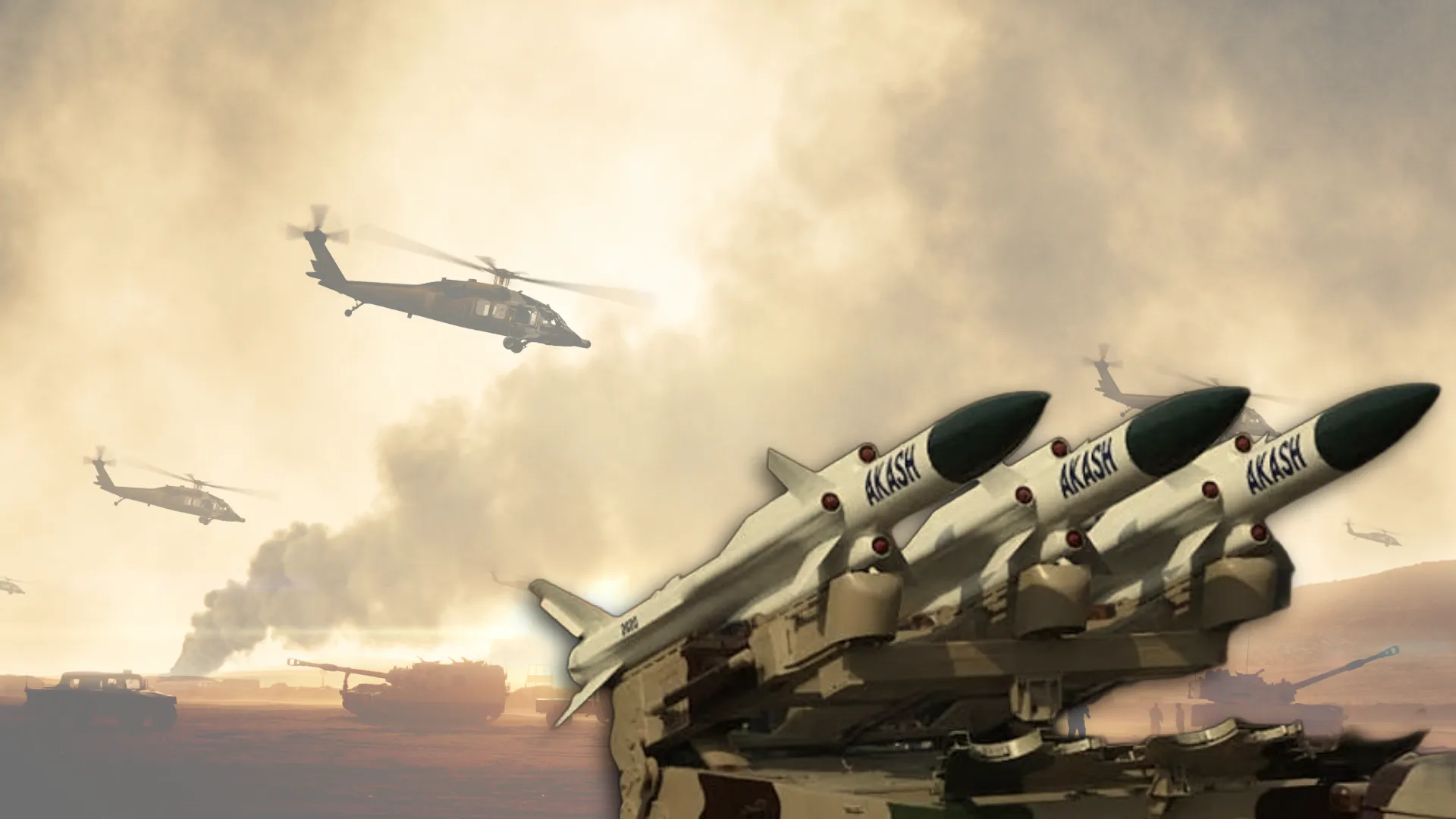
India’s first indigenous surface-to-air missile has found buyers inside Russia’s old sphere — and in Turkmenistan it now stands beside Chinese systems.
On 1 October 2026, India’s Defence Secretary, Rajesh Kumar Singh, confirmed something that arrived without much fanfare: the country’s indigenous Akash air defence system had been exported not only to Armenia, its first foreign buyer, but to Tajikistan and Turkmenistan as well. The Akash missile export is modest by the standards of India’s headline arms deals — no contract values were disclosed, and the announcement ran a few paragraphs in most outlets. Its geography is another matter.
Both new customers sit in Central Asia, a region Russia has armed since the Soviet collapse and still guards through the Collective Security Treaty Organization (CSTO) and forward bases. Tajikistan hosts Russia’s 201st military base and took delivery of Russian S-300 systems in 2023. Turkmenistan, further from Moscow’s orbit, fields four Chinese air-defence systems and is not a CSTO member at all. Into both inventories, an Indian-designed surface-to-air missile has now arrived.
That is the interesting part. India is not displacing Russia in Central Asia, and it is not attempting to. But an Indian-built Akash air defence system now stands in arsenals shaped by Russian and Chinese equipment — and the reasons, the caveats and the industrial consequences are worth unpacking carefully.
What India actually exported
India exported the Akash, a short-range surface-to-air missile system designed by the Defence Research and Development Organisation (DRDO) and built by two Defence Public Sector Undertakings, Bharat Dynamics Limited (BDL) and Bharat Electronics Limited (BEL). The Akash air defence system has been in service with the Indian Army and Indian Air Force for about a decade, and DRDO describes it as its first indigenous tactical missile system to be developed, produced and delivered to the services.
The Akash missile export is a complete system, not a crate of rockets: launchers, a fire-control and surveillance radar chain, command-and-control vehicles, the missiles themselves and the support infrastructure needed to keep a battery running. The MoD lists its operating range at 4.5 km to 25 km and its engagement altitude at 100 metres to 20 km. BEL, the nodal production agency, supplies the radars and electronics.
Armenia was the launch customer for the Akash missile export. BEL flagged off the first export battery in November 2024 to a “friendly foreign country” that was widely reported, but not officially named at the time, as Armenia. Yerevan’s order — 15 systems placed in 2022 for about ₹6,000 crore — made the Akash India’s first indigenous surface-to-air missile to win an overseas customer, after the BrahMos cruise missile became India’s first major weapons-export contract with the Philippines in 2022.
Why the Akash missile export lands in Russia’s neighbourhood
The Akash missile export matters because of where it landed, not how much it was worth. Tajikistan and Turkmenistan have traditionally armed themselves from Russia and, increasingly, from China. An Indian system gives both a third option at a moment when Moscow’s capacity to supply is strained by the war in Ukraine and its own battlefield demand.
That shift is measurable. Russia has supplied roughly two-thirds of Central Asia’s arms imports since 1991 and remains embedded through the CSTO, bilateral air-defence agreements and forward bases. But the Jamestown Foundation notes that Beijing’s share of the regional arms market rose from 1.5% to 13% between 2012 and 2022, and that Türkiye’s Bayraktar TB2 drone has been the most transformative recent addition. Central Asian governments are not leaving Russia; they are diluting their dependence on any single supplier.
An air-defence sale is a particularly sticky form of that dilution. Every Akash missile export carries training, spare missiles, software updates and mid-life upgrades with it, binding a buyer to a supplier for decades. That is precisely why an Indian entry into a market Russia has long treated as its own is worth more than the contract value suggests.
In Turkmenistan, an Indian system beside Chinese ones
The Akash missile export to Turkmenistan will place Indian batteries in the same national inventory as four Chinese-made air-defence systems, and that is the detail that makes the Central Asia air defence picture worth watching. At Turkmenistan’s Independence Day parade in Ashgabat on 27 September 2026, the Chinese FK-2000 was shown publicly for the first time, following the Chinese FD-2000, KS-1A and FM-90 that have been in service for years.
| System | Origin | What is confirmed |
|---|---|---|
| Akash | India | Short-range SAM; DRDO-designed, built by BDL and BEL; range 4.5–25 km (MoD) |
| FK-2000 | China | Gun-and-missile short-range air defence; shown at the 27 September 2026 parade |
| FD-2000 | China | In Turkmen service; shown in the parade air-defence formation |
| KS-1A | China | In Turkmen service; shown in the parade air-defence formation |
| FM-90 | China | In Turkmen service; shown in the parade air-defence formation |
The two suppliers’ systems are not integrated into a single network. Turkmenistan is simply adding a new origin to a mixed arsenal — the same diversification logic that has pulled Chinese, Turkish and Italian equipment into the region. What makes the Central Asia air defence picture distinct is that the Indian entry comes with no alliance attached: Turkmenistan is a permanently neutral state that withdrew from the CIS joint air-defence system and sits outside the CSTO, so the Akash there is a procurement choice, not a bloc realignment.
Tajikistan is the sharper case. It is a CSTO member with a Russian military base on its soil, which makes an Indian air-defence purchase there a more sensitive addition to Moscow’s own integrated air-defence architecture. Both governments have yet to publicly confirm the deliveries themselves.
The markets read: Bharat Dynamics and Bharat Electronics
For investors, the Akash missile export points at two listed companies. Missile production sits with Bharat Dynamics Limited (BDL), while BEL supplies the radars, electronics and command-and-control systems and served as nodal production agency for the weapon system. Any Akash missile export expansion therefore reaches two of India’s larger defence public-sector firms directly.
The stronger signal, though, is the trend behind the Akash missile export rather than the one deal. According to the Ministry of Defence, India defence exports hit a record ₹38,424 crore in FY2025-26, up ₹14,802 crore, or 62.66%, on the previous year’s ₹23,622 crore. Defence Public Sector Undertakings contributed 54.84% of that and the private sector 45.16%, and the government has set a target of ₹50,000 crore in exports by 2029. India defence exports on this trajectory lengthen production runs and lower unit costs for the Indian armed forces as well.
The domestic base matters too. In FY2025-26 India’s annual defence production reached a record ₹1.78 lakh crore, up 15.6%, and the MoD has previously signed a contract worth over ₹8,160 crore with BDL for the improved Akash weapon system for the Indian Army, with indigenous content rising from 82% towards 93%. Exports and domestic orders reinforce each other on the same production lines.
Investment disclaimer
This article discusses listed defence companies — Bharat Dynamics Limited and Bharat Electronics Limited — and the broader defence-export trend. It is not investment advice, a recommendation, or a valuation of any security. Order books and export pipelines are indicative and can slip. Readers should consult a registered investment adviser before acting on anything here.
What to watch
Five forward indicators will show whether the Akash missile export to Central Asia is a one-off or the start of a durable third-supplier position for India. Each is a concrete, checkable signal, not a prediction.
- Akash-NG. The new-generation variant, with an indigenous radio-frequency seeker and a solid rocket motor, completed user evaluation trials in December 2025, paving the way for induction into the Indian Air Force. It is a more capable and more valuable future export product once it enters service.
- Contract values. Neither the Defence Secretary’s statement nor any official release disclosed the value or quantity of the Tajikistan and Turkmenistan deals. Confirmed numbers would show how much the Akash is actually contributing to the export total.
- Support performance. Export reputations are built on deliveries, training and spares. How reliably Armenia, Tajikistan and Turkmenistan are supported will shape whether further buyers follow.
- Moscow’s response. Russia retains the CSTO, forward bases and deep structural ties across Central Asia. Whether it treats a third supplier inside its traditional market as routine or as friction is worth tracking.
- Official confirmation. The country-specific export claim rests on the Defence Secretary’s on-record statement of 1 October 2026. A PIB release or confirmation from the buyer governments would settle it beyond doubt.
Read together, the Akash missile export to Central Asia is less a single sales milestone than a marker of a wider shift: an Indian-designed air-defence system is now a live option for states that once bought only from Moscow or Beijing, at a time when both those suppliers carry new risks. India is not replacing anyone. It is becoming one more name on a list that used to be short — and in the arms trade, being on the list at all is the first prize.
The caveats around the Akash missile export are real: the values are undisclosed, the deliveries are unconfirmed by the buyers, and Central Asia’s dependence on Russia remains deep. But the direction is clear, and it runs through two Indian production lines in Hyderabad and Bengaluru.
Source transparency. Verified facts in this article are drawn from Ministry of Defence and Press Information Bureau releases, and the official product pages of DRDO, Bharat Dynamics Limited and Bharat Electronics Limited, alongside reporting by The Hindu BusinessLine, Janes, China Daily and the Jamestown Foundation. Strategic and market assessments are TES Analytical Estimates and are labelled as such. The country-specific export claim rests on the Defence Secretary’s on-record statement of 1 October 2026; no PIB release naming Tajikistan and Turkmenistan was available at the time of writing.