
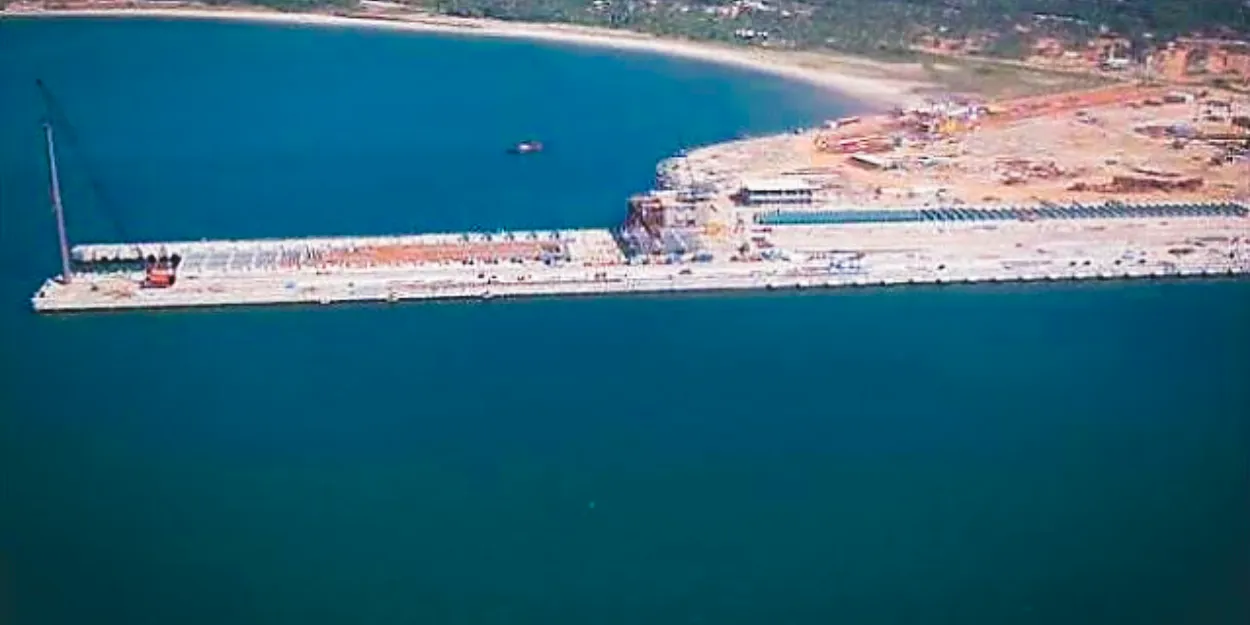
On 8 October 2026 the Indian Navy opened 120 new family dwelling units, in-living accommodation for 156 personnel of the Defence Security Corps (DSC — the armed force that guards defence installations), and a kindergarten at Naval Base Karwar. The same base is still waiting for the covered dry berths that would let it overhaul a capital ship under its own roof.
That asymmetry is the real story of the Project Seabird Karwar housing handover. Housing is the completable half of India’s largest naval infrastructure programme. The industrial half — the dockyards, workshops and covered berths — decides whether INS Kadamba is a base the Western Fleet can repair at, or only berth at.
This is not a minor distinction. Phase IIA is approved to berth 32 warships and submarines and 23 yardcraft, more than tripling the 10 ships Phase I was built for. Yet the covered dry berths and dockyard packages that make overhaul possible remain in tender as of early October 2026. The housing is delivered; the capability it is meant to serve is not.
Key takeaways
- The 8 October 2026 handover at Naval Base Karwar added one tower of 60 dwelling units for married senior sailors, one tower of 60 units for Naval Defence Civilians, in-living quarters for 156 DSC personnel, and a kindergarten.
- NCC Ltd built the residential and amenity blocks; trunk infrastructure was executed by Cemindia Projects India Ltd, the firm renamed from ITD Cementation India Ltd in September 2025.
- Phase IIA’s headline capability — four covered dry berths, the tallest 75 metres and able to hold four capital ships at once — is still in procurement; the Dockyard Works package on the government portal shows bids open into November 2026.
- Housing without dockyard capacity leaves Karwar a well-populated anchorage: ships can berth, but deep repair still routes to Mumbai or Cochin until the industrial packages land.
- Watch the dockyard and fleet-base awards, the naval air station’s clearances, and any parliamentary revision of the Phase IIA cost baseline.
What the Project Seabird Karwar housing handover delivers
The accommodation inaugurated at East of Manzil Creek (EOMC) and Amadalli on 8 October 2026 consists of one tower of married accommodation for senior sailors of 60 dwelling units, one tower of 60 dwelling units for Naval Defence Civilians, in-living accommodation for 156 DSC personnel, and a kindergarten school. The Chief of Defence Staff, General N S Raja Subramani, inaugurated the complex in the presence of Vice Admiral Vivek Dahiya, Director General Seabird.
The Ministry of Defence release is precise about the split: M/s NCC Ltd, Hyderabad, constructed the residential accommodation and amenity facilities, while the trunk infrastructure was delivered by M/s Cemindia Projects India Ltd. That second name matters for anyone tracking the contractors, because Cemindia is the company formerly listed as ITD Cementation India Ltd — renamed in September 2025 after the Adani Group’s Renew Exim DMCC acquired a controlling stake. Older reporting that credits “ITD Cementation” for Karwar work is describing the same firm under its previous name.
The two towers are modest next to the township plan they belong to. Full development of the Phase IIA townships at Naval Base Karwar is meant to reach 2,160 accommodation units for senior sailors and 3,168 for defence civilians, inside four townships built for roughly 10,000 dwelling units. The October towers are an instalment, not the settlement — a down payment on a municipal footprint the base will take years to fill.
The kindergarten and the DSC block are the parts that rarely make headlines but carry the operational load. The DSC is the corps that mans the gates and perimeter of a defence installation; giving its personnel in-living quarters keeps a standing guard force on site rather than commuting in. A kindergarten does the quieter work of making a remote coastal posting sustainable for families — the difference between a billet officers accept and one they avoid.
Why Naval Base Karwar needs homes beside the jetties
Karwar is designed to hold about 10,000 uniformed and civilian personnel with their families. On-base housing puts the technicians who repair and arm warships minutes from the hulls they service, rather than an hour or more away. That proximity, not the housing itself, is the operational value.
The logic runs back to the 1971 war, when Mumbai’s congested harbour exposed the Western Fleet to the risk of being bottled up in a busy commercial port. The Karwar naval base was chosen to disperse that risk: a deep-water station set behind breakwaters, tucked between the Western Ghats and the Arabian Sea, and — as the Navy has repeatedly noted — outside the strike range of Pakistani aircraft. The foundation stone was laid in October 1986, and INS Kadamba was commissioned in May 2005.
Dispersal only works if the base can sustain what it hosts. A warship alongside a jetty is a ship that can sail; a warship that must return to Mumbai or Cochin for scheduled docking is a ship that is absent for weeks and drags escorts along with it. The Navy’s own release frames the housing as part of a self-sustaining base, and the phrase is apt: a station with homes, schools and utilities but without heavy repair lines is a garrison, not an industrial anchor.
The economic case is real but secondary. Ministry figures for the ongoing Phase IIA work put job creation at roughly 7,000 direct and 25,000 indirect positions, most of them in Uttara Kannada. That is a genuine regional dividend, and it is also the reason the housing can be built faster than the dockyards: family accommodation is conventional construction, while a covered dry berth over tidal water is not.
The industrial bottleneck at INS Kadamba Phase IIA
Physical capability at INS Kadamba Phase IIA turns on three procurement packages still in progress in late 2026: Dockyard Works (DY), which builds the dockyard buildings and repair infrastructure; the Fleet Base Landside works (FBL); and the Fleet Base Waterfront works (FBW). Until these are awarded and built, the covered dry berths and dockyard shops do not exist, and the base’s overhaul capability stays theoretical.
Karwar is not starting from zero. Phase I, completed in 2011, left the base with a breakwater-protected harbour, a pier, a Naval Ship Repair Yard and India’s first shiplift and ship-transfer system. The shiplift can raise most Indian naval ships out of the water for docking, but not the largest hulls — aircraft carriers and fleet replenishment tankers sit beyond its capacity. That gap is what the Phase IIA covered dry berths are meant to close, which is why their delay matters more than the pace of the housing. A yard that can lift a frigate but not a carrier is a repair facility with a ceiling; the covered berths remove it.
The centrepiece is the covered dry berth: four such berths are planned, and the tallest rises about 75 metres — higher than the Qutub Minar — across roughly 33,000 square metres, sized to dock and maintain up to four capital ships at once. Enclosed repair also does something open berths cannot: it keeps a refit out of the view of overhead optical reconnaissance, so a new radar or weapon fit is not photographed while it is being installed.
None of that industrial work is finished. The Dockyard Works tender (reference DGSB/DC02/03 of 2022) on the government e-procurement portal shows bid submission extended to 12 November 2026, and companion fleet-base packages carry similar late-2026 submission windows. Corrigenda and date extensions have recurred across these files. The pattern is familiar to anyone who has followed the project: the MoD’s own Standing Committee flagged in 2017 that Phase IIA was already running years behind, largely because the project-management consultant was appointed two years after the December 2012 approval.
The wider INS Kadamba Phase IIA scope extends well beyond the water’s edge. It includes a dual-use Naval Air Station with a 2,700-metre runway and a civil enclave, expanded armament and missile storage, and logistics for ships and aircraft. Each of those is a separate package with its own tender clock, and each has to clear environmental and design scrutiny before construction starts.
The armament side is the least visible and among the most consequential. The existing Naval Armament Depot, the Missile Technical Position and the associated common facilities at the Karwar naval base are being expanded under Phase IIA, with the Navy seeking design consultants for new ordnance storage. That matters because a warship’s sea time is bounded by how quickly it can rearm: a station that can berth and repair a vessel but cannot store, test and issue its weapons is only partly a base at all.
Who gains — and what slippage costs the Navy
The strategic gain is dispersal: a protected deep-water base that spreads high-value targets along the western seaboard instead of concentrating them in Mumbai. The cost of delay is operational: every year the dockyard packages slip, capital warships homeported at Karwar still depend on legacy repair yards, and the base’s independence from Mumbai stays on paper.
The same dispersal logic now runs down the western flank, where INS Jatayu at Minicoy anchors the Eight Degree Channel. Karwar is the mainland hub of that architecture; the island bases are its outposts. A naval base that cannot maintain its own ships weakens the whole chain, because the fleet’s reach is only as long as its nearest repair yard.
The geography explains the urgency. The Karwar naval base sits close to the Persian Gulf to east Asia shipping lane that carries a large share of the world’s energy trade, and it lies south of Mumbai and north of Kochi on India’s western seaboard. For the Indian Navy, that position supports the role it has adopted in recent years as a first responder in the western Indian Ocean, from anti-piracy patrols to escorting merchant traffic through the Red Sea crisis. None of that posture is sustainable from a base that cannot maintain the ships it sends out.
For the contractors, the read-through is direct. NCC Ltd carries the residential and amenity order book; Cemindia Projects Ltd, now inside the Adani Group, carries the trunk infrastructure and, through the marine packages, a share of the waterfront works. Both sit inside the wider Indian warship-building boom and the defence-industry order books that feed off it. Execution pace at the Karwar naval base feeds straight into when these firms can bill naval infrastructure work. That is a scheduling fact about listed companies, not an investment view.
History counsels patience with the cost line. Project Seabird was first sanctioned in 1985 at ₹350 crore; Phase I, commissioned in 2005 and completed in 2011, closed at roughly ₹2,629 crore. Phase IIA was approved by the Cabinet Committee on Security in December 2012 at ₹13,500 crore, revised by the mid-2010s to about ₹19,600 crore. The management consultant AECOM publicly describes the wider programme as a “$3 billion” effort. No audited, updated Phase IIA baseline has been published since.
What to watch next
Three indicators will show whether Naval Base Karwar is becoming the overhaul base it is meant to be. First, the award of the Dockyard Works and fleet-base packages. Second, environmental clearances and a construction schedule for the dual-use Naval Air Station with its 2,700-metre runway. Third, whether Parliament extracts a revised Phase IIA cost baseline from the Ministry of Defence.
Until the first of these lands, the housing will keep arriving faster than the capability it serves. The Ministry’s release notes that Phase IIA is expected to source more than 90 percent of materials and equipment domestically and to reach IGBC Gold certification on completion — both official projections, not audited outcomes. The base’s green credentials and its industrial reach will be judged on the same timeline, and that timeline now runs through the dockyard awards.
Karwar’s town is being populated. What the fleet can do once it casts off still depends on the sheds and shops that have not yet been built.
Frequently asked questions
What did the October 2026 inauguration at Karwar include?
The 8 October 2026 handover at East of Manzil Creek and Amadalli added one tower of 60 dwelling units for married senior sailors, one tower of 60 dwelling units for Naval Defence Civilians, in-living accommodation for 156 Defence Security Corps personnel, and a kindergarten school. NCC Ltd built the residential and amenity blocks; Cemindia Projects India Ltd delivered the trunk infrastructure.
The residential and amenity works were constructed by M/s NCC Ltd, Hyderabad. Trunk infrastructure was executed by M/s Cemindia Projects India Ltd — the company formerly named ITD Cementation India Ltd, renamed in September 2025 after the Adani Group acquired a controlling stake.
Why does the covered dry berth matter more than the housing?
The covered dry berth is what turns the Karwar naval base from a berthing anchorage into an overhaul base. Four are planned; the tallest is about 75 metres high and can dock up to four capital ships at once, enabling enclosed maintenance away from overhead reconnaissance. Those berths, and the Indian Navy dockyard packages around them, are still in tender.
What is the cost of Project Seabird Phase IIA?
Phase IIA was approved in December 2012 at ₹13,500 crore and later revised to about ₹19,600 crore. The management consultant AECOM describes the wider programme as a “$3 billion” effort. No audited, updated baseline has been published since.