
India’s newest sea route to Russia was declared open in November 2024. A year later, Moscow was still describing it as something it was “working on activating”.
The Chennai Vladivostok corridor has excellent arithmetic and very little cargo. The distance between those two facts says more about India’s Russia strategy than any joint communiqué.
Why the Chennai Vladivostok corridor is still waiting for its first liner service
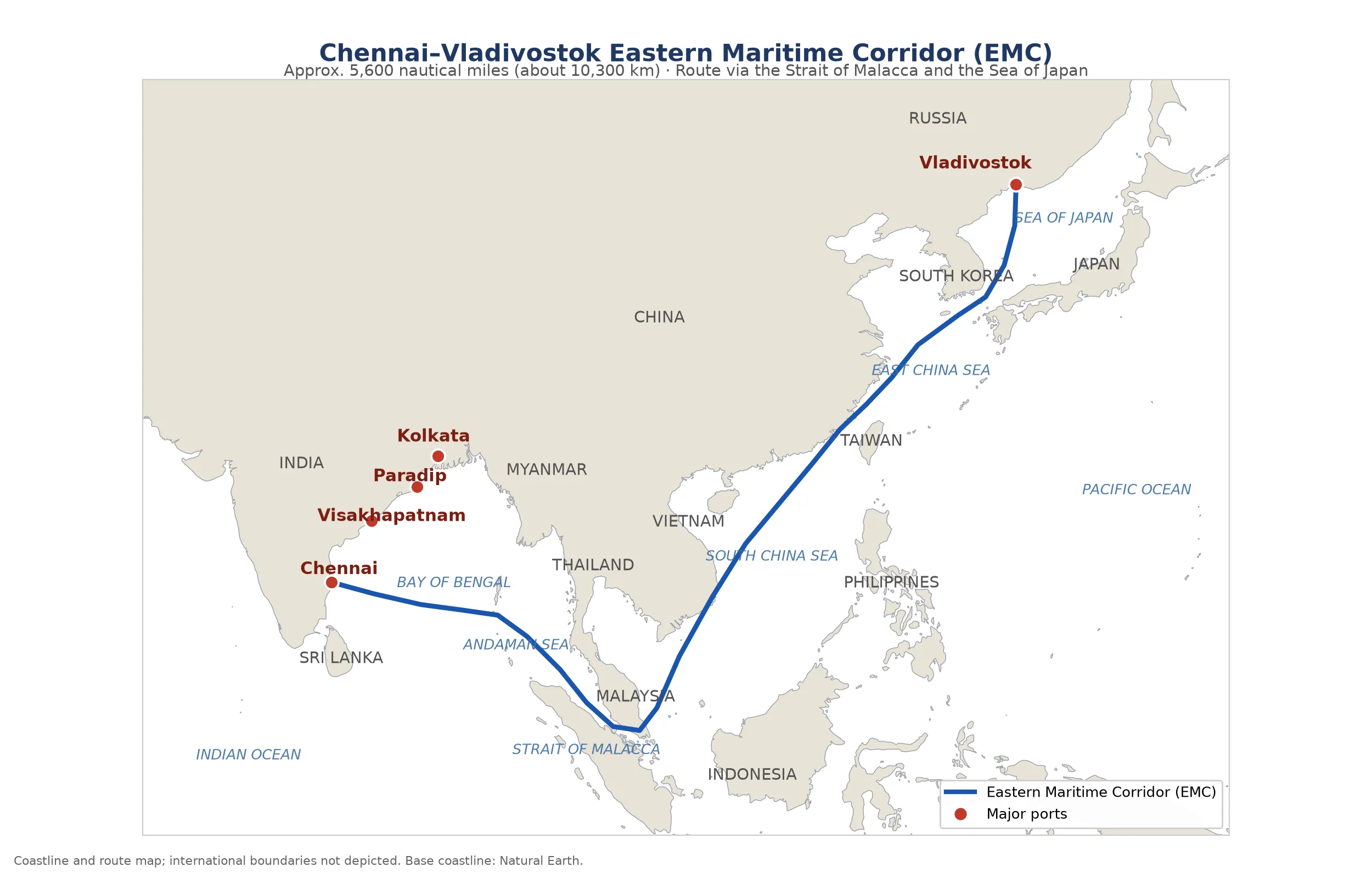
The Chennai Vladivostok corridor is a roughly 5,600 nautical mile sea link between India’s east coast and Russia’s Far East, agreed by the two governments in 2019. New Delhi calls it operational; Moscow says it is still being activated, and no regular liner service exists. Three gaps explain the difference: terminal capacity, a rupee–rouble payment mechanism that remains unsettled, and cargo that flows mostly one way.
The record starts in November 2024, when Union Minister for Ports, Shipping and Waterways Sarbananda Sonowal told reporters the corridor “has become operational”, and that container ships carrying crude oil, metal and textiles had started arriving at Indian ports.
Moscow’s language shifted quietly a year later. In December 2025, Russia’s Consul General in Chennai, Valerii Khodzhaev, described the route as one his side was “working on activating”, adding that it “will take time”. By March 2026, Russian trade coverage was reporting that Moscow was “activating the launch”. By August 2026, a Russian logistics journal put it bluntly: whatever the 2019 paperwork said, “no real cargo flow along this route ever materialized”.
The commercial picture matches the cautious language. Russia’s largest ocean carrier, FESCO, has said there is “not a single service offering a direct line along this route”, and that India–Vladivostok cargo moves through transshipment ports in China or Vietnam in roughly 28 days. A route sold on a 24-day transit is, in practice, being served in about 28.
There is a precedent worth recalling. Former Indian ambassador to Russia Ajai Malhotra noted that a Mumbai–Vladivostok corridor was attempted in 1993 and “didn’t work out” because the cargo was missing. The current effort has better politics behind it and faces the same unanswered question about volumes.
On paper, the corridor saves 3,000 nautical miles and up to 16 days
The traditional India–Russia sea route runs 8,675 nautical miles from Mumbai to St Petersburg via the Suez Canal. The Chennai Vladivostok corridor covers about 5,647 nautical miles, a saving of roughly 3,000 nautical miles (5,608 km), or about 35 per cent. Official sources put transit at about 24 days against more than 40.
A ship leaving Vladivostok sails south through the Sea of Japan, past the Korean peninsula, Taiwan and the Philippines in the South China Sea, through the Malacca Strait, into the Bay of Bengal and on to Chennai. It is a tropical, open-ocean route that exchanges Suez and Hormuz exposure for exposure to Malacca, one of the chokepoints that define Indo-Pacific shipping.
A feasibility study by CRISIL for the Chennai Port Authority identified coal, crude oil, liquefied natural gas, fertilisers and containers as the core cargoes, a list India’s Ports Ministry has repeated since the first India–Russia workshop on the corridor in January 2024. Official sources describe the distance saving as “up to 40 per cent”; the published distances work out to about 35.
Coking coal is the cargo that decides everything
Coking coal is the commodity that makes or breaks the Chennai Vladivostok corridor. India’s east coast holds more than 70 per cent of the country’s crude steel capacity, and metallurgical coal from Russia’s Far East is closer and cheaper than the Australian benchmark that has long dominated Indian imports.
The demand is large. India imported about 56 million tonnes of coking coal in 2022–23, and consumption is expected to roughly double over the coming decade as steel output rises. Australia has historically supplied 70–75 per cent of it; that share has slipped to around 60 per cent as mills test alternatives. Russia is already among India’s top three suppliers.
Price is doing the work. After Moscow lifted exchange-rate-linked export duties on most coal in January 2024, Russian coking coal was quoted about US$12 a tonne below its Australian equivalent. For steel plants strung along the east coast (Haldia, Dhamra, Paradip, Visakhapatnam, Gangavaram and Kakinada), that gap and a shorter voyage form the corridor’s strongest commercial argument.
Scale that gap to a single ship. On a hypothetical 75,000-tonne cargo, US$12 a tonne is about US$900,000 in price difference before freight and financing. That is TES arithmetic on an illustrative load, and actual contracts will differ.
Reported volumes show early momentum: coal shipments on the corridor are said to have risen 87 per cent and crude oil 48 per cent year-on-year in FY 2024–25. That is a single-outlet figure and deserves care: it describes opportunistic cargo, and no scheduled service stands behind it.
The east coast refinery problem
Crude oil, the corridor’s other headline cargo, runs into a hard limit. Only five of India’s 18 public-sector refineries sit on the east coast, and the private plants able to process heavier, high-sulphur Russian crude are all on the west coast.
The Observer Research Foundation set out the mismatch: most east-coast refineries are older, underused and configured for lighter Middle Eastern grades, while Russian Urals and similar crudes carry sulphur they cannot economically strip. The plants built for that job sit in Gujarat, thousands of kilometres from Chennai.
The practical consequence is that much Russian crude may keep landing in the west whatever the eastern corridor’s economics. Remove the crude and the corridor becomes a coal-and-bulk proposition, which is why coking coal carries the weight.
Two further constraints keep volumes thin. The first is backhaul: a viable route needs laden cargo in both directions, and ORF found that this had never been established. The second is scale: a dedicated Chennai–Vladivostok service is reckoned to need at least 100 containers a week to justify itself. Add Vladivostok’s harsh winters, container imbalances and the unsettled rupee–rouble settlement mechanism, and the case for patience is clear.
Why it matters now: Hormuz, the Red Sea and the Russian pivot
The case for the Chennai Vladivostok corridor has strengthened because India’s traditional routes broke. The Red Sea crisis, and then the 2026 disruption of the Strait of Hormuz, made a Russia route that bypasses Suez and Hormuz strategically valuable before it is commercially proven.
Container shipping through the Red Sea fell about 90 per cent between December 2023 and February 2024, and rerouting around the Cape of Good Hope added days and fuel cost to every Asia–Europe voyage. When Hormuz was then disrupted, India’s crude sourcing tilted further toward Russia, at points to more than half of imports, while the Gulf states’ share fell from about 41 per cent to 31 per cent.
Both governments have kept the corridor on the agenda. The joint statement after the 23rd India–Russia Annual Summit in December 2025 committed them to support the International North-South Transport Corridor, the Chennai Vladivostok corridor and the Northern Sea Route together, alongside a new memorandum on training crews for polar waters. Moscow’s broader Arctic push, and China’s new Ningbo-to-Felixstowe Arctic container service, give the eastern route a longer strategic horizon.
What to watch
Four signals will show whether sailings are starting to match the paperwork.
- A scheduled sailing. A published frequency is the first real proof of a functioning route. A one-off consignment proves little.
- East-coast refining. Any commitment to new or upgraded east-coast capacity able to run Russian grades would change the corridor’s crude economics.
- The payment rail. A working rupee–rouble mechanism would remove a structural obstacle that no amount of port building fixes.
- Vladivostok’s terminals. Russia’s own plans for oil, LNG and fertiliser capacity there are forecast to take four to ten years; funding commitments will show how seriously they are meant.
Frequently asked questions
Is the Chennai Vladivostok corridor operational?
On paper, yes: India declared it operational in November 2024. In practice no regular liner service exists, and Russia described the route in December 2025 as still being “activated”. Cargo moves mainly through transshipment, in about 28 days against an advertised 24.
How long does the Chennai Vladivostok corridor take?
The advertised transit is about 24 days, against more than 40 days for the Mumbai–St Petersburg route via the Suez Canal. In current practice, transshipped cargo takes roughly 28 days.
What cargo moves on the Chennai Vladivostok corridor?
Coking coal is the anchor cargo, alongside crude oil, LNG, fertilisers and containers. Crude is constrained by limited refining capacity on India’s east coast, so the corridor’s strongest economics lie in metallurgical coal and bulk.
Why is the Chennai Vladivostok corridor important to India?
It offers a Russia route that avoids the Suez, Red Sea and Hormuz chokepoints (while still transiting Malacca), feeds east-coast steel mills with cheaper coking coal, and supports India’s Act Far East policy and its longer-term access to the Arctic.
The takeaway
The corridor already wins on distance: about 35 per cent shorter and up to 16 days faster. What it lacks is a buyer for every sailing. A route lives on tonnage, and today the tonnage is a set of opportunistic coal and crude cargoes with no weekly schedule behind them. Until a steel mill’s coking coal, a refinery’s crude or a carrier’s timetable makes the route routine, “operational” stays a word in a press release. The corridor is a bet on the 2030s, and someone has to fund the years in between.
Source note: Route distances and transit figures are drawn from India’s Ministry of Ports, Shipping and Waterways, the CRISIL feasibility study for the Chennai Port Authority, and the joint statement of the 23rd India–Russia Annual Summit. Refining-capacity constraints and the backhaul assessment are from Observer Research Foundation research; trade and port data from Hindu BusinessLine, The Indian Express and PIB. Statements on the corridor’s operating status are attributed to the named officials and carriers. The coal-cargo calculation is TES arithmetic on a hypothetical load. Market and strategic inferences are The Eastern Strategist’s own analysis.
Disclaimer: This article discusses trade flows, shipping economics and commodity supply for analytical purposes only. It is not investment advice, and nothing here is a recommendation to buy or sell any security or commodity. Readers should consult a licensed adviser before acting on any market view.