
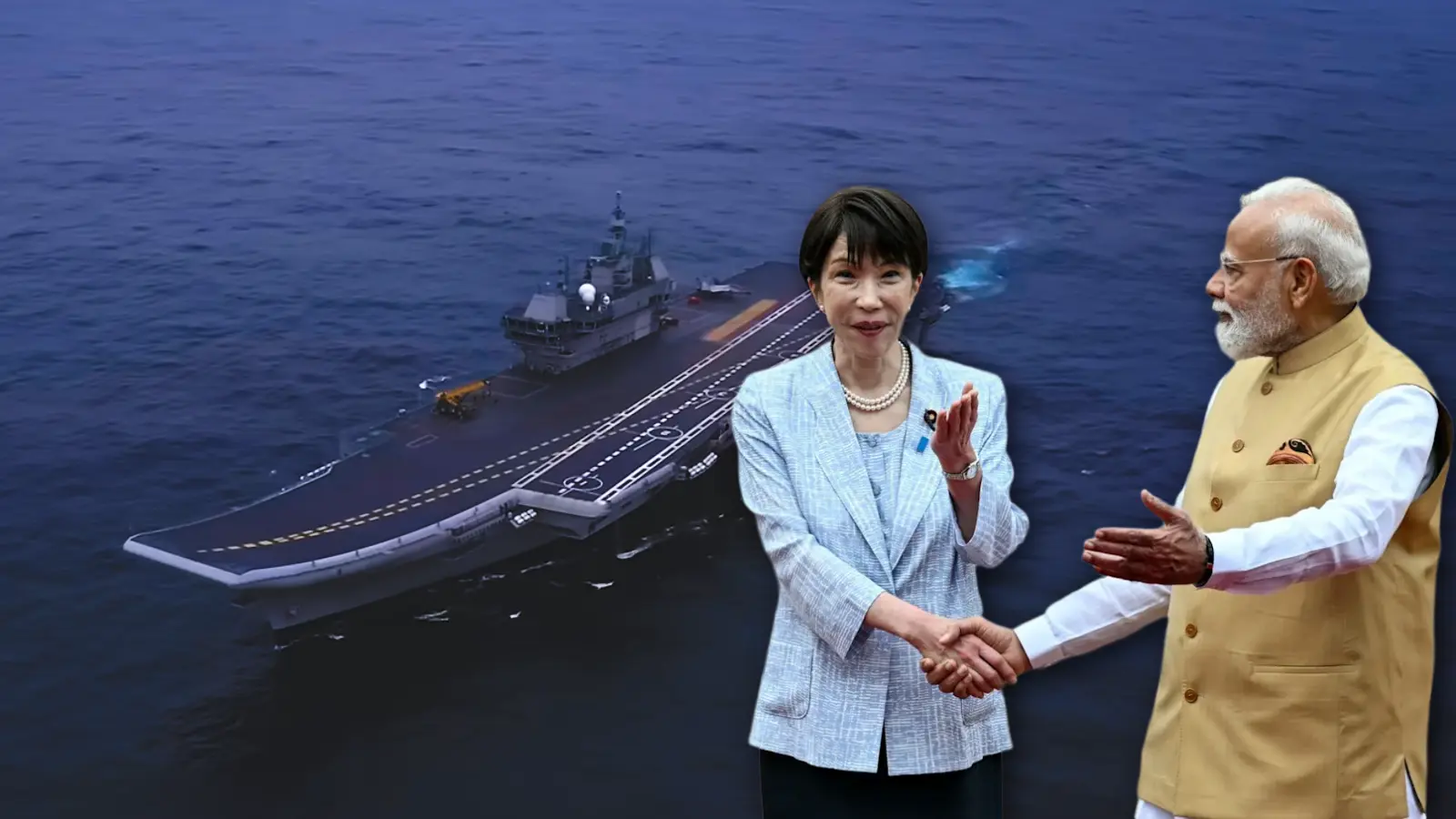
The UNICORN naval project now sits at the center of the Indo-Pacific’s shifting security architecture as a single, unified naval antenna. This piece of hardware, co-developed by Bharat Electronics Ltd (BEL) and Japan’s NEC Corporation, represents a departure from decades of Japanese commercial pacifism. It is the first tangible result of a defense co-development pact that moves the bilateral relationship beyond infrastructure and into the sensitive realm of integrated combat technology.
In the meeting rooms of Hyderabad House this July, Prime Ministers Narendra Modi and Sanae Takaichi signaled that the era of separating trade from regional security is over. Takaichi, Japan’s first female leader who assumed office in October 2025, brought a pragmatic edge to Tokyo’s engagement with New Delhi. The 16th India-Japan Annual Summit was not a celebration of the Mumbai-Ahmedabad bullet train. Instead, it focused on a 5 trillion yen ($32 billion) investment target aimed at shielding critical supply chains from geopolitical shocks.
The India-Japan Joint Declaration on Economic Security Cooperation, signed on July 2, 2026, establishes a “Joint Coordination Platform.” This body is tasked with securing the flow of semiconductors and critical minerals, treating industrial capacity as a pillar of national defense rather than a matter of private commerce. India requires Japanese technical precision to scale its domestic manufacturing; Japan requires India’s scale and geography to hedge against escalating volatility in the East China Sea.
How the UNICORN naval project drives regional convergence
Geopolitics has forced this convergence. China’s naval expansion and the militarization of contested maritime spaces have made the “Free and Open Indo-Pacific” less of a diplomatic slogan and more of a logistical requirement. For India, the priority is securing the Indian Ocean sea lanes that carry the bulk of its trade. For Japan, an export-heavy nation dependent on imported energy, any disruption in these waters is an existential threat.
The cooperation now reaches into the digital soil. While 120 memorandums of understanding valued at $12.5 billion were signed during the summit’s economic forum, the strategic weight lies in the minerals. Lithium, cobalt, and rare earth elements—essential for electric vehicles and missile guidance systems—are the new gatekeepers of influence. By linking Japan’s advanced processing capabilities with India’s rising industrial demand, the two nations are attempting to build a technological ecosystem that can function independently of a single dominant supplier.
Artificial intelligence and cyber resilience have similarly moved from the laboratory to the situation room. The summit’s emphasis on AI reflects a shared understanding that the next decade of geopolitical influence will be determined by who controls secure computing infrastructure and trusted data networks. This is a strategy of resilience. The goal is to ensure that neither country is vulnerable to economic coercion or technological blockades.
The Quad remains a vital diplomatic layer, but the India-Japan axis is the most practical of these regional arrangements. It is built on a blunt assessment of risk. If the sea lanes from the Strait of Hormuz to the Malacca Strait are compromised, both economies face immediate contraction. Naval exercises and information-sharing agreements have transitioned from occasional drills to a continuous operational necessity.
Significant friction remains despite the political alignment. Defense industrial cooperation is in its infancy. Differences in procurement systems, strict export controls, and regulatory hurdles in both New Delhi and Tokyo continue to slow the translation of policy into hardware. The UNICORN project is a proof of concept, not a finished fleet.
The bilateral trade volume has also failed to keep pace with the intensity of the security dialogue. While Japanese capital flows into Indian metro systems and industrial corridors, market access and regulatory barriers remain persistent complaints for Japanese firms. Political resolve is currently high, but the partnership’s longevity depends on whether these institutional bottlenecks can be cleared before the next regional crisis.
Success will not be measured by the number of signed memorandums. It will be determined by the speed at which both nations can integrate their defense industries and secure their mineral pipelines. The strategic reset is a response to a more dangerous neighborhood, where economic dependence is increasingly used as a lever of power.