
Pakistan’s three-front crisis crested in a single week of September 2026: air strikes into Afghanistan, an intensifying two-insurgency war in Balochistan, and an IMF review deciding the next tranche of a $7 billion bailout. Each front is now drawing on the same scarce reserves.
Consider one week in the life of Pakistan. On 21 September, its fighter jets struck militant hideouts in eastern Afghanistan. On 23 September, its air-defence units shot down eight drones over Torkham and Kohat. On 24 September, it bombed ten sites across Kandahar, Paktia and Khost, including a formation the government identified as the Afghan army’s 203rd Mansouri Corps. Through the same seven days, the Baloch Liberation Army (BLA) published its latest battlefield tally: 25 claimed operations in ten days against security forces in Balochistan. And in Karachi, an International Monetary Fund (IMF) mission sat down with the finance ministry to decide whether the country has earned its next $1.2 billion tranche.
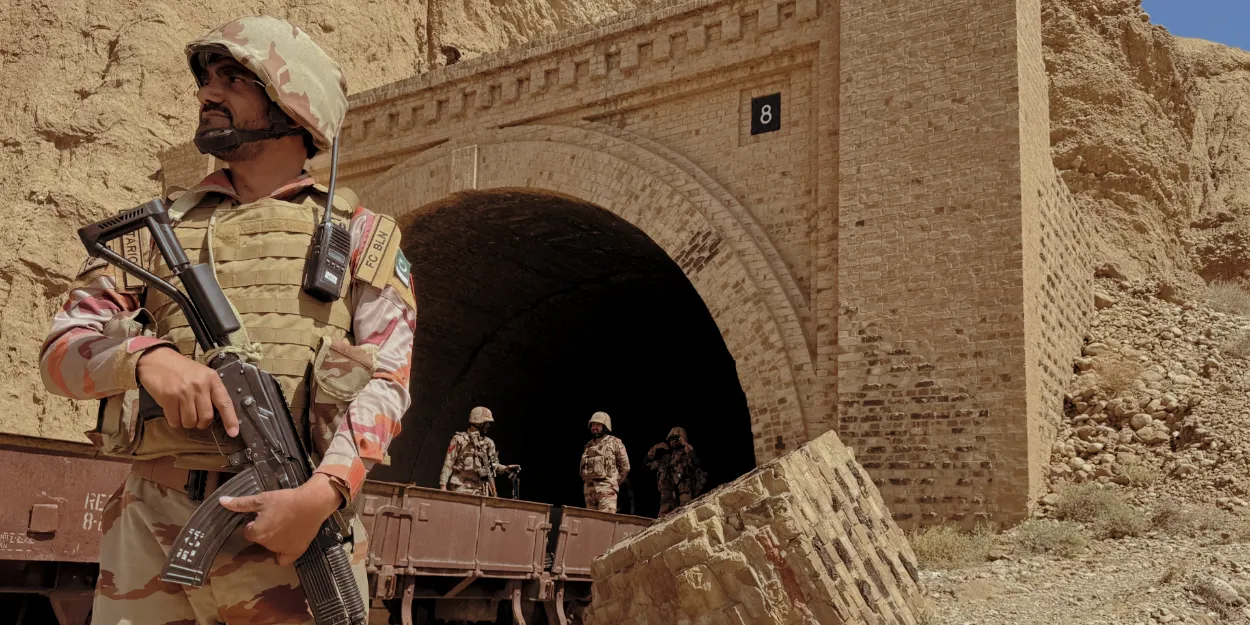
Any one of these would define a normal news cycle. Together, they describe Pakistan’s three-front crisis: a state fighting on its western border, inside its largest province, and against its own balance of payments, with each front now drawing on the same scarce foreign exchange and political attention.
Front One: Why the Afghan Border Keeps Reigniting
The latest escalation ended three months of relative calm along the 2,600-kilometre border, and it followed a familiar script. Pakistan and Afghanistan fought their worst conflict in years in late February, when Pakistan launched what it called Operation Ghazab lil Haq on the night of 26 February after cross-border firing. TES covered that round of fighting in detail in an earlier analysis of the February war. A Chinese-mediated ceasefire followed in March and held, barely, through summer.
The collapse began on 18 September, when a suicide bomber rammed an explosives-laden vehicle into a mosque near the old Police Lines in Kohat, in Khyber Pakhtunkhwa, followed by an exchange of fire as gunmen tried to storm the adjoining police compound. Provincial officials put the confirmed toll at 31 dead, including eight attackers, according to Pakistani police sources; earlier same-day reports had put the figure lower, at 15 to 21, as the death toll was revised upward through the day. Wire reporting from the scene described a coordinated assault as gunmen tried to storm the compound during Friday prayers. Two days later, six security personnel died in a separate shootout in Hangu.
The retaliation followed within days. Strikes on 21 September killed 28 militants, Pakistani officials said, though the United Nations said three civilians also died in the same bombardment. On 23 September, eight drones crossed from Afghanistan toward Torkham and Kohat and were shot down; Kabul denies launching them. On 24 September, the Pakistan Air Force hit ten locations that Information Minister Attaullah Tarar described as being used “for launching and storing these drones,” calling the strikes “deliberate, precise, calibrated, and proportionate.” Taliban spokesman Zabihullah Mujahid called the attacks “reckless, careless, and hostile” and said Kabul would mount “an appropriate response.” Overnight, border units clashed in the Gulistan sector; Islamabad says 13 Afghan Taliban personnel were killed, while Kabul claims it destroyed a Pakistani post near Spin Boldak and denies any losses of its own.
Beneath the exchange of fire sits an irreducible dispute. Pakistan accuses the Afghan Taliban of sheltering the TTP and more than two dozen allied militant groups; Foreign Minister Ishaq Dar told the UN General Assembly this week that Pakistan wants “concrete and verifiable” action against them. The Taliban government denies the charge and calls militancy Pakistan’s internal problem. A UN Security Council monitoring report covering December 2025 to June 2026 found that continued Afghan Taliban support for the TTP had increased the frequency and lethality of attacks inside Pakistan, and flagged growing operational links among the TTP, al-Qaeda, ISIL-K and the BLA. Mediation by China, Turkey, Qatar and Saudi Arabia has produced truces, never settlements. The UN mission says cross-border violence killed at least 499 civilians and wounded 1,216 between October 2025 and June 2026 alone.
Front Two of Pakistan’s Three-Front Crisis: Balochistan’s Two-Insurgency War
The second front is older, and by the numbers, getting worse. Attacks in Balochistan rose from 83 in July to 89 in August 2026, according to the Pakistan Institute for Conflict and Security Studies, which called July the deadliest month nationally of the year and Balochistan the most affected province. The longer arc is steeper still: ACLED data shows attacks across Pakistan nearly quadrupling, from 658 in 2022 to 2,425 in 2025, with TTP attacks alone rising more than sevenfold to 838.
The BLA now operates on a schedule that resembles a conventional campaign rather than sporadic terrorism. In the first week of September it claimed 28 operations across the province, including ambushes on military convoys in Kharan, Kalat and Mastung, an attack on checkpoints at Zero Point near Gwadar, and strikes on vehicles connected to the Saindak copper project, claiming 52 personnel killed. Between 14 and 23 September it claimed another 25 operations, including the temporary seizure of a police station in Khuzdar. Its spokesman describes the campaign as an “economic blockade” against what the group calls an “occupying military,” vowing to fight until an independent Balochistan is established. These are the BLA’s own, unverified figures; the group’s statements also concede a dozen of its own fighters killed in a single week of clashes, and Pakistani and separatist casualty claims routinely diverge and cannot be independently reconciled.
Two developments matter more than the raw counts. The first is geography. Reporting on what has been called the Durand Dispatch tracker has noted that eleven Pashtun-majority districts of northern Balochistan, from Zhob to Qila Abdullah, recorded no attacks between January and May 2026. Since 10 June, when gunmen attacked police installations across four of those districts, at least 13 attacks have hit the belt, including a July ambush that killed 27 police personnel guarding a dam project near Ziarat. The insurgency has spread out of its Baloch heartland into the province’s Pashtun north, through precisely the districts the N-50 and Quetta-Taftan highways cross.
The second is convergence. The 1 September customs-house attack at Ziarat Cross was claimed not by the BLA but by the TTP, in a Pashtun district a hundred kilometres from Quetta. Analysts remain divided on whether this reflects deliberate coordination between the two ideologically distinct groups or simple opportunism, with each exploiting whatever access it has in a given area. [Editorial flag: the specific named-analyst quotes in the original draft (attributed to Al Jazeera) could not be independently verified against a live source in this session and have been removed pending confirmation — see delivery note.] What is independently documented is the UN monitoring report’s separate finding of growing operational links among the TTP, al-Qaeda, ISIL-K and the BLA, which suggests Pakistani intelligence services are already planning for a scenario in which the state fights two coordinated insurgencies in one province rather than two separate ones.
What Pakistan’s Counter-Offensive Looks Like
The military’s answer is an intensifying clearance campaign conducted in a distinctive political language. Since 21 September, the Inter-Services Public Relations (ISPR) wing has reported 33 militants killed in Balochistan: 22 in Operation Shaban on the outskirts of Quetta, and 11 more in a Nushki raid on 25 September. Earlier operations in Kharan and Washuk recovered 2.9 tonnes of explosives, according to ISPR. President Asif Ali Zardari praised the forces for “eliminating 33 Indian-backed khawarij and terrorists.”
That sentence contains the frame Rawalpindi has chosen: the state brands the TTP “Fitna al-Khawarij” and Baloch separatist groups “Fitna al-Hindustan,” a label asserting Indian sponsorship of the insurgency. India denies the allegation, as it has denied previous Pakistani accusations of backing the BLA, and TES has found no independent verification for the specific sponsorship claims made in either direction. Balochistan Chief Minister Sarfraz Bugti has ruled out negotiations with the insurgents and promised an intensified campaign instead, and the appointment of former ISI counterintelligence officer Faisal Naseer as national coordinator of the National Counter Terrorism Authority signals that the response will be intelligence-led. Whether force alone can reverse a trend that has quadrupled nationwide violence in three years remains an open question that the casualty data has not yet answered.

Front Three: The IMF Review Inside Pakistan’s Three-Front Crisis
The third front is fought in spreadsheets, and this week it was in Karachi. An IMF mission led by Iva Petrova opened the fourth review of Pakistan’s $7 billion Extended Fund Facility, alongside a review of its $1.4 billion climate-resilience facility, a combined package worth roughly $1.2 billion if the Executive Board approves. About $4.5 billion has been disbursed since the 37-month programme began in September 2024. Managing Director Kristalina Georgieva, meeting Prime Minister Shehbaz Sharif on the sidelines of the UN General Assembly, struck an upbeat note: “Strong implementation has helped preserve stability, restore confidence and regain market access.”
The background is less soothing. Pakistani media reporting on the fund’s own review documents has flagged an 853 billion-rupee statistical discrepancy in last year’s accounts, a 370 billion-rupee shortfall against promised health and education spending, and roughly 174 legislative amendments the IMF wants passed to improve governance of state-owned enterprises. The Gulf war, which began with American strikes on Iran in February 2026 and rerouted global shipping around the Cape of Good Hope while unsettling energy markets from the Strait of Hormuz to the Bab el-Mandeb — TES’s fuller account of that conflict’s origins is available here — has raised Pakistan’s fuel import bill and domestic prices precisely when the programme demands fiscal restraint. The State Bank expects the current account deficit to stay below 1 per cent of GDP and targets reserves above $21 billion by June 2027, but only after Pakistan repays $3 billion to Saudi Arabia.
Can Pakistan Pay for Three Wars?
No modern state has sustained this combination cheaply. Counter-insurgency in a province the size of France, air operations across an international border, and a border force on permanent alert all draw on the same scarce foreign exchange the IMF review is counting. The finance ministry’s own caution, that blocked roads and halted economic activity in the final days of September could cost the month’s tax target of 1,331 billion rupees, is a quiet acknowledgment that the war economy and the fund programme are now the same ledger.
Set against Pakistan’s three-front crisis, India offers an instructive comparison of how a large regional economy has absorbed the same external shock differently. Industry bodies there have pushed the government to revive a decade-old scheme for mobilising household gold deposits, partly in response to a record gold-import bill driven by prices that have risen sharply amid the Gulf war’s safe-haven demand. Whether that scheme succeeds where a decade of low participation did not is a separate question TES has not yet reported on in depth; the point for Pakistan is narrower: the Gulf war’s economic shock is reshaping policy choices well beyond Islamabad, in an economy with far deeper reserves to draw on.
The Convergence Risk: What Happens Next
The first is whether the Afghan escalation tips back into full-scale war. The Taliban have promised “an appropriate response” to the Kandahar strikes; every previous round of retaliation in this cycle has followed within days. The February war showed how quickly border skirmishing can escalate into strikes on cities.
The second is whether the two internal insurgencies actually merge. If the TTP’s Pashtun networks and the BLA’s Baloch campaign begin sharing corridors rather than merely sharing districts, Pakistan faces a coordinated two-coast problem, running from the Khyber passes to the Arabian Sea at Gwadar, home to the Chinese-operated port near whose coastal approaches the BLA attacked checkpoints at Zero Point this month. China’s position matters here: Beijing is simultaneously the principal mediator with Kabul and the principal investor in Balochistan, a dual role the current escalation strains from both directions.
The third is the fund. If the IMF board delays the tranche over the governance shortfalls and the accounting discrepancy, Islamabad enters the winter fighting season with thinner reserves and a fuel bill inflated by a war not of its own making.
| Front | Principal adversary | This week’s flashpoint | The trend |
|---|---|---|---|
| Afghan border (2,600 km) | Afghan Taliban forces | Strikes on Kandahar, Paktia, Khost; Gulistan clash | February war, March ceasefire, now collapsing again |
| Balochistan | BLA, and expanding TTP activity | 25 claimed operations in 10 days; Operation Shaban | 89 attacks in August, up from 83 in July; new Pashtun-belt front |
| The economy | The external account | Fourth IMF review, $1.2 billion at stake | Gulf-war import bill; 853 billion-rupee accounting gap flagged |
The three fronts are not separate wars. They are one crisis with three faces, and Pakistan’s capacity to choose which one to fight first is narrowing.
- Pakistan fought on three fronts in a single week in September 2026: air strikes into Afghanistan, a counter-insurgency surge in Balochistan, and an IMF review deciding the next $1.2 billion of external financing.
- The Afghan-Pakistan ceasefire collapsed into strikes, drone incursions and a border clash; the UN says cross-border violence killed at least 499 civilians between October 2025 and June 2026.
- Balochistan’s insurgency escalated to 89 attacks in August and has spread into the province’s Pashtun-majority districts, raising the risk — flagged separately by the UN — of TTP-BLA operational overlap.
- The state frames both insurgencies as India-sponsored; India denies the charge, and BLA and ISPR casualty claims remain independently unverified.
- The IMF review coincides with Gulf-war-driven fuel inflation and an 853 billion-rupee accounting discrepancy — the economic floor beneath all three fronts of Pakistan’s three-front crisis.
Source transparency
Verified fact: the Kohat mosque attack and casualty figures, IMF review timing and figures, ACLED and Pakistan Institute for Conflict and Security Studies attack counts, and the dates of the February war and subsequent ceasefire.
Official statement: quotes from Attaullah Tarar, Zabihullah Mujahid, Ishaq Dar, Asif Ali Zardari and Kristalina Georgieva, and the ISPR and BLA casualty claims, none of which TES has independently verified.
TES Analytical Assessment: the framing of these developments as a single interconnected “three-front crisis,” the reading of Chinese mediation incentives, and the three convergence scenarios in the closing section.
Frequently Asked Questions
Why is Pakistan fighting Afghanistan?
Islamabad accuses the Afghan Taliban of sheltering the TTP and allied groups that attack Pakistani territory; Kabul denies this and calls militancy an internal Pakistani problem. Strikes and border clashes have recurred since the February 2026 war, with the current round beginning on 21 September 2026.
What is happening in Balochistan?
A separatist insurgency led primarily by the BLA has intensified, with attacks rising to 89 in August 2026, according to the Pakistan Institute for Conflict and Security Studies, and has expanded from the Baloch heartland into Pashtun-majority districts. The military has responded with operations under the Azm-i-Istehkam counter-terrorism framework.
What is Azm-i-Istehkam?
It is Pakistan’s national counter-terrorism campaign framework, under which operations such as the current Operation Shaban clearance around Quetta are conducted. It pairs military operations with intelligence restructuring against what the state calls foreign-sponsored terrorism.
Can Pakistan’s economy sustain three conflicts at once?
That is the open question behind the IMF’s fourth review. The $7 billion Extended Fund Facility has helped stabilise the economy, but Gulf-war-driven fuel inflation, an 853 billion-rupee accounting discrepancy and missed health and education spending leave little fiscal room for the simultaneous costs of border conflict and counter-insurgency.
1 thought on “Pakistan’s Three-Front Crisis: Kabul, Balochistan, IMF”