
The GSAT-7C launch date has not been announced. On 15 October 2026, the Ministry of Defence signed a ₹2,563 crore contract with NewSpace India Limited (NSIL) for the Indian Air Force satellite, four years and ten months after the Defence Acquisition Council (DAC) first cleared the project at ₹2,236 crore. A second contract signed the same day, worth ₹1,543 crore with Bharat Dynamics Limited (BDL) for Varunastra heavy weight torpedoes, equals about 6 per cent of BDL’s order book at the end of March 2026.
Both contracts were announced in a Press Information Bureau (PIB) release. It records the money, the contractors and the user services. It does not record dates, quantities or specifications, and that gap, including the GSAT-7C launch date, is where this piece starts.
The GSAT-7C Launch Date Is Unannounced, and the PIB Release Sets No Schedule
The Ministry of Defence release of 15 October 2026 names the contract value, the contractor and the user service. It gives no launch date, launch vehicle, orbital slot or delivery timeline. The ministry describes GSAT-7C as an indigenously designed, developed and manufactured satellite that will give the Indian Air Force secure, resilient and seamless communication. That is the full official description in the release.
The contracts were signed in New Delhi in the presence of Additional Secretary and Director General (Acquisition) A. Anbarasu. The ministry said both agreements advance domestic defence manufacturing and self-reliance in critical technologies, in line with Aatmanirbhar Bharat and Make in India.
History offers a reference point but not a forecast. ISRO launched GSAT-7 for the Navy in 2013 and GSAT-7A for the Air Force on 19 December 2018, so the GSAT-7C satellite contract extends a series that is already operational. Geosynchronous schedules have also moved before. TES’s report on the NVS-03 launch for NavIC records a date given to Parliament for the end of 2025 that was not met on that timeline.
TES assessment: the first firm GSAT-7C launch date is more likely to appear in the Department of Space’s launch calendar than in a Ministry of Defence statement. Until the GSAT-7C launch date appears there, the contract fixes the price and the contractor, not the day the satellite reaches orbit.
Nearly Five Years Separate the DAC’s GSAT-7C Approval From the Contract
The DAC granted Acceptance of Necessity (AoN) for the GSAT-7C satellite and ground hubs on 23 November 2021, at ₹2,236 crore under the ‘Make in India’ category. The contract signed on 15 October 2026 is ₹2,563 crore, which is ₹327 crore or about 14.6 per cent higher. The two figures are not like-for-like: the 2026 release does not say whether the ground hubs are part of the contract.
The 2021 Defence Acquisition Council statement remains the clearest official description of the role. It said the project would provide real-time connectivity for software defined radios (SDRs), meaning radios whose waveforms are set in software, and would let the armed forces communicate beyond line of sight in a secure mode. It also said the satellite would be designed, developed and launched in India. An AoN is an approval in principle with an indicative cost; the contract is where price, contractor and delivery obligations are fixed.
That sequence is the acquisition path for a satellite built entirely at home. The GSAT-7C satellite contract reflects approval in 2021, signature in 2026 and a launch still to be scheduled. The Air Force’s earlier dedicated satellite, GSAT-7A, is reported to link its airbases, radars and airborne platforms, which makes GSAT-7C a capacity and secure-waveform addition rather than a first step.
| Item | GSAT-7C (Air Force) | Varunastra (Navy) |
|---|---|---|
| Contractor | NewSpace India Limited, Bengaluru | Bharat Dynamics Limited, Hyderabad |
| Contract value, 15 October 2026 | ₹2,563 crore | ₹1,543 crore |
| Earlier reference point | DAC AoN, 23 November 2021: ₹2,236 crore (satellite and ground hubs) | BDL contract, 11 June 2019: ₹1,187.82 crore |
| Change against reference | +₹327 crore (+14.6%) | +₹355.18 crore (+29.9%) |
| Quantity and scope in 2026 release | Not stated | Not stated |
| Launch or delivery schedule | Not stated | Not stated |
Varunastra Adds ₹1,543 Crore, About 6% of the Bharat Dynamics Order Book
The Bharat Dynamics order book stood at ₹26,176 crore on 31 March 2026, according to BDL’s FY26 investor presentation. The ₹1,543 crore Varunastra torpedo contract equals about 5.9 per cent of that figure and roughly 2.7 times the ₹572 crore of revenue BDL reported for April to June 2026. It follows the ₹1,187.82 crore Varunastra order signed on 11 June 2019.
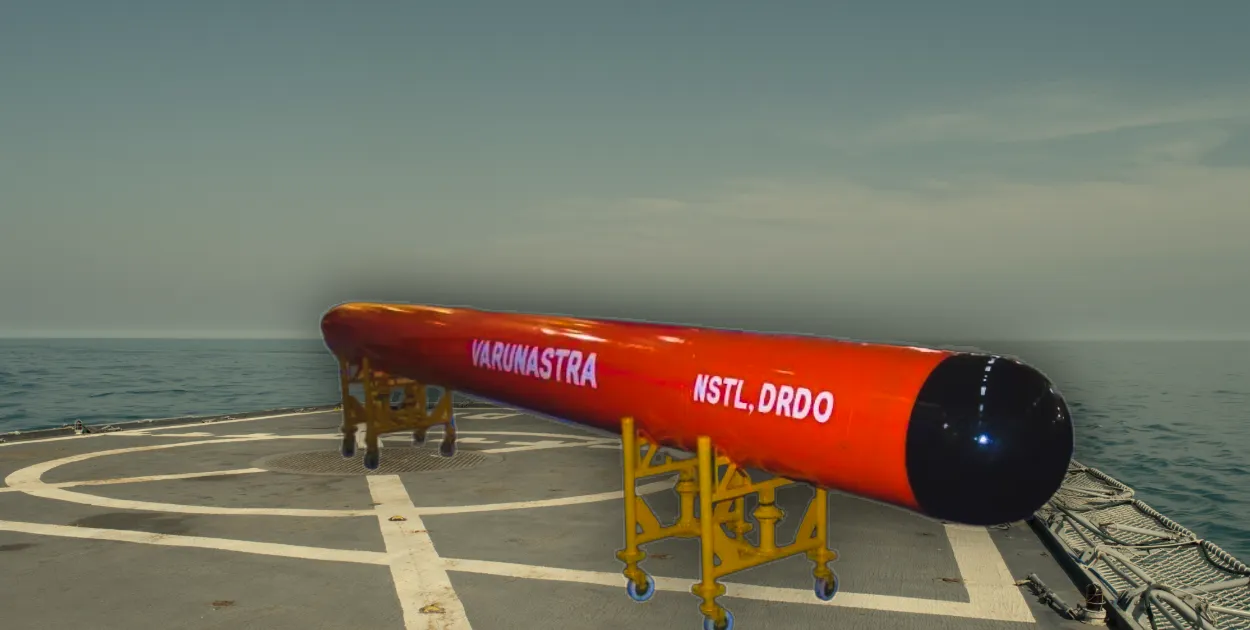
BDL’s own media release on the 2019 order described Varunastra as a ship-launched, electrically propelled underwater weapon with an automatic guidance system, to be built at its Visakhapatnam unit in collaboration with DRDO, with execution over 42 months. The 2026 PIB release adds that the Naval Science and Technological Laboratory (NSTL) developed the Varunastra torpedo, that it has advanced manoeuvring capability, and that it can engage submarines at long range. The 2026 release states no quantity, so a per-torpedo price cannot be derived from either contract.
For investors, the more useful comparison is with BDL’s own numbers. The company reported Q1 FY27 revenue of ₹572 crore and standalone profit of ₹118.79 crore, a recovery from the execution delays of FY26. A brokerage update dated 18 August 2026 cited BDL management’s FY27 order-inflow target of about ₹15,000 crore; on that basis the Varunastra torpedo order alone is roughly 10 per cent of the year’s target. BDL’s other recent Air Force contract, the ₹810.79 crore airfield-strike order, is covered in TES’s analysis of the SAT-SAAW deal.
The release names only two companies. NSIL is not listed, so BDL is the only direct listed exposure in this announcement. Any read-through to suppliers of electronics, launchers or alloys would be inference, and TES will wait for exchange filings before naming any.
Pakistan’s Hangor Submarines Frame the Varunastra Order, but the MoD Has Not Linked Them
The Pakistan Navy commissioned its first Hangor-class submarine, PNS Hangor, in Sanya, China, on 30 April 2026. The programme covers eight boats, reported as four built in China and four at Karachi Shipyard and Engineering Works. The Ministry of Defence release mentions neither Pakistan nor any submarine class, and Varunastra has been on contract since June 2019, so the order belongs to a longer anti-submarine warfare programme rather than a reaction to one commissioning.
TES assessment: the timing still matters. As air-independent propulsion submarines enter Pakistan’s fleet, a domestic heavy weight torpedo line gives the Navy a weapon it controls end to end, without export approvals. India’s own submarine pipeline runs on a longer clock: TES reported that the additional Scorpene submarines awaiting Cabinet approval would not put a new boat to sea before 2032, and its comparison of the Navy’s 2026 fleet with Pakistan’s sets out where the surface fleet stands. Torpedoes and sensors are the nearer-term lever.
Three Disclosures Would Settle the GSAT-7C Launch Date and Varunastra Quantity
Three documents would close most of the gaps in the 15 October release. None has been published yet, and each sits with a different institution.
- The launch vehicle and slot behind the GSAT-7C launch date, which only ISRO and the Department of Space can confirm.
- The contract’s delivery schedule and whether ground hubs are included, which the MoD or NSIL would have to state.
- BDL’s stock exchange filing on the Varunastra order, which in 2019 gave the 42-month execution period and may give the quantity this time.
The torpedo order is now a delivery question for BDL’s Visakhapatnam line. The satellite order is a scheduling question for ISRO’s launch calendar, and that is where the GSAT-7C launch date will eventually be set.
Questions on the GSAT-7C Launch Date and Contract
What is the GSAT-7C launch date?
No GSAT-7C launch date has been announced. The PIB release of 15 October 2026 gives the contract value, ₹2,563 crore, and the contractor, NSIL, but no launch schedule or vehicle.
Why did the GSAT-7C contract come in 2026?
The DAC approved the project in principle on 23 November 2021, and the contract followed on 15 October 2026. The release does not explain the interval or itemise the steps in between.
How much is the Varunastra contract worth to BDL?
The contract is worth ₹1,543 crore, about 5.9 per cent of BDL’s ₹26,176 crore order book at 31 March 2026. The release does not state how many torpedoes are covered.
Investment Disclaimer: This article discusses procurement contracts, order books and listed companies for informational and analytical purposes only. It is not investment advice or a recommendation to buy or sell any security. Readers should consult a SEBI-registered adviser before making investment decisions.
Source note: Ministry of Defence and PIB releases of 15 October 2026 and 23 November 2021, BDL’s 2019 media release and results disclosures, and Pakistan Navy statements as reported by Naval News.