
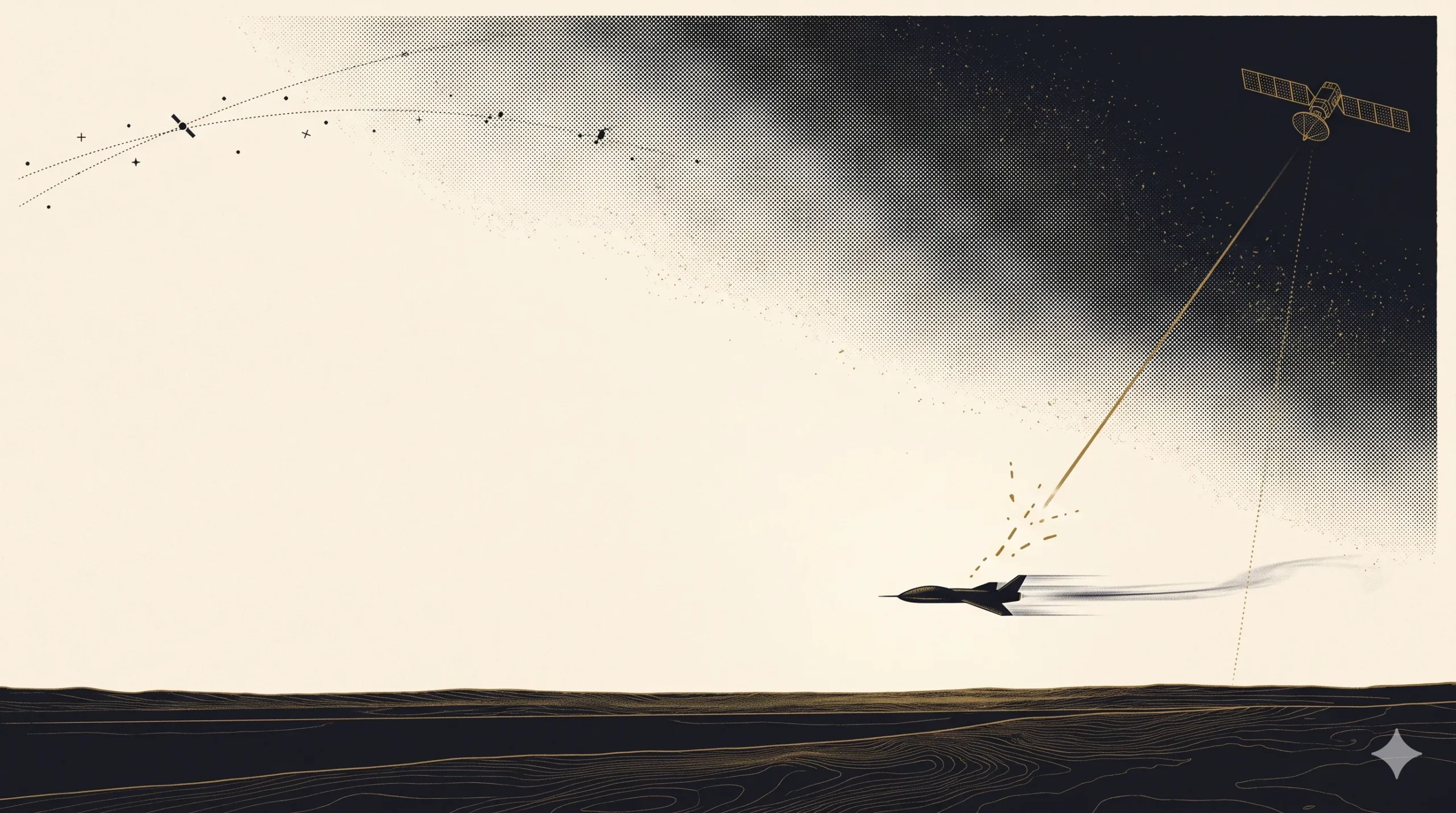
The Starshield speed cap that took effect on 14 October 2026 cut military terminals’ connections above 100 mph (about 160 km/h), the speed at which Ukraine’s interceptor drones chase Russian jet-powered strike drones, according to Kyiv. India’s Army has no dedicated satellite and still relies on the Air Force’s GSAT-7A, with its own GSAT-7B expected around mid-2028. Both facts raise one question: who controls the link.
What the Starshield speed cap Did on 14 October and What Remains Disputed
SpaceX limited Starshield, the military version of Starlink, to connections moving below 100 mph (about 160 km/h), without warning to Ukraine. Ukrainian officials say the Starshield speed cap disrupted drone missions and cancelled some operations. Who ordered it, and whether it has been lifted, are both disputed.
Elon Musk said Starshield is owned and controlled by the US government, with limits decided by the US military and ultimately the president. Reuters reported, citing three sources, that the instruction to scale back the service came from the White House, while a senior US official denied it came directly from President Donald Trump.
On status, a Ukrainian defence ministry source said on 15 October that in-motion service had been restored but did not say whether the formal limit remained. Zelenskyy said on 17 and 18 October that the cap was still in place, and called it a message from Washington that SpaceX carried out technically. Musk says service has been restored. TES could not confirm which account holds as of 21 October.
The timing drew attention because Trump had been pressing Kyiv to stop strikes on Russian oil infrastructure, a pressure TES covered in its report on the Trump energy ceasefire. Ukrainian officials questioned whether the two were linked. No public evidence shows that they were.
Why the Starshield speed cap Hits Interceptor Drones Harder Than Navigation
A cap on a satellite link matters most for a drone that must fly fast and stay connected. Navigation satellites, such as GPS and India’s NavIC, supply position and time. Satellite communication carries the two-way traffic, video, commands and target data, that lets an operator steer a drone in flight. Ukrainian officials say interceptors chasing jet-powered drones fly above 160 km/h, which is where the cap bit.
A geostationary satellite such as GSAT-7B sits 35,786 km up, so a command and its response need roughly half a second through the satellite, against tens of milliseconds in low orbit, and a drone at 160 km/h covers about 22 metres in that time, which makes geostationary links suited to long-route command and surveillance but not to an operator steering an interceptor onto a fast target.
Ukrainian presidential adviser Serhii Beskrestnov said the limit left Kyiv without protection against jet-powered strike drones. One unit, the 7th Rapid Reaction Corps, reported disconnections of 10 to 20 seconds, sometimes below the stated threshold. TES covers India’s own satellite navigation in its report on the NVS-03 launch for NavIC.
The episode also separates two products. Musk describes Starlink as a commercial service for civilian or defensive use and Starshield as a US government system. TES’s reading: the same constellation can carry different rules depending on who holds the contract.
Satellite links have been targets before. Russia’s attack on Viasat’s KA-SAT network in February 2022 showed how quickly communications themselves become part of a war. The 2026 cap shows a second route to the same outcome, a policy decision and not a missile.
How India’s Drones Fly: Line-of-Sight Radio, Satellite Links and Pre-Set Routes
Indian military drones fly on one of three links. Older Heron Mk I and Searcher drones are controlled by line-of-sight radio from a ground station. Newer types, the Heron Mk II and the MQ-9B, add a satellite link for control beyond line of sight. A third mode is a pre-programmed route guided by navigation and inertial sensors, which needs no live link. The satellite link is the one a Starshield speed cap could break.
The Heron has a line-of-sight range of about 250 km and about 1,000 km under satellite control, according to the manufacturer’s published figures. The armed forces operate dozens of Heron Mk I and Searcher drones on line-of-sight links. Four Heron Mk II drones with satellite links have been inducted, and the services are reported to be buying more through an emergency route after Operation Sindoor, with at least 60% indigenous content.
The MQ-9B is the larger commitment. The Ministry of Defence signed a contract on 15 October 2024 for 31 aircraft: 15 SeaGuardians for the Navy and eight SkyGuardians each for the Army and the Air Force, with deliveries expected from around 2029. The Navy has flown leased MQ-9Bs since November 2020, and on 17 August 2026 the ministry signed a ₹1,943 crore lease for two more over 30 months.
India’s own long-endurance drones are still in trials. DRDO’s TAPAS BH-201 and Archer-NG are being built with satellite links, and a reported image of the Archer-NG prototype shows a nose bulge for the satellite antenna.
TES found no public statement on which satellite capacity carries these drone links. The lease contract is reported to include dedicated satellite bandwidth supplied by the contractor, alongside ground stations, though TES could not corroborate that with a second source.
ISRO’s GSAT-7A was launched in 2018 with Ku-band capacity that sources said would help drone operations, and the ministry describes GSAT-7B as giving beyond-line-of-sight communication to “weapon and airborne platforms”. TES’s reading: the Indian satellites are meant to carry the drone link, but whether today’s drones use them is not public. A Starshield speed cap would matter to India only if a drone link ran on foreign-controlled capacity.
Who Controls Each Layer of India’s Military Communications
India owns the geostationary layer of its military satellite communications and has announced no military constellation in low Earth orbit, the layer Ukraine relied on. The table sets out each service’s position as of 21 October 2026, a week after the Starshield speed cap.
| Layer | Satellite | Position | Control |
|---|---|---|---|
| Navy | GSAT-7 (2013); GSAT-7R (CMS-03) | GSAT-7R launched 2 November 2025 | Indian-built, ISRO-launched |
| Air Force | GSAT-7A (19 December 2018); GSAT-7C | GSAT-7A in service (official mission life eight years from launch); GSAT-7C contracted 15 October 2026 at ₹2,563 crore, launch date unannounced | Indian-built |
| Army | Shares GSAT-7A; GSAT-7B | GSAT-7B contracted March 2023 at ₹2,963 crore; launch expected mid-2028 | Indian-built; shared capacity until launch |
| Low-orbit broadband | Starlink (licensed in India) | IN-SPACe authorisation 8 July 2025; spectrum and security assessments pending; no commercial service | Foreign-owned commercial service |
Compiled by TES from Ministry of Defence, PIB and press reports.
TES assessment: the geostationary layer is sovereign but thin for the Army, which uses part of another service’s satellite. The low-orbit layer, which carries the fast links drones need, has no Indian military equivalent in the public record.
The Army itself said in 2022 that future needs such as handheld secure satellite phones and a high-speed data backbone would call for low-Earth-orbit constellations. That statement, and not the Ukraine episode, is the clearest official signal on where the requirement points.
The Army Waits Until Mid-2028 for GSAT-7B, and Three Contracts Are Closing the Gap
The Indian Army has no dedicated communications satellite and depends on the Air Force’s GSAT-7A. Its GSAT-7B, a five-tonne geostationary satellite contracted for ₹2,963 crore, is now expected around mid-2028, according to officials cited on 19 October. The original plan was November 2027.
Three programmes are closing the gap. GSAT-7R went into orbit for the Navy on 2 November 2025. The Ministry of Defence signed the ₹2,563 crore GSAT-7C contract with NewSpace India Limited on 15 October 2026, covered in TES’s report on the GSAT-7C launch date. GSAT-7B would complete the geostationary set for all three services.
GSAT-7A, the satellite the Army shares, had an official mission life of eight years from its 19 December 2018 launch, though ISRO said the orbit insertion lengthened it. No public figure gives its remaining years. By mid-2028 it will have been in orbit for about nine and a half years, so, after the Starshield speed cap, the GSAT-7B date carries more weight than a routine schedule slip.
The six-month slip in GSAT-7B is a schedule fact, and the response is already visible: GSAT-7R launched and GSAT-7C signed within the past twelve months. TES tracks the wider programme list on its India military platforms hub.
Starlink Is Licensed in India but Has Not Launched, and Security Reviews Come First
Starlink holds a telecom licence and a five-year authorisation from India’s space regulator, IN-SPACe, dated 8 July 2025, but it has no spectrum and no commercial service. The Department of Telecommunications has licensed three satellite operators, Starlink, OneWeb India and Jio Satellite Communications, and all three are in security assessments before they can seek spectrum.
On 7 October Musk accused unnamed “oligarchs” of blocking Starlink’s entry. The Ministry of Communications replied on 8 October that the framework is fair and non-discriminatory and called the claim “baseless and misconceived”. Reliance rejected the suggestion on 16 October.
TES found no announced military element in Starlink’s India plans. The Starshield episode still sharpens the questions the security assessments will ask: who can change access terms, from where, and with what notice.
What to Watch After the Starshield speed cap
Will the Starshield speed cap be lifted for Ukraine?
Ukraine says it is in active negotiations with the Pentagon and SpaceX, and Senator Thom Tillis has called for a Pentagon inspector general investigation. No on-record White House or Pentagon explanation had been reported as of 16 October.
How do Indian military drones fly?
Heron Mk I and Searcher drones use line-of-sight radio. Heron Mk II and the MQ-9B add a satellite link for control beyond line of sight, and some routes are pre-programmed. Public sources do not say which satellite capacity carries those links.
Will GSAT-7B launch by mid-2028?
Officials give mid-2028, after a six-month slip. TES expects a firm date to appear first in the Department of Space’s launch calendar, as with GSAT-7C.
Will India add a military low-Earth-orbit layer?
No such programme has been announced in the sources TES reviewed. The Army’s 2022 statement on low-orbit needs is the signal to follow, and the next marker is a contract or requirement notice.
Does the Starshield episode change the Starlink decision in India?
The ministry says security assessments come first and has set no date. Whether the Ukraine episode enters those assessments is not public.
TES assessment: the Starshield speed cap showed the exposure, and India’s geostationary programme answers the control question for the Army by 2028, if the schedule holds. The harder decision sits one layer up. If a fast, low-orbit link becomes standard for drones and air defence, New Delhi will have to choose between a sovereign constellation, a licensed foreign one under conditions, or the exposure Kyiv met on 14 October.
Source note: Ministry of Defence and PIB releases, Ministry of Communications statements, IN-SPACe authorisation records, and Reuters, AP and other press reporting on the Ukraine episode.