
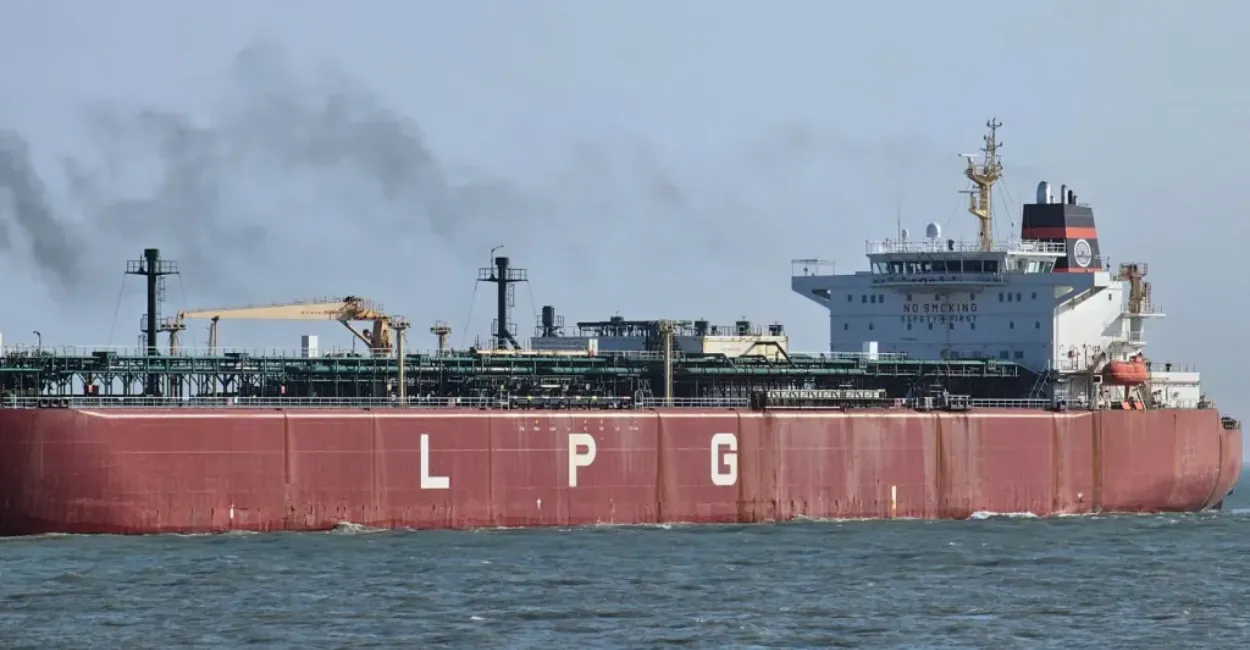
Gulf of Kutch oil transfers have begun. According to Bloomberg, as republished by gCaptain, two supertankers recently moved Persian Gulf crude onto other very large crude carriers (VLCCs) off Gujarat, and at least two more were doing the same on 1 October 2026. These are the first eastbound transfers of Gulf crude seen in the area since the Iran war began, per tanker-tracking data from Bloomberg and the analytics firm Vortexa.
The volumes are small. The signal is not. The Gulf of Oman transfer zone is saturated, and the nearest place with room to spare is India’s western coast.
- Gulf of Kutch oil transfers involve four VLCCs so far, against roughly three VLCC pairs starting transfers every day in the Gulf of Oman (Vortexa).
- Vortexa says a ship-to-ship (STS) operation near Hormuz now takes nearly 10 days, up from five to seven.
- Kpler modelling suggests west-coast India needs about seven more VLCCs than Oman for the same flow.
- No source reviewed by TES says who is buying the Kutch cargoes, or under which Indian permissions they move.
- A pressure signal, not yet a hub
- Why Oman’s anchorages are full
- What the extra distance costs
- Iran’s blacklist and the India link
- What India gains, risks and still does not know
- Four signals to watch
Gulf of Kutch oil transfers are a pressure signal, not yet a hub
Gulf of Kutch oil transfers are ship-to-ship operations in which two tankers moor together and pump crude between them at sea. Four vessels is a handful against the main system. Vortexa estimates that crude loaded on VLCCs west of Hormuz has been transferred at around 6 million barrels per day since late August, roughly three VLCC pairs a day, as Reuters reported.
Headline exports are not collapsing. Oilprice.com reports that Gulf crude exports excluding Iran reached at least 16.5 million bpd in September, matching the pre-war average. Only about 60 per cent crossed Hormuz, against 83 per cent before the war.
The system works, at a price. Gulf of Kutch oil transfers show where the strain is pushing it next. TES has tracked the wider arrangement in its explainer on Hormuz ship-to-ship transfers.
Oman’s anchorages are full because Saudi barrels came back to Hormuz
The immediate cause is Saudi Arabia’s loss of its western bypass. Reuters dates the shutdown of the East-West Pipeline to 13 September, which halted loadings at Yanbu on the Red Sea. Bloomberg places the first strike on 10 September. Saudi officials have attributed the attack to Iraq-based actors; Houthi involvement is widely discussed but attribution remains contested. TES covered the shutdown in its report on the East-West pipeline and the wider Red Sea threat in its Bab el-Mandeb explainer.
Kpler data cited by Reuters show Saudi exports through Hormuz on track for about 3.6 million bpd in September, up from roughly 900,000 bpd in August. Reuters also reported that Aramco sold more than 60 million barrels for STS transfer off Sohar, Oman, across September and October. Kpler analyst Panagiotis Krontiras estimated that the increase of nearly 3 million bpd would need 36 to 40 more VLCCs.
One caveat matters for any forecast. Saudi Arabia has since restarted the pipeline. CNBC reported on 29 September that flows were restored to around 3.5 million bpd, with Kpler satellite imagery showing a “major operational recovery” at Yanbu. Maritime Executive then reported a fresh, unattributed strike on the terminal. The Hormuz surge may ease, and the Kutch relay will follow whichever bypass proves more durable.
Queues are the visible result. Vortexa analyst Emma Li told Reuters that an STS operation now takes nearly 10 days. Producers are moving to a more distant anchorage because the Oman zone cannot absorb more volume.
Moving the transfer point costs fleet capacity, and freight shows it
Each extra day of steaming removes a tanker from the market. Kpler’s modelling, as reported by the analytics site ShipUniverse, compares transfer locations for a notional flow of 3 million bpd.
| Transfer area | Round-trip cycle | VLCCs for 3 million bpd |
|---|---|---|
| Gulf of Oman (Sohar/Fujairah) | 17 days | about 25 |
| West coast of India | 21 days | about 32 |
| Malaysia | 38.5 days | about 58 |
Source: Kpler estimates, September 2026, as reported by ShipUniverse. The 3 million bpd flow is a modelling case, not an observed volume.
Read correctly, the table says Gulf of Kutch oil transfers cost about seven more vessels than Oman for the same flow. The VLCC fleet is already stretched. AGBI, citing Clarksons Research, reports that VLCCs waiting in the Gulf of Oman make up about 15 per cent of the global fleet.
How Gulf of Kutch oil transfers register in VLCC freight rates
Reuters, citing LSEG data, reported that the Middle East-to-China VLCC rate reached a record $1.27 million a day on 21 September. IranWire’s summary of the Bloomberg report puts the pre-war range at $30,000 to $50,000. Benchmarks differ: the Baltic Exchange’s Gulf of Oman-China route, TD34, averaged $864,698 a day in the week to 25 September, according to Oil & Gas Middle East.
TES has not found a published, sourced per-barrel freight cost attributable to Kutch routing, so this article does not offer one.
Iran’s blacklist is what makes the Indian angle matter
The security case for Kutch is distance from Hormuz. Bloomberg notes that transfers off India’s west coast could reduce the risk of vessels being caught in attacks that have sporadically targeted ships near the strait.
Iran’s shipping controls point the other way. In late August the Persian Gulf Strait Authority, a new Iranian body, published a list of 45 vessels it said had violated its transit rules and threatened fines, detention or confiscation. Maritime Executive reported that the threat extends to companies and ships working with them. Reuters added that some listed tankers are owned or chartered by Saudi Aramco and the Abu Dhabi National Oil Company (ADNOC), and that at least three Indian refiners planned to stop using blacklisted vessels, including for STS.
That is the verified India link: Indian buyers are already adjusting to Iranian rules. Whether Tehran would act against shuttle tankers beyond the Gulf of Oman is not established in any source TES has found. It is a risk to monitor, not a development to report. For the wider conflict, see TES’s US-Iran war 2026 explainer.
History offers an echo. During the 1980s Tanker War, Iran moved crude loadings from Kharg Island towards Larak Island as Iraqi attacks intensified. Wars tend to push transfer points away from the threat.
What India gains, risks and still does not know
Kutch and Jamnagar sit in the same corner of Gujarat, home to some of India’s largest refining capacity, including Reliance’s Jamnagar complex and Nayara Energy’s Vadinar refinery. For Indian refiners, proximity to Gulf of Kutch oil transfers could, in principle, open cargoes to Indian refiners. No source TES has reviewed says Indian refiners bought any Kutch cargo. The reported flows are eastbound, to other VLCCs, for East Asia.
The risks are plausible but unquantified. The Indian Navy has run maritime security tasks in the Gulf of Oman under Operation Sankalp since June 2019. Whether concentrated STS activity off Gujarat will change its surveillance posture is a question, not a reported fact. The Gulf of Kutch also holds a marine national park and sensitive coastal habitat, so a spill during STS would be serious.
Four signals will show whether the Kutch relay lasts
- Pair count off Gujarat. Two completed and two under way is the baseline. A sustained rise would mean Oman’s capacity has not recovered.
- Yanbu and the pipeline. Steady flows near 3.5 million bpd would reduce the Hormuz load. Further strikes would increase it.
- Freight. If VLCC rates stay near $1 million a day, long diversions remain affordable for those paying them. A sustained fall would shift volume back to Oman.
- Iran’s enforcement. Any action against vessels beyond the Gulf of Oman, or any Indian regulatory notice on STS, would quickly change the economics.
Gulf of Kutch oil transfers may stay a footnote or become routine. The answer depends on two bypass routes and one blacklist, not on India.
Frequently asked questions
What are Gulf of Kutch oil transfers?
They are ship-to-ship transfers of Persian Gulf crude between VLCCs off Gujarat. Bloomberg reported on 1 October 2026 that two had been completed and two more were under way.
Why are Gulf producers using the Gulf of Kutch?
Anchorages off Oman and the UAE are congested. Vortexa says STS operations there now take nearly 10 days, up from five to seven.
Is India buying this crude?
Reporting so far does not say. The cargoes are described as moving to VLCCs bound for East Asia.
Does the Kutch route make freight dearer?
It lengthens the round trip from about 17 to about 21 days, per Kpler, which ties up more ships for the same volume.
Sourcing note. Verified reporting: Bloomberg/Vortexa (Kutch transfers), Reuters/Kpler/LSEG (volumes, rates), Clarksons Research via AGBI (fleet share), Maritime Executive and Reuters (Iran blacklist). Modelling figures are Kpler estimates as relayed by ShipUniverse. Statements under “TES assessment” are editorial analysis, not reported fact.