The closest New Delhi has come to a written security guarantee is Article IX of the 1971 Indo-Soviet treaty, which promised consultations, not soldiers. Ukraine is now being offered something with a bigger name and a similar shape.
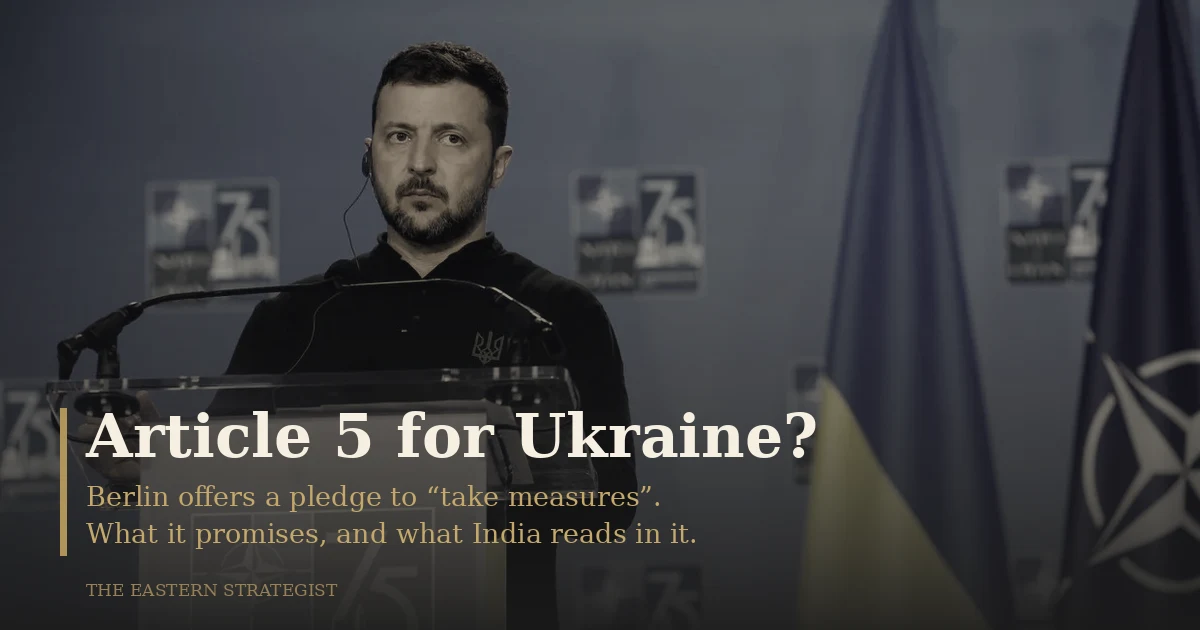
An Article 5 security guarantee for Ukraine came back onto the table in Berlin on 19 November 2026, after the idea was first raised in December 2025, and the written text never uses the words “Article 5”. The joint statement of the leaders of Germany, France, the United Kingdom and Ukraine lists “a legally binding commitment, subject to national procedures, to take measures to restore peace and security in the case of a future armed attack by Russia”. Washington’s envoy called the idea Article 5-like. Russia’s Deputy Foreign Minister rejected NATO “quasi-membership” for Kyiv as “an unacceptable option” the next day.
India’s position, restated by the Ministry of External Affairs (MEA) on 10 November, is that peace can only come through dialogue and diplomacy.
For Indian readers, the Berlin pledge is a familiar puzzle. India has never relied on another state’s promise to fight for it, and the reasons it chose that path explain why a paper guarantee for Kyiv may struggle to hold. A settlement, if one comes, would also reach India through two channels it watches every week: the price of Russian crude and the delivery calendar for Russian-built air defence.
What the Article 5 security guarantee for Ukraine actually promises
The 19 November joint statement says guarantees for Ukraine must be “robust and legally binding” once a ceasefire enters into force. Its components include a European-led Multinational Force Ukraine supported by the United States, a proposed US-led ceasefire monitoring and verification mechanism, and a legally binding commitment, subject to national procedures, to “take measures” after a future Russian attack. TES reading: the text commits no state to use force, because “measures” is undefined.
The meeting of the Coalition of the Willing was hosted by Chancellor Friedrich Merz at the Federal Chancellery and co-chaired by French President Emmanuel Macron and British Prime Minister Andy Burnham, according to the German government and NATO. More than 30 heads of state and government took part. NATO Secretary General Mark Rutte attended, and so did the US envoys Steve Witkoff and Jared Kushner.
The statement was issued by the leaders of Germany, France, the United Kingdom and Ukraine, with the United States taking part in the meeting. The idea of an Article 5-style guarantee is older than the meeting: Euronews reports that it was first raised in December 2025 and never fully developed. The statement also backs Ukraine’s right to choose its alliances (a TES paraphrase of its section on peace talks), the point on which Moscow’s demand differs.
Kushner supplied the headline. “I think we’ve gotten the Russians comfortable with that concept where any security guarantee for Ukraine would be based on Article 5,” he said, according to Al Jazeera. He added two conditions: the pledge “has to be in America’s interest” and must sit within “a broader security package”. He also acknowledged that doubts remained about Moscow’s intentions.
What Zelenskyy asked in Berlin
President Volodymyr Zelenskyy’s reply was a question. “I’m not sure we have a common acceptance of Article 5,” he told reporters after the meeting, as reported by Euronews. “What does it mean?” At a later press conference he asked about US forces: “What about American soldiers? Do you have an answer on it? Me not. For today. I don’t know the answer.”
For Kyiv, the test is physical. Zelenskyy has said that, for him, Article 5 means partner forces on Ukrainian soil, and he put the question of a future Russian attack as “not if, but when”. TES reading: the Berlin text answers part of that through the proposed European-led force and leaves the American part open.
Territory shadows the package. Latin Times reported on 12 November that Kushner tied any final guarantee to settling territory first, and Zelenskyy said on 13 November that Washington had asked whether Ukraine would leave parts of Donbas, a request he rejected. Europe backed its pledge with money: the statement cites a NATO commitment of €70 billion for 2026, at least as much in 2027, and an EU Ukraine Support Loan of €90 billion by the end of 2027, while the guarantees themselves start only once a ceasefire enters into force.
Why NATO’s Article 5 deters, and why a copy outside NATO may not
Article 5 of the 1949 North Atlantic Treaty does not oblige any ally to fight. It commits each to take “such action as it deems necessary, including the use of armed force”. TES assessment: its deterrent weight comes from what stands behind the words, namely an integrated command, allied forces already stationed on the eastern flank and the nuclear umbrella. A pledge without that structure carries the wording but not the weight.
The alliance has invoked Article 5 once, after the attacks of 11 September 2001. TES assessment: that record shows how much the clause depends on political will at the moment of crisis, and what makes it credible in peacetime is that an attacker would meet allied troops from the first day.
A guarantee for Ukraine would lack most of that, as TES reads it. Eric Ciaramella, whom Al Jazeera describes as a senior fellow at the Carnegie Endowment for International Peace, argued in a commentary published by the Royal United Services Institute (RUSI) on 10 November that the idea of an Article 5-style pledge for Ukraine “strains credulity”, and that “a pledge by Trump to do so would be especially implausible”. RUSI notes that the views are the author’s own.
What “subject to national procedures” means for an Article 5 security guarantee for Ukraine
The phrase hands the final decision back to each capital, which would decide under its own constitutional rules what “measures” to take. TES assessment: in the United States, a commitment meant to bind successive administrations would normally need a treaty ratified by the Senate, as the North Atlantic Treaty was in 1949, while an executive pledge could be reversed by a later president. The joint statement does not say what form the American part will take, and Kushner’s condition that the guarantee serve America’s interest points the same way.
Budapest 1994 promised assurances, not a guarantee
In the Budapest Memorandum of 5 December 1994, Russia, the United Kingdom and the United States gave Ukraine “security assurances” when it joined the nuclear Non-Proliferation Treaty as a non-nuclear state. The text commits the three to “seek immediate United Nations Security Council action” if Ukraine faced nuclear aggression. The English text never uses the word “guarantee”, and each of its three guarantor signatories holds a Council veto.
TES assessment: that record is the backdrop to Kyiv’s questions in Berlin, and any Article 5 security guarantee for Ukraine will be read against it. The memorandum’s other promises, respect for Ukraine’s borders and no threat or use of force, were framed as reaffirmations of existing commitments, with only a pledge to “consult” if questions arose. The table below sets the four texts side by side.
| Text | Who commits | What is promised | Enforcement |
|---|---|---|---|
| NATO Article 5 (1949) | All 32 allies | “Such action as it deems necessary, including the use of armed force” | Integrated command, forward-based forces, nuclear umbrella; ratified treaty |
| Budapest Memorandum (1994) | Russia, UK, US | Respect borders; “seek immediate United Nations Security Council action” in case of nuclear aggression | None beyond the Security Council, where Russia holds a veto |
| Berlin declaration (2026) | Statement by the leaders of Germany, France, the UK and Ukraine; the US is named for monitoring and support | Legally binding commitment “to take measures” after a future Russian attack | Proposed US-led ceasefire monitoring and verification; European-led Multinational Force Ukraine; applies once a ceasefire enters into force; “subject to national procedures” |
| India–USSR treaty, Article IX (1971) | India, Soviet Union | No help to a third party attacking the other; “mutual consultations” if either is attacked or threatened | Political will of a Security Council permanent member |
TES assessment: read across, every text short of NATO’s rests on what the guarantor chooses to do on the day. The 1971 row is the one India signed, and the reasons it mattered lie outside its wording, as the India section below argues.
Moscow rejected NATO-style status for Kyiv within a day
On 20 November, Russian Deputy Foreign Minister Sergei Ryabkov said any formula for “quasi-membership” of NATO for Kyiv, or a “creative solution”, was “an unacceptable option for us”. A heavy Russian air attack ran through the night of 19 and 20 November, and Poland’s defence minister said Russian weapons came down in south-eastern Poland. TES found no source tying the attack to the Berlin meeting.
Ryabkov, quoted by Interfax, said security guarantees could be discussed once the West acknowledged Moscow’s “nonnegotiable” demand that Ukraine not join NATO. Moscow’s sequencing is rigid: no Ukrainian NATO membership first, guarantees after. Kushner says Moscow accepts an Article 5 basis. Ryabkov rejects NATO-style status for Kyiv. The next round of talks will show whether the two statements conflict or cover different ground.
The air attack began at 18:00 on 19 November and ran through the night. Ukraine’s Air Force, in preliminary figures, said Russia launched 84 cruise missiles and 404 drones, and Zelenskyy put the number of ballistic missiles at 27. At least eight people were killed, six in Kyiv and two in Lviv, according to Ukrainian officials. Rolling outages hit the Lviv, Zakarpattia and Ivano-Frankivsk regions, and three bridges across the Dnipro in Kyiv were damaged.
Poland’s operational commander, Lieutenant General Ireneusz Nowak, called the strike a record. Poland’s defence minister called it “one of the largest since the beginning of the full-scale war”. The attack followed Ukrainian strikes on the Kerch Strait bridge on 16 and 17 November, after which President Vladimir Putin had promised a response.
In Poland, Defence Minister Władysław Kosiniak-Kamysz said a Kh-101 cruise missile had come down at Nowy Lipowiec, a second object he said could also be described as a missile at Rudnik nad Sanem, and a jet-powered drone at Mołodycz. No one was hurt.
The region hosts Koalicja-2026, the Multinational Force Ukraine exercise that the Berlin statement welcomed. “It does not look like an accident,” the minister said, as Warsaw asked NATO for more forces and equipment under its Eastern Sentry mission. Rutte called the incident “clearly dangerous” and “a consequence of Russia’s ongoing war against Ukraine”. In remarks on 19 November, before the latest crash, Trump said Putin had been “landing drones in Poland and a couple of little missiles, by mistake”.
The Shenzhen meeting on 19 November did not move the Ukraine file. The joint US-China-Russia statement did not mention the war, according to RFE/RL, and Trump then joined the Berlin talks by phone, Al Jazeera reported, which fits the low expectations TES set out in its analysis of the Trump Xi Putin summit for India. The last US-Russia-Ukraine round, in Abu Dhabi on 10 and 11 November, also ended without a breakthrough, a track TES followed from its first announcement in October.
Why India built its security without an Article 5 guarantee
India has no mutual-defence treaty with any state. Its closest equivalent, the 1971 treaty with the Soviet Union, offered consultations. TES reading: what made it count that December was a partner willing to use its Security Council veto, and an Indian military able to finish the war on its own. That pairing is the logic behind strategic autonomy as India practises it.
External Affairs Minister Swaran Singh and Soviet Foreign Minister Andrei Gromyko signed the Treaty of Peace, Friendship and Cooperation in New Delhi on 9 August 1971. Article IX bound each side not to assist any third party in conflict with the other, and to “immediately enter into mutual consultations” if either was attacked or threatened. It contained no automatic military obligation.
Four months later, that was enough. UN Security Council records show the Soviet Union vetoing three draft resolutions on the India–Pakistan situation, on 4, 5 and 13 December 1971. The last, a US draft calling for an immediate ceasefire and withdrawal of forces, was vetoed on 13 December, according to a contemporary report in The Daily Star. Indian forces fought the war to its end on 16 December. TES reading: the veto bought time, and Indian forces did the rest.
The 1971 treaty lapsed with the Soviet Union and was replaced by a treaty signed on 28 January 1993, according to the Indian analyst Nandan Unnikrishnan, quoted by TASS.
India now describes Russia as a special and privileged strategic partner and the United States as a comprehensive global strategic partner, and the Ministry of External Affairs says the Quad is not directed against any country. None of these is a mutual-defence alliance, and TES reads that as deliberate. The investment has gone into Indian capability, from layered air defence to the indigenous missile programmes TES tracked in its report on the Anant Shastra air defence tender. TES found no Indian government statement on the Berlin text at the time of writing.
TES assessment: that history gives India a particular reading of Berlin, which is that a guarantee is as strong as the forces and the political will behind it on the day. NATO’s own denial-defence concept, which TES examined in NATO’s new theory of victory, begins with forward land forces halting an attack at the point of contact. Kyiv’s demand for partner troops on its soil is, on this reading, a demand for the part of the 1971 formula that wording cannot supply.
What a Ukraine settlement would change for India’s oil and defence supplies
The reported data say Gulf supply and freight, not Ukraine diplomacy, explain most of the recent swing in Russian crude prices for India. TES assessment: a settlement that includes an Article 5 security guarantee for Ukraine would be a second-order driver of India’s crude bill, working through sanctions and payment frictions over time, and a slower one for defence deliveries. The direction of both effects is an inference, not a reported forecast.
Urals crude traded at a discount of about ₹2,900 ($31) a barrel to Brent at Russia’s Baltic ports in the first week of November, the widest since April 2023, according to Argus data cited by Kommersant and reported by the Moscow Times. Argus attributed the widening to weak demand and high shipping costs. Delivered to India, ThePrint reported Urals offers at about ₹280–375 ($3–4) below Dated Brent in November, citing an OilPrice.com analyst, against a premium of about ₹650 ($7) in early October. Rupee figures use ₹93.4 to the dollar, the 18 November close.
Preliminary mid-November Kpler figures put Russian crude arrivals in India at about 1.7 to 1.8 million barrels a day in November, down from about 2.07 million in October, according to ThePrint and the Moscow Times. ThePrint attributed the fall mainly to pricing, and the Moscow Times noted that Hormuz-route imports of 2.1 million barrels a day had overtaken Russian supply.
TES has tracked how Baltic tensions affect Indian crude imports through price before volume. TES assessment: because returning Gulf crude is a main driver of the November discount, a ceasefire could narrow the gap only partly, for example if freight and insurance costs eased.
On defence, the Indian outlet Organiser reported on 4 June 2026, citing unnamed defence sources, that a fourth S-400 squadron had reached India under the 2018 deal, with the fifth and final unit expected in the coming months. Reports in January, citing Russian officials, had put the fifth squadron in 2027.
TES found no Ministry of Defence statement and no later update. C4Defence attributed the delays to the Russia–Ukraine war and sanctions-related payment problems. TES assessment: a settlement would not change the contract but could ease the payment and logistics pressures behind the delay, and India’s answer to such delays has been to build more at home.
Three signals to track
- The next negotiating round. Merz has said further talks are expected soon with Europe at the table, with the United Arab Emirates as a possible venue, according to RFE/RL. Whether the US commitment is drafted as a treaty for the Senate or as an executive pledge will show how binding the American part is, in TES’s reading.
- Russian conduct during talks. Another attack on the scale of 19 and 20 November while negotiators meet would test Kushner’s claim that Moscow is comfortable with an Article 5 basis.
- The Urals discount through December. TES assessment: a narrowing discount at Indian ports would show Gulf supply and freight easing, or traders pricing in fewer sanctions frictions, and either would change what Indian refiners pay for Russian crude.
TES’s reading of December 1971 is that India’s guarantee was a capable partner at the Security Council and an army in the field, and that the second half mattered more. Ukraine is being offered the first half on paper while the second is still being negotiated. Whatever form the Article 5 security guarantee for Ukraine finally takes, New Delhi’s own conclusion from fifty-five years ago stands: a guarantee is only as strong as the forces behind it.
Source note: This article draws on the texts of the North Atlantic Treaty, the 1994 Budapest Memorandum, the 1971 India–USSR treaty and the 19 November 2026 Berlin joint statement; German government, NATO and MEA statements; Ukrainian and Polish official figures; UN Security Council records; Argus and Kpler data; and reporting by major news agencies. Assessments are The Eastern Strategist’s own.