
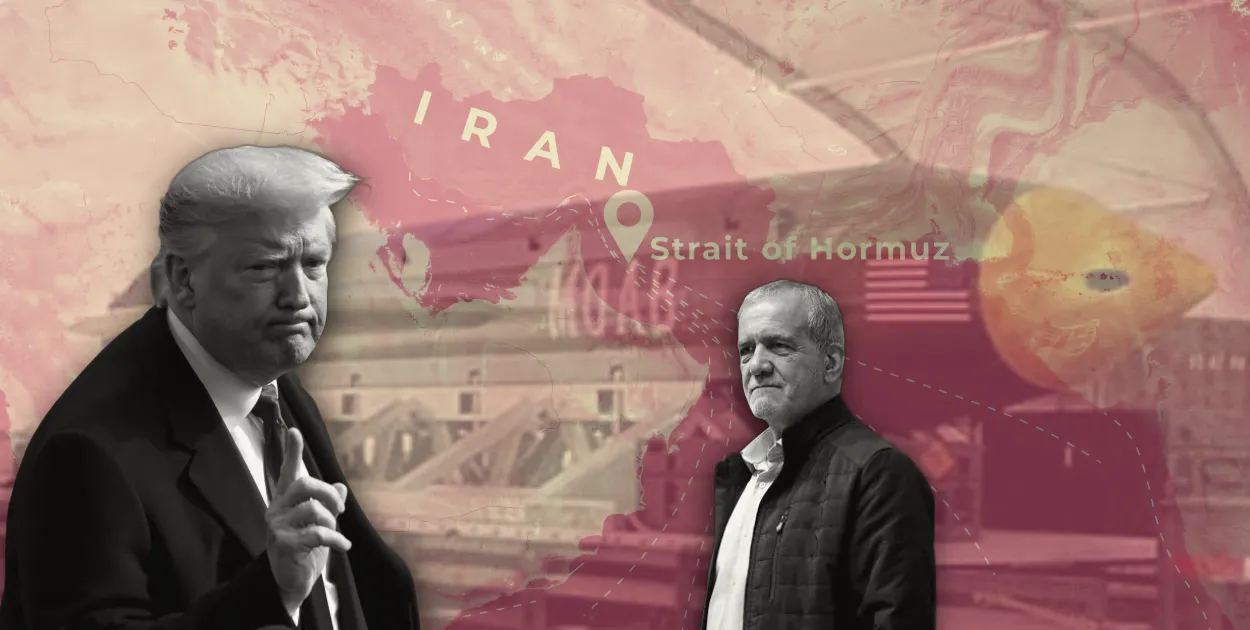
India took almost no Iranian crude this year: two cargoes in April, under a short-lived US waiver, according to Kpler. That does not shield it from what Washington is now weighing. On the morning of 15 October 2026 (IST), CNN reported, citing multiple US officials, that the US military has drawn up options to use the GBU-43/B Massive Ordnance Air Blast (MOAB) bomb, the so-called “mother of all bombs”, against Iranian energy infrastructure and nuclear sites if President Donald Trump orders combat to resume.
The Iran energy strike impact on India would travel through China. Iran’s oil goes overwhelmingly to Chinese refiners, and if a strike removed those barrels, those refiners would bid for substitutes in the Russian and Gulf supply that Indian refiners also depend on.
What CNN Reports About a MOAB Strike, and What It Leaves Open
The report describes plans, not a decision. According to CNN, one source said Trump has ordered additional strike packages that include “a lot of energy infrastructure” and the possible use of a MOAB, and that the plan’s wording places the attack “prior to US retrograde” from the Central Command area. CNN reads that as a strike, a declaration of victory and a quick pullout. A second source said plans for nuclear sites, including Pickaxe Mountain, also call for the MOAB.
The political frame matters as much as the weapon. CNN notes that Trump has said publicly he will take no new action before the 03 November 2026 midterms, though advisers privately do not know whether that is final. A White House official said the administration does not comment on plans “that may or may not exist”; the Pentagon said it plans for a wide range of scenarios.
Doubts run through the report. The MOAB is a 21,600-pound (about 9,800 kg) air-blast bomb, last used in Afghanistan in 2017. CNN’s sources say it likely lacks the capability to penetrate deep enough to destroy sites such as Pickaxe Mountain, and one called it a weapon of area clearance and psychological effect. For deeply buried targets the US used the 30,000-pound GBU-57 Massive Ordnance Penetrator in June 2025. CNN also reports that some options amount to a “fireworks show” meant to give Trump an off-ramp.
TES Analysis Energy infrastructure is a held-back card in this war, not a new one. On 13 March 2026 US forces hit military sites on Kharg Island while sparing its oil facilities. On 30 March 2026 Trump threatened to obliterate Iran’s power plants, oil wells and Kharg, which he said had been “purposefully not yet touched”, as S&P Global reported. Israel’s strikes on South Pars, TES’s report on the energy front, showed how quickly such targets draw retaliation.
This article treats a strike that damages Iranian export capacity as a scenario, not a forecast; a symbolic MOAB strike would move supply far less.
Why the Iran Energy Strike Impact on India Runs Through China
China, not India, is the customer that would lose supply. According to S&P Global Commodity Insights, China imported about 1.5 million barrels a day (mb/d) of Iranian crude in 2025, most of it to small independent refiners in Shandong, known as teapots. These plants run on discounted crude and hold little storage, so when one cheap source closes they move to the next within weeks.
That switch has begun. The US blockade reinstated in mid-July cut China’s Iranian intake to an estimated 534,000 barrels a day in August from about 823,000 in July, according to preliminary Kpler data. Kpler analyst Muyu Xu said teapots would need more Russian Urals or fuel oil because ESPO cargoes were sold out. The two figures come from different data providers and are indicative, not a like-for-like series.
Traders saw the pattern in March. A trade source in Dongying told S&P Global that buyers of Iranian crude would shift to Russian barrels and push their price up.
Beijing has condemned the US strikes and says it will safeguard its interests against US sanctions. It has not intervened militarily; reports of Chinese dual-use supplies to Iran persist, and Trump said on 13 October 2026 he does not believe China is helping Iran. TES examined the pattern in its earlier analysis of why China did not defend Iran. China’s stake is its refiners’ feedstock, and it will defend that in the market.
Iran energy strike impact on India: the two channels, competition for replacement crude and retaliation against Gulf supply. A scenario, not a forecast. Figures as attributed in the text.
India and China Are Already Bidding for the Same Russian Barrels
India remained the largest destination for Russian crude in September, but its intake fell to 1.82 mb/d from 2.6 mb/d in June, according to Kpler ship-tracking data. Kpler said the decline should not be read only as a response to US tariff threats: stronger Chinese buying had tightened supply. India is diversifying, it added, not abandoning Russian crude.
The contest is months old. In April, Kpler data showed India and China each securing about 1.6 mb/d of Russian crude. A strike that erased Iran’s remaining exports would add the teapots’ full demand to that queue.
Washington’s signals on Russian oil are mixed. On 15 October 2026, US Ambassador Sergio Gor told the Bloomberg New Economy Forum in Delhi that Trump would likely decide “over the next few days” on the Lindsey O. Graham Sanctioning Russia and Iran Act of 2026 (H.R. 5334), which allows tariffs of up to 100 per cent on top buyers of Russian energy.
He said the options are not aimed at any individual country and that India “does fall in one of those buckets, along with a lot of other countries.” The Ministry of External Affairs said in September that India had conveyed the law’s implications for its energy security at senior levels of the US administration.
Six days earlier, on 09 October 2026, the US Treasury moved to ease Russian diesel sanctions for six months, as Trump sought to bring down fuel prices before the midterms. TES covered the tariff law in its analysis of the 30-day clock. The law was signed on 18 September 2026.
TES Analysis Two US decisions on Iranian energy targets and Russian-oil tariffs may land within weeks of each other, and Washington is pulling in opposite directions on Russian oil. Neither is aimed at New Delhi. Either could raise its import costs.
A Strike Would Raise the Stakes for Gulf Energy Sites and a Contested Hormuz
Indian seafarers are already in the line of fire. On 06 October 2026, the Ministry of External Affairs (MEA) said 12 crew members, 11 of them Indian, were injured when the Panama-flagged tanker MT On Peace was hit by a projectile off Oman; 17 of its 19 crew were Indian. On 11 October 2026, the MEA confirmed that the Marshall Islands-flagged MT Valthera was struck by an unknown projectile, with all 11 Indian crew safe, and that two of the 11 Indian seafarers aboard the Nicaragua-flagged MT Petro Dolphin remained missing after a separate drone strike off Sohar, as reaffirmed by Shipping Minister Sarbananda Sonowal on 12 October 2026.
Iran’s Islamic Revolutionary Guard Corps (IRGC) said on 12 October 2026 that it had struck a third “violator” supertanker in two days. The UK Maritime Trade Operations (UKMTO) centre logged four separate attack alerts across the strait on 11 October 2026; no independent source has verified the IRGC’s third supertanker claim. Hormuz was already working at reduced capacity: according to Rystad Energy, 5 to 7 mb/d have moved through ship-to-ship transfers outside the strait since September 2026, accounting for 60 to 70 per cent of its flows.
Tehran has said how it would answer an attack on its energy sites. In March 2026 the Iranian army said it would target all US-linked energy infrastructure in the region, and in April 2026 a senior adviser to the supreme leader warned that strikes on power plants would draw attacks on energy infrastructure in US-allied Gulf states. Those states supply India. Some Gulf oil has begun moving by ship-to-ship transfer off Gujarat (see TES’s earlier report on the Gulf of Kutch transfers), with Vortexa tracking 680,000 barrels a day across 82 cargoes in September 2026—roughly 65 per cent refined products and 35 per cent crude—bound primarily for South Korea, India, China and Japan.
TES Analysis Iran already contests Hormuz while its own exports are squeezed by the US blockade. If a strike damaged what remains of its export capacity, its stated incentive to spare Gulf energy sites would weaken further.
The closest precedent is the attack on Saudi Arabia’s Abqaiq plant on 14 September 2019, which briefly cut about half of Saudi output and produced one of the largest single-day Brent gains on record. In 2019 the shock met open sea lanes. In 2026 those lanes are contested, and that is the second route by which the Iran energy strike impact on India would arrive.
How Much Cushion India Holds, and What Is Being Built
Minister of State for Petroleum and Natural Gas Suresh Gopi told the Rajya Sabha on 23 March 2026 that India’s strategic petroleum reserves held 3.372 million tonnes of crude, about 64 per cent of the 5.33 million tonne capacity built by Indian Strategic Petroleum Reserves Limited (ISPRL). Full caverns cover about 9.5 days of requirement; with oil marketing companies’ (OMCs) stocks, national cover is about 74 days, below the 90-day benchmark the International Energy Agency (IEA) sets for its members. TES has not found a newer official fill figure.
Phase II is the government’s response. The Union Cabinet approved an additional 6.5 million tonnes at Chandikhol in Odisha (4 million tonnes) and Padur in Karnataka (2.5 million tonnes), which it said would add about 12 days of supply, under a public-private partnership model, as set out in the Cabinet decision.
According to the government’s reply to Parliament’s Standing Committee on Petroleum and Natural Gas, the Padur-II concession agreement was signed on 01 October 2025 and financial closure is in progress, while 400 acres have been acquired at Chandikhol and its request for proposals is under review. The committee has flagged delays and budget cuts.
Diversification has done more of the work so far. On 11 March 2026, Petroleum Ministry Joint Secretary Sujata Sharma said about 70 per cent of crude imports came from outside Hormuz and that India sourced from 40 countries (subsequently updated to 41 countries in the 23 March 2026 Rajya Sabha reply). Iraqi cargoes returned to India in September 2026 above their pre-war pace, according to Kpler-based tracking. Indian refiners have tendered for tankers to fetch Gulf crude themselves, and Abu Dhabi National Oil Company’s (ADNOC) Murban grade loads at Fujairah after a pipeline run that bypasses the strait.
| Indicator | Latest figure | Source |
|---|---|---|
| Strategic reserve fill | 3.372 million tonnes of 5.33 million (about 64%) | Government reply, Rajya Sabha, 23 March 2026 |
| Cover at full strategic capacity | About 9.5 days | Government reply, Rajya Sabha |
| Total national oil cover | About 74 days, including oil company stocks | Petroleum Ministry data |
| Phase II expansion | 6.5 million tonnes approved; about 12 more days of supply | Union Cabinet decision |
| Crude imports from outside Hormuz | About 70% (March 2026) | Petroleum Ministry briefing, 11 March 2026 |
| Iranian crude into India | Two cargoes in April under a US waiver | Kpler |
| Russian crude intake | 1.82 mb/d in September 2026, down from 2.6 mb/d in June 2026 | Kpler ship-tracking |
| Delhi pump prices | Petrol Rs 102.12/litre, diesel Rs 95.20/litre (14 October 2026; frozen since 25 May 2026) | PPAC |
Who Absorbs Costlier Crude While Delhi Pump Prices Stay Unchanged?
Brent futures fell about 1.5 per cent to roughly $104.40 a barrel on 15 October 2026, as traders weighed US moves to ease shipping restrictions against supply risk in the Middle East. At home, the Petroleum Planning and Analysis Cell (PPAC) lists Delhi petrol at Rs 102.12 a litre and diesel at Rs 95.20 on 14 October 2026. Those prices have remained frozen since 25 May 2026, following four hikes in ten days that lifted rates from Rs 97.77 and Rs 90.67 on 15 May 2026.
TES Analysis For investors, the first test of a further crude rise would fall on refining and marketing margins. With pump prices unchanged, a higher import bill is carried by state-run marketers Indian Oil Corporation, Bharat Petroleum and Hindustan Petroleum, or by the exchequer through duties, unless retail prices move. Reliance Industries, which TES reported in September as India’s biggest single buyer of Russian crude, faces a different exposure: the price of replacement barrels if Chinese buying keeps tightening that market.
What Should New Delhi Watch Before 03 November 2026?
Will the US strike Iran’s energy infrastructure before the US midterm elections?
No decision has been announced. CNN reported that plans cover strikes either before or after the 03 November 2026 midterms, but also that Trump has publicly said he will take no new action before them, and that advisers privately do not know whether that is final. The White House declined to discuss the plans.
When will Trump decide on Russian-oil tariffs that could hit India?
Ambassador Sergio Gor said on 15 October 2026 that a decision under the Lindsey O. Graham Sanctioning Russia and Iran Act of 2026 was likely within days. The rate, the countries named and any waivers have not been announced. The law allows tariffs of up to 100 per cent on top buyers of Russian energy, and the US separately eased Russian diesel sanctions for six months on 09 October 2026.
How will China respond to an Iran energy strike?
Beijing has condemned US strikes on Iran and pledged to protect its interests against US sanctions, without military intervention. For India, the signal to watch is in the market: Chinese independent refiners’ purchases of Russian Urals and fuel oil, which set the price of the barrels India competes for.
For the full sequence of the conflict and its shipping fallout, see the TES Iran war and Hormuz crisis hub.
Source note: This analysis draws on CNN’s reporting of US strike plans, statements from India’s Ministry of External Affairs, Ministry of Petroleum and Natural Gas and Ministry of Ports, Shipping and Waterways, PPAC price data, government replies to Parliament, and Kpler, Rystad Energy and S&P Global data as reported. Passages marked TES Analysis are the publication’s own assessment.

1 thought on “How a US MOAB Strike on Iran’s Energy Sites Would Hit India Through China”