
Wellington does not need a seat at the AUKUS table to become load-bearing for it. Selective integration through Pillar II, Five Eyes and Australia could deliver the capability — and quietly reopen a question New Zealand has not faced since 1986: whether a nuclear-free state can be nuclear-protected.
Key Takeaways
- New Zealand’s route into the AUKUS architecture does not run through Pillar I. Pillar II — autonomy, quantum, cyber, electronic warfare and undersea systems — carries no nuclear-propulsion requirement, which is where Wellington’s constraints actually bite.
- Australia is the practical bridge. Five Eyes membership, the Five Power Defence Arrangements and an explicit New Zealand defence-strategy commitment to deepen the alliance with Canberra give Wellington standing that a formal AUKUS application would not.
- Undersea warfare is the test case: maritime surveillance, autonomous underwater systems, anti-submarine warfare and oceanographic data are contributions New Zealand can make without a nuclear-powered submarine.
- Deeper technological integration raises a question Wellington has deferred since 1986 — whether it can accept protection underwritten by US nuclear forces while retaining a nuclear-free policy.
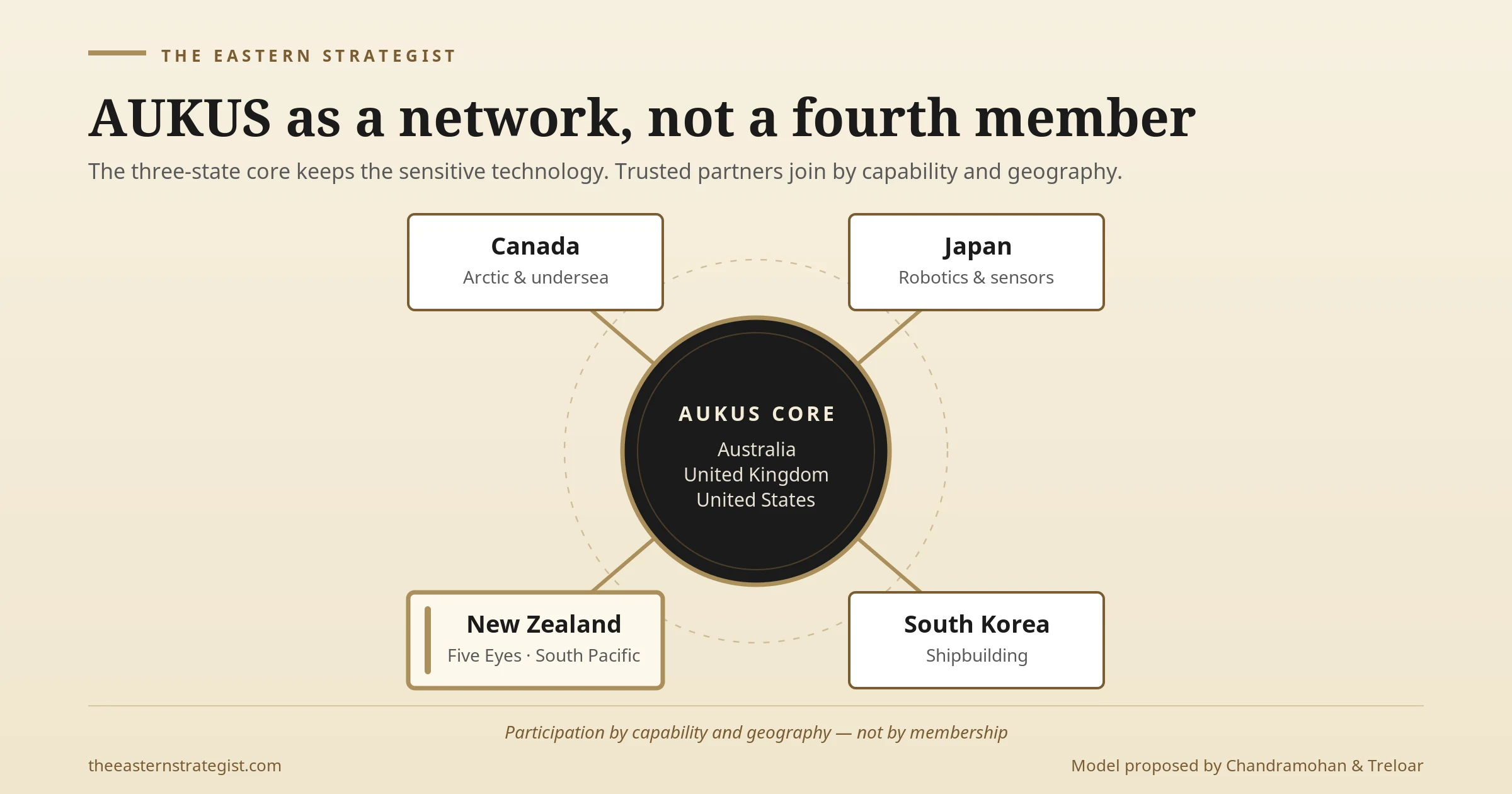
- The template is a hub-and-network AUKUS, not an “AUKUS Four”: a three-state core with trusted partners joining by capability and geography rather than by membership.
AUKUS is entering a second phase, and the submarines are no longer the interesting part. What began in 2021 as an arrangement most closely associated with Australia’s acquisition of conventionally armed, nuclear-powered submarines is becoming something broader: AUKUS Pillar II, a framework for integrating advanced defence technologies, industrial capacity, intelligence and military operations among close allies.
For New Zealand, that shift creates both a challenge and an opportunity. Wellington does not need to participate in AUKUS Pillar I to become more deeply connected to the architecture developing around AUKUS. It could pursue selective participation through Pillar II, Australia–New Zealand defence integration, Five Eyes intelligence cooperation and specific technological projects.
Yet the technological question points toward a more consequential strategic one. As New Zealand becomes more integrated with Australian and American defence systems, should it also reconsider its position outside the US security guarantee — and, ultimately, US extended nuclear deterrence?
AUKUS Pillar II is a different question from submarines
Pillar I is about nuclear-propelled submarines and is closed to New Zealand on policy grounds. Pillar II covers artificial intelligence and autonomy, quantum, cyber, electronic warfare and undersea capabilities — areas where Wellington’s nuclear-free stance is not an obstacle to contribution.
The distinction between AUKUS’s two pillars is critical. Pillar I concerns Australia’s acquisition of conventionally armed, nuclear-powered submarines. New Zealand’s longstanding nuclear-free policy makes participation politically problematic.
AUKUS Pillar II is different. It concentrates on advanced capabilities including artificial intelligence and autonomy, quantum technologies, cyber, electronic warfare and undersea capabilities.
Wellington has already been considering possible AUKUS Pillar II participation. New Zealand’s Ministry of Defence published further advice to ministers on potential participation in September 2025, demonstrating that the issue remains under active consideration. The Ministry’s own published update frames Pillar II as the mechanism through which additional partners can engage, while Pillar I remains a trilateral submarine programme. See the New Zealand Ministry of Defence update on AUKUS Pillar II and next steps.
The better question is therefore not whether New Zealand should simply “join AUKUS,” but where New Zealand can add capability to the AUKUS ecosystem. That framing allows Wellington to separate nuclear propulsion from cooperation on technologies increasingly central to Indo-Pacific military operations — a separation analysts at the Lowy Institute have argued Pillar II needs to make sharper if it is to deliver anything tangible.
Australia is the bridge, not a fourth pillar
The most workable pathway runs through Canberra rather than through a formal application to Washington and London. Joint capability projects, compatible interoperability standards and personnel exchanges could integrate New Zealand practically before any institutional question is settled.
Australia and New Zealand are Five Eyes partners, longstanding military partners and members of the Five Power Defence Arrangements. New Zealand’s current defence strategy explicitly calls for enhancing the ANZUS alliance with Australia as well as strengthening its most important security partnerships.
Rather than constructing an “AUKUS Four,” Australia could become an interface connecting New Zealand to selected Pillar II activities. Joint Australian–New Zealand capability projects could be designed around compatible security and interoperability standards. New Zealand personnel could participate in appropriate experimentation and exercises, while defence industries could collaborate on technologies intended to operate within wider allied architectures.
The principle is practical integration before institutional integration.
That sequencing matters because the alternative — a formal membership negotiation — would force Wellington to settle its hardest political questions first. Working through Canberra allows capability cooperation to accumulate while the declaratory questions wait.
Undersea warfare is the test case
New Zealand does not need a nuclear-powered submarine to contribute to the undersea layer. Maritime surveillance, autonomous underwater systems, anti-submarine warfare, oceanographic information and secure communications are all contributions Wellington can make, and its geography between Australia, Antarctica and the South Pacific makes them valuable.
The maritime domain provides an obvious starting point. AUKUS Pillar II increasingly encompasses autonomous systems, artificial intelligence and undersea warfare. New Zealand’s contribution could lie in maritime surveillance, autonomous underwater systems, anti-submarine warfare, oceanographic information, secure communications and maritime domain awareness.
Geography reinforces the argument. New Zealand occupies an important position between Australia, Antarctica and the South Pacific. Its own defence strategy emphasises an immediate region stretching from Antarctica into the Pacific. An Australian–New Zealand network of crewed and autonomous sensors could contribute to a wider allied maritime picture, connecting New Zealand to the undersea architecture surrounding AUKUS without requiring participation in Pillar I.
The demand signal is already visible. Australia, Britain and the United States announced their first Pillar II signature project in 2026, focused on shared payloads and enabling systems for uncrewed underwater vehicles, with a 2027 delivery target — the detail ASPI’s analysts set out when the project was announced at the Shangri-La Dialogue. The project is not about building new uncrewed craft; each partner is already doing that. It is about making them able to navigate, detect and attack together.
That is precisely the layer where a smaller partner can add value without a shipyard. TES has separately examined how a Chinese undersea sensor recovered in the Lombok Strait turned a 250-metre-deep channel into a live test of who can see beneath the surface in the Indo-Pacific, and how India’s Project-77 submarines, AUKUS and the Quad function as complementary rather than competing pillars of undersea deterrence.
Five Eyes provides the second bridge
New Zealand already belongs to an intelligence relationship connecting all three AUKUS countries. As the boundary between intelligence cooperation and advanced military technology blurs, that membership becomes an information backbone for graduated participation.
Autonomous platforms require data. Anti-submarine warfare depends upon acoustic and other intelligence. Cyber operations rely on threat intelligence. AI-enabled military systems require secure information environments. In each case, the entry requirement is not a submarine but access to, and trust within, an information architecture New Zealand already inhabits.
That does not mean every AUKUS technology should become available to New Zealand. Sensitive capabilities will remain compartmented. Instead, participation could be graduated according to technological sensitivity, operational requirements, security standards and the contribution each partner can make.
Graduation is the design principle worth defending. It lets the core protect its most sensitive work while drawing a wider set of partners into the layers where their contribution is genuinely additive.
The bigger question: extended deterrence
Deeper integration eventually forces a question Wellington has deferred since the 1980s. For much of the Cold War New Zealand sat inside the ANZUS relationship; after it excluded nuclear-armed and nuclear-powered vessels, Washington suspended its ANZUS security obligations in 1986. Rebuilding defence cooperation since then has not restored that guarantee.
In 1986, Washington suspended its ANZUS security obligations toward New Zealand. The treaty itself was not formally abolished, but the US–New Zealand security relationship ceased to operate as originally envisaged.
Relations have since recovered substantially. The 2010 Wellington Declaration rebuilt practical cooperation, while the 2012 Washington Declaration established a framework for closer defence cooperation and dialogue. But rebuilding defence cooperation is not the same as restoring the old US security guarantee.
AUKUS therefore creates a longer-term question: if New Zealand becomes increasingly integrated with Australian and American intelligence, undersea surveillance, cyber systems, autonomous platforms and operational planning, should its ultimate deterrence relationship remain fundamentally different from Australia’s?
One possibility would be renewed US–New Zealand security guarantees accompanied by some form of strategic consultation over extended nuclear deterrence. Reliance on US extended nuclear deterrence would not necessarily require New Zealand to acquire nuclear weapons or host them on its territory. The more difficult issue would be political: whether accepting protection ultimately backed by US nuclear forces could be reconciled with New Zealand’s nuclear-free identity and longstanding advocacy of nuclear disarmament.
That would be a profound policy change. New Zealand has continued to criticise extended nuclear deterrence in international nuclear diplomacy, meaning such a shift should not be portrayed as either imminent or inevitable. But it is increasingly a question worth debating.
The American side of that debate is itself unsettled. As TES set out in its assessment of the restored Pacific Command and the 2026 US National Defense Strategy, partners relying on US extended deterrence now need conventional integration accompanied by credible consultation about escalation and nuclear coercion — a commitment Washington has not made explicit.
Nuclear-free but nuclear-protected?
Being nuclear-free and being protected by a nuclear-armed ally are not the same policy. New Zealand could retain prohibitions on nuclear weapons in its territory while building a substantially deeper security relationship with Washington — beginning with conventional commitments and consultation mechanisms, and leaving extended deterrence to a separate debate.
A renewed security guarantee could initially focus on conventional defence commitments, consultation mechanisms and interoperability. Extended deterrence could then be debated separately rather than treated as an automatic consequence of AUKUS participation.
This approach would also recognise how much the strategic environment has changed since the dispute of the 1980s. New Zealand’s nuclear-free policy developed in a very different Indo-Pacific — before China’s emergence as a major military and nuclear power and before today’s increasingly contested South Pacific.
The relevant question is therefore not simply whether New Zealand should abandon its nuclear-free tradition. It is whether that tradition can coexist with deeper participation in an allied deterrence architecture.
A network rather than an “AUKUS Four”
Australia, Britain and the United States should remain the AUKUS core. Around them, trusted partners could participate according to capability and geography rather than becoming full members — Japan in robotics and sensors, Canada in Arctic and undersea capability, South Korea in shipbuilding, New Zealand in intelligence integration and South Pacific maritime surveillance.
This hub-and-network architecture would allow AUKUS to protect its most sensitive technologies while drawing upon a wider allied industrial, intelligence and technological base. New Zealand’s comparative advantages are specific: Five Eyes intelligence integration, maritime surveillance, South Pacific geography and exceptionally close interoperability with Australia.
The same logic is visible elsewhere in the region’s architecture. TES has argued that the Quad should move from dialogue to a functional maritime security compact built on seabed surveillance and chokepoint contingency planning, precisely because project-based participation travels further than institutional expansion. The 2026 Pacific Islands Forum told a comparable story in the South Pacific, where influence is being contested through arrangements rather than alliances.
Building the network around AUKUS
The long-term significance of AUKUS may extend well beyond Australia’s submarines. Its greater strategic value could lie in creating connective tissue between allied defence industries, intelligence systems, technologies and military forces.
A future Indo-Pacific crisis will not respect the institutional boundaries separating AUKUS, Five Eyes, ANZUS and other regional partnerships. What will matter is whether allied sensors exchange information, autonomous platforms operate together, supply chains sustain common systems and political leaders understand how they will respond collectively to coercion.
Bringing New Zealand closer through AUKUS Pillar II would be a logical first step. But it may not be the last.
Over time, technological integration could force Wellington, Canberra and Washington to confront the strategic question left unresolved since the 1980s: can New Zealand remain nuclear-free while once again becoming nuclear-protected?
The answer need not involve New Zealand joining Pillar I, hosting nuclear weapons or abandoning its independent foreign policy. It could instead involve rebuilding a security guarantee appropriate to the twenty-first century and determining, through New Zealand’s own political debate, what role extended deterrence should play within it. AUKUS could therefore become more than a mechanism for bringing New Zealand into advanced defence technology. It could become the catalyst for reconsidering New Zealand’s place within the wider Indo-Pacific deterrence architecture.
What a networked AUKUS changes for New Delhi
New Zealand is not a marginal actor in India’s Indo-Pacific accounting. New Delhi and Wellington signed a Memorandum of Understanding on Defence Cooperation in March 2025, alongside a decision to develop a roadmap for bilateral defence industry collaboration, and New Zealand joined the Indo-Pacific Oceans Initiative. By July 2026 the relationship had been elevated to a Strategic Partnership with a Roadmap to 2030, a Maritime Cooperation Arrangement between the two defence forces, and a stated goal of doubling two-way trade by 2030. A second India–New Zealand Defence Strategic Dialogue met in Wellington in August 2026, covering maritime security, joint training and personnel exchanges.
Those channels matter more, not less, if Wellington moves closer to the AUKUS technology network. A New Zealand inside a Pillar II information architecture — Five Eyes collection, undersea surveillance data, common interoperability standards — becomes a different kind of partner from a New Zealand outside it. For New Delhi, the practical question is whether the bilateral defence-industrial roadmap agreed in 2025 can be sequenced alongside Wellington’s allied integration, or whether the standards New Zealand adopts will be set in Canberra, Washington and London before Indian industry has a chance to meet them.
The industrial read
The Pillar II signature project on uncrewed underwater vehicle payloads, with its 2027 delivery target, is a demand signal for a specific industrial layer: undersea autonomy, acoustic sensing, secure communications and maritime domain awareness. That is the layer where Indian industry has been building capability, and where the exposure sits across the listed defence universe — Bharat Electronics in sensors and electronics, Bharat Dynamics in underwater weapons, Mazagon Dock Shipbuilders in submarine construction, Data Patterns in defence electronics, and private primes including Larsen & Toubro and Tata Advanced Systems across submersibles and platform integration. Solar Industries sits in the adjacent energetics and propellant chain.
Two caveats deserve stating plainly. First, AUKUS partners have built a defence-trade exemption architecture that still leaves roughly a fifth of intra-AUKUS trade outside licensing relief as of September 2026, concentrated in precisely the sensitive categories — undersea acoustics and missile technology among them — where third-country participation is hardest to secure. An Indian supplier seeking into that chain faces the same export-control wall as an AUKUS-adjacent one, and New Zealand’s presence inside the network does not lower it. Second, Indian participation in AUKUS structures is not on the table and is unlikely to be: New Delhi’s approach to the grouping has been to treat its own Project-77 nuclear-attack submarine programme as sovereign and complementary rather than as a reason to seek membership.
The more realistic commercial channel runs through the bilateral route — the India–New Zealand defence industry roadmap, the Maritime Cooperation Arrangement, and the Combined Maritime Forces framework in which both navies already operate. Those are agreements New Delhi controls, and they do not require Washington’s licensing permission to deepen.
Investment disclaimer: This section is strategic and industrial analysis, not investment advice. Company names are cited to identify sectoral exposure to undersea warfare and maritime domain awareness capabilities; no order book, contract, mandate or valuation is asserted. Readers should consult a SEBI-registered investment adviser before acting on any view expressed here. The Eastern Strategist and the authors hold no position in the companies named.
What to watch
- Whether New Zealand’s Ministry of Defence converts its September 2025 advice to ministers into a formal Pillar II decision, and on what technology-specific terms.
- Whether the first AUKUS Pillar II signature project on uncrewed underwater vehicle payloads meets its 2027 delivery target — the clearest available test of whether Pillar II produces capability or only coordination.
- Whether Australian–New Zealand joint capability projects are written to AUKUS interoperability standards from the outset, which would integrate Wellington practically without any membership decision.
- Whether New Zealand’s 2026–27 defence policy reviews reopen the extended nuclear deterrence question, and whether any New Zealand minister uses the word “guarantee” in Washington.
- Whether the India–New Zealand defence industry roadmap agreed in 2025 produces named projects before allied standards harden around Wellington.
Frequently asked questions
- Is New Zealand joining AUKUS?
- New Zealand is not joining AUKUS as a member and has not applied to. Its Ministry of Defence published further advice to ministers in September 2025 on possible participation in Pillar II, the advanced-capabilities arm covering AI and autonomy, quantum, cyber, electronic warfare and undersea systems. Pillar I, the nuclear-powered submarine programme for Australia, remains closed to Wellington on policy grounds.
- Can New Zealand join AUKUS Pillar II without joining Pillar I?
- Yes, in principle. The two pillars are structurally separate: Pillar I is a trilateral submarine programme among Australia, the United Kingdom and the United States, while Pillar II was designed as the vehicle through which additional partners can engage on specific technologies. Participation in Pillar II carries no requirement to accept nuclear propulsion.
- Why did the US suspend its ANZUS obligations to New Zealand?
- Washington suspended its ANZUS security obligations toward New Zealand in 1986, after Wellington excluded nuclear-armed and nuclear-powered vessels from New Zealand territory and waters. The treaty was not formally abolished, but the security relationship ceased to operate as originally envisaged. The 2010 Wellington Declaration and the 2012 Washington Declaration rebuilt practical defence cooperation without restoring the original guarantee.
- What does AUKUS Pillar II actually cover?
- Pillar II, known as Advanced Capabilities, covers artificial intelligence and autonomy, quantum technologies, cyber, electronic warfare, hypersonics and counter-hypersonics, and undersea warfare. Its first signature project, announced in 2026, focuses on shared payloads and enabling systems for uncrewed underwater vehicles with a 2027 delivery target.
- What is the difference between being nuclear-free and being nuclear-protected?
- A nuclear-free policy prohibits nuclear weapons from a state’s territory and, in New Zealand’s case, bars nuclear-armed and nuclear-powered vessels from its waters. Being nuclear-protected means relying on a nuclear-armed ally’s deterrent for ultimate security. The two are separable: a state can retain territorial prohibitions while accepting protection underwritten by another state’s nuclear forces, though the political tension between the two is what makes the question difficult for Wellington.
Source note: Analysis draws on New Zealand Ministry of Defence publications, including its AUKUS Pillar II update and next-steps paper; Australian Strategic Policy Institute and Lowy Institute commentary on Pillar II; and The Eastern Strategist’s own reporting on undersea deterrence, the Quad and US Indo-Pacific strategy. Indian bilateral details draw on the March 2025 India–New Zealand joint statement, the July 2026 Strategic Partnership Roadmap 2030, and reporting of the second India–New Zealand Defence Strategic Dialogue in August 2026.