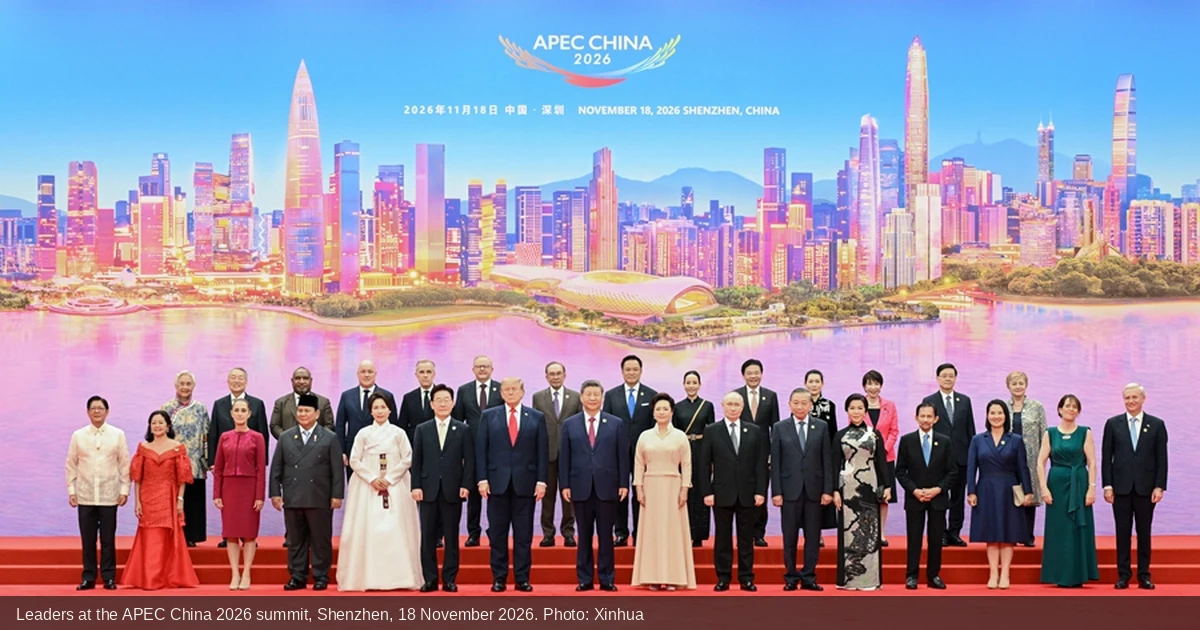
Xi Jinping walked to the foot of Air Force One in Shenzhen to receive Donald Trump. A day earlier, Prime Minister Narendra Modi had sat with Trump at the Quad table in Manila. New Delhi now has to read Thursday’s three-way talks from outside the room, with the Manila outcomes already in hand.
The Trump Xi Putin summit opens in Shenzhen on Thursday, 19 November 2026, with no Indian seat and low official expectations. A senior Trump administration official said Washington does not “expect to get any kind of agreement” on nuclear arms. For India, the useful facts sit elsewhere: the US–China tariff truce runs to 10 January 2027, a $14 billion US arms package for Taiwan has been on hold since May, and the Quad leaders committed in Manila on 17 November to a business forum in Mumbai and joint patrol-aircraft activity in 2027.
Those dates give South Block a working calendar. The choreography at Shenzhen Bao’an International Airport on Wednesday drew the cameras, but the readouts that follow Thursday’s sessions will matter more to Indian planners than any embrace on a tarmac.
What is confirmed before the Trump Xi Putin summit, and why India is watching from outside
The White House has confirmed a Trump–Xi bilateral and the first sitting US–China–Russia leaders’ meeting on the sidelines of the Asia-Pacific Economic Cooperation (APEC) summit, which runs on 18 and 19 November. Washington has framed nuclear arms reduction as the opening subject. India is not a participant, and its interests run through trade, energy, technology controls and the Indo-Pacific balance.
According to a Wall Street Journal report of 18 October, President Vladimir Putin first proposed the three-way format in a telephone call with Trump on 9 October. The Journal also reported a disagreement over format: Beijing wanted prepared statements and set outcomes, while the US side preferred an open discussion. Kremlin aide Yuri Ushakov said on 16 November that if no joint communique emerges, each president would give his own assessment of the talks.
TES found no official Indian statement on the Shenzhen talks at the time of writing. The agenda is crowded and the three capitals do not agree on it.
- Nuclear arms. New START, the last US–Russia strategic arms treaty, lapsed in February 2026. China’s Foreign Ministry said in October that asking China to join trilateral disarmament talks now would be neither fair, reasonable nor realistic. After the Trump–Xi White House summit on 24 September, the White House said Trump had pressed for trilateral arms-control talks; the Chinese Foreign Ministry’s release, according to the Arms Control Association, did not mention arms control at all.
- Ukraine. Trump told reporters he would discuss “denuclearization” and “my favorite subject, Ukraine”, while US officials separately indicated Ukraine would not be raised. German President Frank-Walter Steinmeier told the broadcaster ARD that Xi reacted with irritation when Ukraine was floated for the trilateral and called it a European war. The talks follow Ukrainian strikes on 16 and 17 November that destroyed a road span of the Kerch Strait bridge to Crimea.
- Sanctions and trade. At the APEC business sessions on Wednesday, Putin called Western powers “former hegemons” and said sanctions had backfired. Xi said China would “firmly uphold the rules-based multilateral trading system” and argued that Russia and China should lead the push towards a multipolar world.
- Washington’s home front. Democrats won a House majority in the 3 November midterm elections, and Al Jazeera reported on 18 November that Mary Peltola had won the Alaska Senate race. The new Congress sits in January.
- Chips. On 16 November the US Commerce Department released an interim rule requiring data-centre operators in Singapore, Malaysia, Thailand and Indonesia to obtain a US licence before buying advanced AI chips. Days earlier, on 12 November, Nvidia announced that Jensen Huang had resigned as chief executive after an inquiry into his ties with a woman US authorities suspect of spying for China. Beijing has denied spying on Huang.
What the Shenzhen airport welcomes do and do not show about China’s priorities
Xi greeted Trump personally at the aircraft steps on 18 November, a departure from long-standing Chinese practice and a reciprocal gesture after Trump met Xi at Joint Base Andrews in September. Putin, who landed on 17 November, was received by Cai Qi of the Communist Party’s Politburo Standing Committee. Each welcome sent a message, and neither settles what Beijing will concede.
Reading the two welcomes as a ranking is tempting and probably wrong. Cai Qi is a member of the Communist Party’s Politburo Standing Committee, China’s top decision-making body, and a South China Morning Post headline called Putin’s reception the highest-level airport welcome in Shenzhen; in May, Foreign Minister Wang Yi met him in Beijing. A ranking, if there is one, is Beijing’s to explain. Xi then held more than two hours of talks with Putin on Wednesday and, according to reports, called him an old friend.
Indian diplomacy has seen this kind of theatre before. On 21 February 1972, Zhou Enlai’s handshake with Richard Nixon at Beijing airport made the front pages, yet the substance came a week later in the Shanghai Communique, barely two months after Washington had sent the USS Enterprise into the Bay of Bengal during the 1971 war. Shenzhen’s photographs will travel fast. The texts will tell India more.
There is also a doctrinal point. Xi’s call at APEC for Russia and China to lead a multipolar order, and Russian lawmaker Pyotr Tolstoy’s remark that the meeting could become a “new Yalta”, both describe a world run by a few capitals. New Delhi’s stated preference, set out repeatedly by External Affairs Minister S. Jaishankar, is a multipolar world that includes a multipolar Asia. That rules out any spheres-of-influence settlement drawn without India, whoever proposes it.
Four files where the Trump Xi Putin summit touches India
Shenzhen is unlikely to produce a grand bargain. What it can change is the pace of US–China trade de-escalation, the handling of the Iran war and the Strait of Hormuz, chip-control enforcement in South-East Asia and the tempo of sanctions on Russian energy. Each of these reaches Indian refiners, manufacturers and the defence supply chain.
| File | Confirmed baseline (18 November 2026) | TES assessment for India |
|---|---|---|
| Nuclear arms | New START lapsed in February; China rejects trilateral caps for now; its 24 September release did not mention arms control. | Expect talk of dialogue channels, not warhead limits. China’s arsenal growth stays outside any treaty, a factor in India’s own deterrence planning. |
| Trade, chips and Taiwan | Tariff truce runs to 10 January 2027; $14 billion Taiwan package on hold since May; new US licence rule for AI chips in four South-East Asian states. | A rollover of the truce looks likelier than structural change. China’s export controls on rare earths and magnets, which Indian manufacturers have felt since 2025, would remain in place either way. |
| Iran war and Hormuz | Washington and Beijing both carry economic costs from the Iran war that began on 28 February and from disruption in the Strait of Hormuz. | A shared US–China interest in open shipping lanes could support de-escalation in West Asia, which would ease India’s crude freight and insurance costs. |
| Ukraine and Russia | Putin rejects Western sanctions; US officials do not expect Ukraine to be central in Shenzhen. | No quick settlement is in sight, so sanctions-related payment and shipping frictions on Russian oil and defence spares are likely to persist into early 2027. |
India’s own positions on these files are already on record. On Ukraine, New Delhi has backed dialogue and diplomacy and, as TES reported in October, India’s ceasefire proposal went further than several other plans. On the Quad, the Ministry of External Affairs has said the grouping is not directed against any country. None of this requires India to be at the Shenzhen table, which fits the strategic autonomy New Delhi has practised since the Cold War.
How India can use the Manila Quad outcomes in the next 90 days
The options below are The Eastern Strategist’s assessment, not government policy. The Manila joint statement gives India four tools that do not depend on what Washington agrees in Shenzhen: the inaugural Quad Business Leaders’ Forum in Mumbai in early 2027, the Indo-Pacific Maritime Surveillance Collaboration, the Quad AI Accelerator and the undersea cable partnership.
The Manila statement expressed “grave concerns about economic coercion, including through arbitrary export restrictions” without naming any country. It was the seventh Quad leaders’ summit a meeting TES previewed in its 15 November curtain-raiser on India’s two tests in 48 hours. On the sidelines, Modi met Philippine President Ferdinand Marcos Jr., Thai Prime Minister Anutin Charnvirakul and Singapore Prime Minister Lawrence Wong.
1. Give the Mumbai business forum a supply-chain agenda
A US–China tariff pause would not remove China’s export licensing on rare-earth oxides, permanent magnets and specialised equipment. The Ministry of Commerce and Industry, as host, could weight the Mumbai forum’s agenda towards joint ventures with Japanese and Australian firms on rare-earth processing and critical minerals, an area where the four leaders committed in Manila to reduce dependence on single suppliers.
2. Turn the 2027 patrol-aircraft activity into lasting maritime domain awareness
Manila set an operational date: a 2027 exercise bringing together P-8 and P-3C maritime patrol aircraft, which the leaders described as the first of its kind in a Quad context and which is detailed in TES’s report on the Quad Summit Manila patrol calendar. The Indian Navy already flies the P-8I and runs the Information Fusion Centre for the Indian Ocean Region in Gurugram. The planning window between December and March is the time to fix information-sharing arrangements, so that the collaboration delivers maritime domain awareness and disaster response for the wider region, consistent with India’s view of the Quad as a grouping that is not aimed at any country.
3. Keep India’s AI and semiconductor build-out clear of new US controls
Washington is pairing tighter licensing in South-East Asia with its Pax Silica framework for trusted AI supply chains, which the US and nine partners, including Singapore, agreed last weekend. The Ministry of Electronics and Information Technology (MeitY) can use the Quad AI Accelerator and Modi’s Manila meetings with Singapore and Thailand to seek clarity on compliance standards early, so that Indian data centres and defence electronics firms do not run into licensing delays.
4. Prepare crude and defence-supply plans for a split outcome
If West Asia de-escalates, Indian refiners could move away from costlier routing and Hormuz ship-to-ship transfers within weeks. If the Ukraine track stalls, payment and shipping exposure on Russian cargoes stays. On defence, the Ministry of Defence can keep pressing Moscow on agreed delivery timelines for pending air-defence and spares orders within the special and privileged strategic partnership, while indigenous programmes reduce that dependence over time.
The Shenzhen scorecard: three signals to track after Thursday
- Will the readouts match? Compare the White House, Kremlin and Xinhua texts. If Beijing’s summary again leaves out nuclear arms control and Ukraine, as its 24 September release left out arms control, China will have taken the hosting credit without new commitments.
- Is the 10 January tariff truce rolled over? An announcement in Shenzhen would steady markets; holding the date open would keep it as leverage when the new US Congress sits in January.
- Does the $14 billion Taiwan package move? A release after Trump leaves China would point to business as usual. A freeze into 2027 would suggest a deeper US–China accommodation in the western Pacific than US officials have acknowledged.
Yalta in February 1945 settled Europe’s map among three leaders, and India, then a colony, had no say in a world order it would later have to work within. In 2026 India is a Quad founder, a Russian defence partner and China’s largest neighbour, and the 90 days to February 2027 belong to it as much as to the three men in Shenzhen. Mumbai’s business forum and the 2027 patrol calendar are the two dates New Delhi controls. How it uses them will count for more than whatever Thursday’s photographs suggest.
Source note: This article draws on White House, Kremlin and Chinese Foreign Ministry statements, the Quad leaders’ joint statement of 17 November 2026, US Commerce Department notices, Arms Control Association analysis and reporting by major news agencies. Assessments are The Eastern Strategist’s own.