The Department of Pharmaceuticals puts China’s share of India’s API imports at 73.7 per cent. A US congressional panel now proposes funding Indian plants as an alternative, and the test for any such plan is how far India’s own ₹6,940 crore scheme has come.
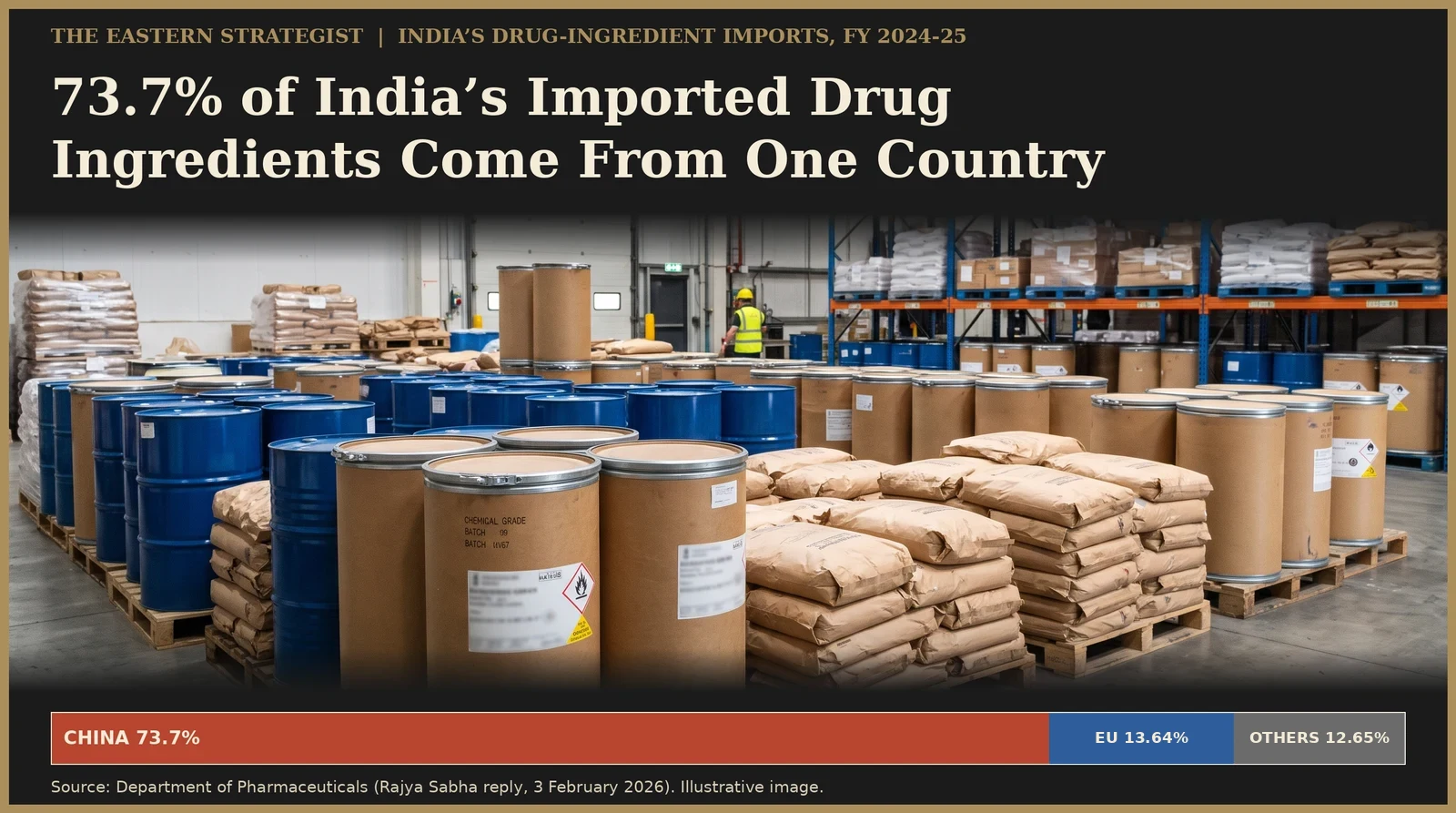
India imported about $4.35 billion of active pharmaceutical ingredients (APIs), bulk drugs and drug intermediates in 2024-25, and China supplied $3.2 billion of it, a 73.7 per cent share, according to the Department of Pharmaceuticals. On 18 November the US-China Economic and Security Review Commission (USCC), an advisory body to the US Congress, proposed a programme that would fund Indian production of these inputs. India’s API import dependence on China is now the subject of a proposal in Washington and a scheme in New Delhi, and the two are moving at different speeds.
Key takeaways
- China supplied $3,204.67 million of India’s $4.35 billion API, bulk drug and intermediate imports in 2024-25, a 73.71 per cent share; the EU was next at 13.64 per cent (Department of Pharmaceuticals, Rajya Sabha reply, 3 February 2026).
- The USCC proposes a Comprehensive Critical Drug Diversification (C2D2) programme with a US-India component. It is a recommendation to the US Congress, not US policy and not an offer to India.
- India’s bulk drug PLI scheme reached ₹3,792.49 crore in cumulative sales by June 2026, though actual incentive payouts stood at just ₹87.70 crore till March 2026 (PIB, August and September 2026).
- The USCC says China cut the prices of 41 APIs and starting materials by 40 to 50 per cent in 2025. That is the Commission’s account; the Indian record names no country.
How India’s API import dependence on China reached 73.7 per cent
China supplied 73.71 per cent of India’s imports of APIs, bulk drugs and drug intermediates in 2024-25, worth $3,204.67 million of a $4,347.75 million total across 200 product categories, according to the Department of Pharmaceuticals. The European Union supplied 13.64 per cent. Together the two account for 87 per cent; every other source shares the rest.
The figures come from a written reply by Union Minister of State for Chemicals and Fertilizers Anupriya Patel in the Rajya Sabha, published by the Press Information Bureau on 3 February 2026 and based on commerce ministry (DGCIS) trade data. The same release lists “predatory pricing” and price volatility among the import risks, without naming a country. At roughly ₹84 to the dollar, an approximate average for the year and a TES conversion, the import bill is about ₹36,500 crore.
The shares describe the chemistry upstream of the tablet: the starting materials, intermediates and active ingredients that Indian formulation makers buy before they produce finished medicines. New Delhi has run dedicated schemes for that layer, listed below, and the 73.7 per cent figure is the measure of the distance still to cover.
What the US panel proposes, and what it does not
The USCC recommends that the US Congress create a C2D2 programme built around US-India cooperation. It would include an early-warning system for essential medicines, multi-year US purchase commitments, and an initiative to support investment in API and key starting material (KSM) production in India. It is an advisory body’s recommendation, and no government has adopted it.
The proposal appears in the Commission’s 2026 Report to Congress, transmitted on 18 November, as one of ten key recommendations. According to the text, a US Federal Trusted Demand Program would make multi-year commitments to buy essential medicines made with qualifying US or trusted-partner ingredients. For India, the Commission says producers should be required to prove “minimal and declining reliance” on Chinese KSMs to receive funding, and that the initiative should, “to the maximum extent practicable”, require matching funds from India and coordination with Indian producers.
Three limits are worth stating. The USCC is a legislative-branch advisory body, and Congress has not acted on the recommendation. The report does not say India has asked for the programme or agreed to it. And the Commission frames the exercise around US supply security and what it calls China’s leverage; India’s stated aim, set out in its own schemes, is self-reliance under Atmanirbhar Bharat. Neither the Department of Pharmaceuticals nor the Ministry of External Affairs had issued a public response to the proposal at the time of publication. On 20 November the Coalition for a Prosperous America, a US advocacy group, questioned the recommendation, citing US Food and Drug Administration findings at some Indian sites and India’s dependence on chemical inputs from China, and asked Congress to examine them before acting.
Where India’s own ₹6,940 crore scheme stands
India’s PLI scheme for bulk drugs has an outlay of ₹6,940 crore and 48 approved projects. By June 2026, actual investment reached ₹5,210.74 crore against a committed ₹4,330 crore, with 39 projects commissioned across 28 APIs and KSMs and cumulative sales of ₹3,792.49 crore, yet actual incentive payouts stood at just ₹87.70 crore till March 2026.
Those figures come from PIB releases of 7 August and 25 September 2026. Cumulative exports under the scheme reached ₹560.16 crore and employment stood at around 5,127 by June 2026 (earlier parliamentary data to September 2025 put established capacity at 55,100 tonnes a year across 26 products and avoided imports at ₹1,807.32 crore). The scheme covers 41 identified products; the import basket spans 200 categories.
| Scheme | Outlay | Latest official figure |
|---|---|---|
| PLI, bulk drugs (KSMs, intermediates, APIs) | ₹6,940 crore | ₹5,210.74 crore invested and ₹3,792.49 crore in sales (to June 2026); ₹87.70 crore disbursed (to March 2026) |
| PLI, pharmaceuticals | ₹15,000 crore | ₹46,744 crore invested (to June 2026); ₹6,659 crore disbursed (to March 2026); 726 KSMs, intermediates and APIs made (191 first-time) with ₹26,123 crore domestic sales (to September 2025) |
| Promotion of Bulk Drug Parks | ₹3,000 crore | Bharuch, Una and Anakapalli, each with ₹1,000 crore of Central assistance; “at various stages of development” (February 2026) |
The scale needs care. Even with domestic sales rising to ₹3,232.33 crore by June 2026 (cumulative sales minus exports), about four years of output still represent less than one-tenth of a single year’s ₹36,500 crore import bill. That comparison spans different periods and product lists, and reflects long gestation periods, not failure. The Department told the Lok Sabha on 7 August 2026 that land acquisition, environmental clearances, high utility costs and long fermentation timelines delayed commissioning and kept payouts low. The Impact Assessment of PLI Schemes, published by NITI Aayog in November with IIM Ahmedabad, draws a distinction: the ₹15,000 crore pharmaceuticals scheme “demonstrates broadly positive outcomes across all four parameters”, while the ₹6,940 crore bulk drugs scheme “presents a more differentiated picture across its four target segments”. It calls one chemical-synthesis segment the strongest and most consistent performer and another vulnerable across indicators.
The three bulk drug parks are the slower element. The Department told the Lok Sabha on 13 February 2026 that they were at various stages of development, and that Tamil Nadu had no park approved and no proposal under the scheme. TES tracks the wider push to localise inputs in its defence and industrial supply chains coverage.
What the 2025 price cuts mean for new Indian plants
The USCC says China cut the prices of 41 APIs and key starting materials by 40 to 50 per cent in 2025, and that this undercut new Indian pharmaceutical production. That is the Commission’s account. The Department of Pharmaceuticals lists predatory pricing as a risk but names no country, and TES found no Indian official confirmation of the 41-product figure.
This pricing risk is why a guaranteed purchase commitment matters to plant operators. A new plant that must compete with imports at half the earlier price needs either a protected volume or a buyer with a long-term contract. The USCC’s Federal Trusted Demand Program is built on that logic, and India’s PLI incentive is a domestic version of it, paying a percentage of incremental sales. New Delhi has also begun pairing incentives with trade floors. In a notification dated 29 January 2026, the Directorate General of Foreign Trade (DGFT) restricted imports of Penicillin-G, Amoxycillin Trihydrate and 6-APA below minimum values of ₹2,216, ₹2,733 and ₹3,405 a kilogram for one year, according to PTI.
The Commission also writes that India’s dependence on Chinese machinery, components and expertise gives Beijing leverage. The same chapter records that India has restricted Chinese investment in some sensitive sectors, subsidised domestic manufacturing and kept its strategic autonomy. For the wider India-China trade picture, TES’s analysis of the Modi-Xi summit and the trade deficit sets out the official figures.
What a US-India arrangement would have to show
The USCC proposal would work only if Indian-made ingredients can meet US quality standards at prices that hold when imported supply is cheap. That is a TES assessment, and it is untested: no programme exists, and no Indian government position on it has been published.
Three conditions follow from the proposal’s own terms, and each bears on India’s API import dependence on China. The first is price: Indian producers would need contracts long enough to carry a plant through a price cut, which is what the US trusted-demand mechanism is designed to provide. The second is traceability. The requirement to prove “minimal and declining reliance” on Chinese KSMs means producers must document every input. That paperwork is a bottleneck for smaller Indian API makers. The third is money on both sides: the matching-funds language implies Indian budget commitments beyond the ₹6,940 crore already set aside.
The question C2D2 leaves open is who supplies that guaranteed demand: a US buyer, Indian public procurement, or Indian private buyers. The proposal’s authors favour a US purchase commitment; India’s PLI scheme pays an incentive on sales and leaves the buyer to the market.
What to watch
What to watch
- Any official Indian responseA statement from the Department of Pharmaceuticals or the external affairs ministry on C2D2 would show whether New Delhi sees the proposal as useful.
- US legislationThe USCC recommends; Congress decides. A bill text would show whether India-specific provisions survive.
- Union Budget 2027Allocations for the bulk drug PLI and parks would show how fast India intends to close the gap itself.
- Bulk drug park milestonesCommissioning of any of the three parks would be the first test of scale.
The 73.7 per cent figure will not fall in a budget cycle. India’s bulk drug scheme has invested more than it committed and has commissioned capacity across 28 ingredients, giving any outside buyer or co-funder a domestic base to build on. What the USCC adds is a possible foreign buyer and a possible co-funder. Whether New Delhi takes that offer depends on terms that nobody has yet written.
Source note: Department of Pharmaceuticals replies to Parliament as published by the Press Information Bureau, NITI Aayog’s Impact Assessment of PLI Schemes, and the USCC 2026 Report to Congress, whose views are the Commission’s own. Rupee conversions and comparisons are TES’s own.