A US congressional advisory panel says Beijing is applying its South China Sea playbook to the Indian Ocean by invoking historic rights and renaming undersea features. The panel now recommends closer undersea coordination with New Delhi, which puts India’s anti-submarine shipbuilding and defence electronics base in focus.
A US congressional panel says China is using in the Indian Ocean the survey-and-rename methods it used in the South China Sea. The U.S.-China Economic and Security Review Commission (USCC) set out that finding in its 2026 report to Congress on 18 November, and the USCC report on India makes undersea coordination one of its recommendations. The Commission says Chinese vessels are mapping the seabed, invoking historic rights and renaming undersea features. In TES’s assessment, the Indian Navy now has to track Chinese survey ships and seabed sensors, not only warship transits.
- Chapter 3 of the USCC 2026 Annual Report warns that Beijing’s expanding naval and surveillance presence is beginning to erode India’s longstanding advantages in the Indian Ocean.
- The Commission recommends that Congress direct the US Secretary of Defense and the Chairman of the Joint Chiefs of Staff to strengthen undersea coordination with India. It is an advisory recommendation, not US law.
- Garden Reach Shipbuilders and Engineers (GRSE) delivered Amini, its fifth Arnala-class anti-submarine vessel, on 5 November 2026 at L&T’s Kattupalli yard, near Chennai.
- The Ministry of Defence signed ₹53,866.50 crore of Next Generation Corvette (NGC) contracts on 2 November 2026, ₹32,000 crore of it with GRSE. Bharat Electronics Limited (BEL) reported a ₹68,717 crore order book on 1 October 2026.
China’s South China Sea playbook in the Indian Ocean
Chapter 3 of the USCC’s 2026 Annual Report warns that China is applying South China Sea tactics to the Indian Ocean. It says Beijing invokes historic rights, renames undersea features and expands surveillance patrols. Indian policymakers warn, the Commission records, that “the South China Sea today could essentially be the Indian Ocean tomorrow” if China’s activities continue to expand unchecked.
The USCC drew these findings from its 17 February 2026 hearing, “India, China, and the Balance of Power in the Indo-Pacific”, a fact-finding trip to India and open-source research. It finds that China’s naval and surveillance presence “is beginning to erode India’s longstanding strategic advantages” in the Indian Ocean Region (IOR).
In the South China Sea, survey work and Chinese naming preceded contested claims. In TES’s assessment, similar groundwork near Indian sea lanes would complicate New Delhi’s work with littoral neighbours.
Why hydrographic surveys change the undersea balance
China lists the deep sea among the priorities of its 15th Five-Year Plan (2026 to 2030), according to USCC Chapter 5. State-affiliated research ships run bathymetric and oceanographic surveys that directly support People’s Liberation Army Navy (PLAN) submarines.
According to the Commission, China’s “Starry Deep Sea” programme maps ocean temperature, salinity and seabed topography. Those physical profiles determine how far sonar signals travel. Chapter 5 is written about US forces; the same mapping would serve Chinese submarines in the Indian Ocean, in TES’s assessment. Better acoustic maps would help them hide near chokepoints and make Indian submarines easier to detect.
Beijing is also building persistent seabed sensor networks under its “Undersea Perspective” effort, known as the “Underwater Great Wall.” The USCC notes that the Chinese vessel Zhu Hai Yun can reportedly operate as a mothership for more than 50 uncrewed vehicles across a 160-kilometre-wide area.
Seabed mapping also puts commercial infrastructure at risk. A USCC-commissioned study of trans-Pacific cables, published in September 2026, cites Chinese patents for deep-sea robot crawlers, deep-sea acoustic sensing, and armour-stripping and cable-splicing technology. The study covers the Pacific, but the same tools would work on Indian Ocean cables, in TES’s assessment, which is why those cables remain an exposed flank for India’s digital economy and financial clearing systems, as TES’s subsea cable geopolitics analysis explores.
What the USCC report on India asks Congress to do
In its 2026 Recommendations, the USCC asks Congress to direct the US Secretary of Defense and the Chairman of the Joint Chiefs of Staff to “engage with their Government of India counterparts to strengthen coordination on undersea and maritime domain awareness in the Indian Ocean”. The Commission wants that work to move “beyond military exercises toward sustained operational cooperation”, including intelligence sharing and monitoring of Chinese submarine activity.
The report calls India “one of the few powers outside the U.S. alliance system with the scale to materially affect the long-term competition with China”. It also records that India will continue to guard its strategic autonomy. It notes that Chinese scholars expect Indian autonomy to keep the Quad from becoming a formal military alliance.
The USCC is a congressional advisory body with no legislative or budgetary authority. TES found no public response from the Ministry of Defence or the Ministry of External Affairs to the Chapter 3 proposal by 21 November 2026.
Separately, the Quad leaders agreed in Manila to a 2027 calendar for P-8 and P-3C patrol aircraft, as TES reported in its Quad maritime patrol coverage.
India’s littoral sub-hunters and survey fleet
New Delhi is countering undersea intrusion by inducting domestic survey vessels and coastal anti-submarine warships. The Indian Navy is acquiring 16 Anti-Submarine Warfare Shallow Water Craft (ASW-SWC), according to a 13 July 2026 Press Information Bureau (PIB) backgrounder. GRSE is building the eight-ship Arnala class with Larsen & Toubro (L&T), and Cochin Shipyard says it is building eight of the parallel Mahe class.
On 5 November 2026, GRSE delivered Amini, its fifth Arnala-class ASW-SWC vessel, to the Indian Navy at L&T’s Kattupalli yard, near Chennai. The Ministry of Defence signed the eight-ship contract with GRSE on 29 April 2019; defence trade reports put its value at ₹6,311.32 crore. Armed with lightweight torpedoes and anti-submarine rockets, these craft hunt coastal submarines and free larger frigates for open-ocean deterrence. TES’s report on Amini’s delivery sets out the delivery timeline.
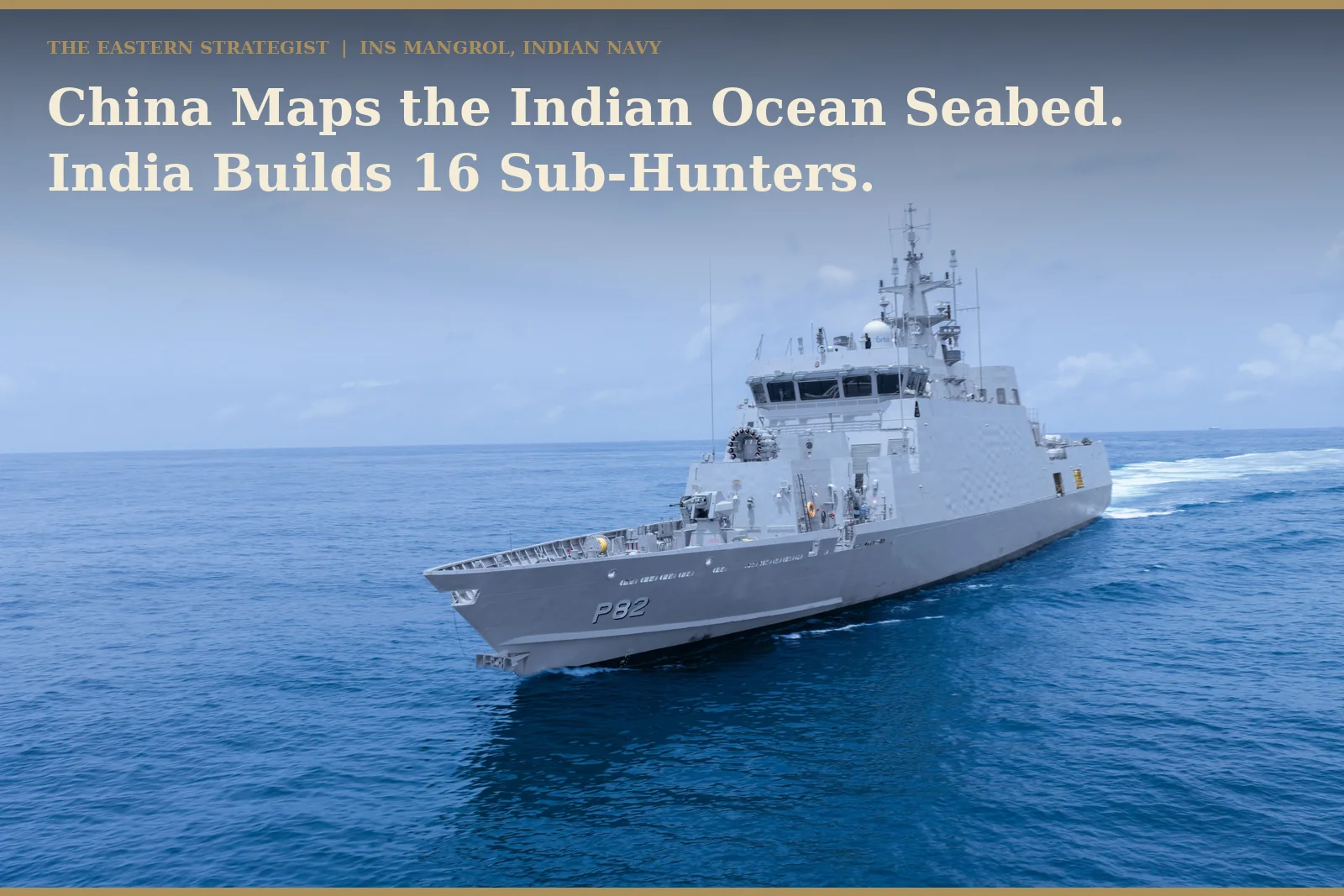
Cochin Shipyard is executing the parallel Mahe-class line on the western seaboard. By 12 October 2026, the Indian Navy had commissioned three Cochin-built vessels: INS Mahe (24 November 2025), INS Malvan (22 July 2026) and INS Mangrol (12 October 2026). According to a PIB release of 9 October 2026, Mangrol has over 80 per cent indigenous content and carries the Abhay hull-mounted sonar and the Maareech advanced torpedo decoy system.
India is also contesting China’s hydrographic presence directly. The Indian Navy commissioned INS Sanshodhak, the last of four GRSE-built large survey vessels, in Kolkata on 21 June 2026. The 110-metre, 3,300-tonne ship has a 6,500-nautical-mile range and carries multibeam echo sounders, autonomous underwater vehicles and remotely operated vehicles. In TES’s assessment, India’s hydrographic capacity gives regional states an alternative to Chinese survey ships.
Defence equities and order-book exposure
The orders behind these companies’ anti-submarine and survey work were placed by the Ministry of Defence between 2019 and 2026, before the USCC report. Listed public sector undertakings GRSE, BEL, Cochin Shipyard, and Mazagon Dock hold the clearest order-book exposure to anti-submarine craft, survey ships, and sonar suites.
| Company (National Stock Exchange symbol) | Undersea and ASW Role | Latest Order Book and Financial Metric | Execution and Pipeline Catalyst |
|---|---|---|---|
| Bharat Electronics (BEL) | Naval sonar systems, MF-STAR radars, combat information systems, and electronic warfare suites. | ₹68,717 crore backlog on 1 October 2026 (2.5x FY26 revenue of ₹27,610 crore); March 2026 backlog was ₹73,882 crore (2.7x). | FY27 inflow guidance (May 2026) of more than ₹55,000 crore, including the unsigned Quick Reaction Surface-to-Air Missile (QRSAM) order of about ₹30,000 crore; management has indicated a corvette electronics opportunity of about ₹20,000 crore. |
| Garden Reach Shipbuilders (GRSE) | Builder of 8 Arnala-class ASW-SWC vessels (5 delivered by 5 Nov 2026) and Sandhayak-class survey ships. | Order book of ₹15,324.13 crore at 31 March 2026 (MoD Annual Report 2025-26), before the ₹32,000 crore NGC contract signed on 2 November 2026. | Signed 5-vessel NGC share of the ₹53,866.50 crore MoD contract on 2 Nov 2026; Elara Capital expects flat to about 5 per cent revenue growth in FY28, with corvette execution picking up from FY29. |
| Cochin Shipyard (COCHINSHIP) | Builder of 8 parallel Mahe-class ASW-SWC vessels for the Indian Navy. | Order book of about ₹21,900 crore at 10 September 2026 (company figure); three Mahe-class vessels (Mahe, Malvan, Mangrol) commissioned by Oct 2026. | Declared lowest bidder (L1) on 16 February 2026 for five Next Generation Survey Vessels worth about ₹5,000 crore; contract not yet signed. Remaining Mahe-class deliveries complete its half of the 16-ship programme. |
| Mazagon Dock (MAZDOCK) | Submarine construction and frontline naval surface combatants. | ₹16,443 crore order book as of 30 September 2026 (BSE filing, 27 October 2026). | Lead yard for the proposed additional Scorpene submarines, which still await Cabinet approval. |
BEL’s 1 October 2026 backlog of ₹68,717 crore equals 2.5 times its FY26 revenue of ₹27,610 crore. The company also posted a 29.2 per cent earnings before interest, tax, depreciation and amortisation (EBITDA) margin in FY26, according to an ICICI Securities note of 21 May 2026, which puts BEL’s average indigenous content at 80 to 85 per cent.
Defence electronics continue to add steady inflows for BEL. On 21 October 2026, BEL disclosed ₹1,011 crore in fresh orders specifically covering sonar systems, radars, and jammers. It followed in November with tri-service orders worth ₹909 crore and ₹619 crore covering optronics, communications, and drones.
After its Q2 FY27 results, BEL management indicated an electronics opportunity of about ₹20,000 crore on the new corvettes, excluding missiles, and expected line-item orders within six months, according to call summaries. The roughly ₹30,000 crore QRSAM order remains unsigned.
The Ministry of Defence signed ₹53,866.50 crore of NGC contracts on 2 November 2026, five vessels with GRSE and three with Goa Shipyard. GRSE told the exchanges that its five-ship share is worth ₹32,000 crore, to be completed within nine years and four months. That is more than twice its ₹15,324.13 crore order book at 31 March 2026. Elara Capital analyst Harshit Kapadia expects GRSE’s growth to be flat to about 5 per cent in FY28, with execution picking up from FY29.
What to watch
- US Congressional LegislationWatch whether the next National Defense Authorization Act (NDAA) takes up the USCC’s recommendation on undersea coordination with India.
- India’s Terms for CooperationTrack whether the Ministry of Defence takes up any US proposal on undersea coordination, and on what terms.
- Chinese Survey Ship Port CallsMonitor deployment requests by Chinese research vessels the USCC describes as state-affiliated in Sri Lanka and the Maldives to gauge Beijing’s mapping tempo.
- Shipyard Execution and BEL InflowsWatch GRSE’s FY28 revenue growth, which Elara Capital expects to be flat, and whether BEL’s corvette electronics opportunity of about ₹20,000 crore turns into orders within the six months management indicated.
China’s seabed mapping, as the USCC describes it, charts the sound channels near Indian sea lanes, the water the Navy’s 16 shallow-water craft and its survey fleet are built to contest. A US congressional advisory body now recommends closer undersea coordination with India to counter China’s expanding Indian Ocean presence. Any bilateral arrangement will move at New Delhi’s pace, while India’s industrial response is already building in Kolkata, Kattupalli, Kochi and Bengaluru.
Investment note: This article discusses defence procurement, corporate order books, and listed public sector undertakings. It is not investment advice or a recommendation to buy or sell any security. Consult a SEBI-registered investment adviser before making financial decisions.
Source note: U.S.-China Economic and Security Review Commission 2026 Annual Report to Congress (Chapters 3 and 5, 18 November 2026) and its September 2026 commissioned study on undersea cables; Press Information Bureau (13 July, 9 October, 2 November and 6 November 2026); Ministry of Defence Annual Report 2025-26; GRSE, BEL, Cochin Shipyard and Mazagon Dock exchange filings; ICICI Securities and Elara Capital research. Strategic assessments are TES’s own.