
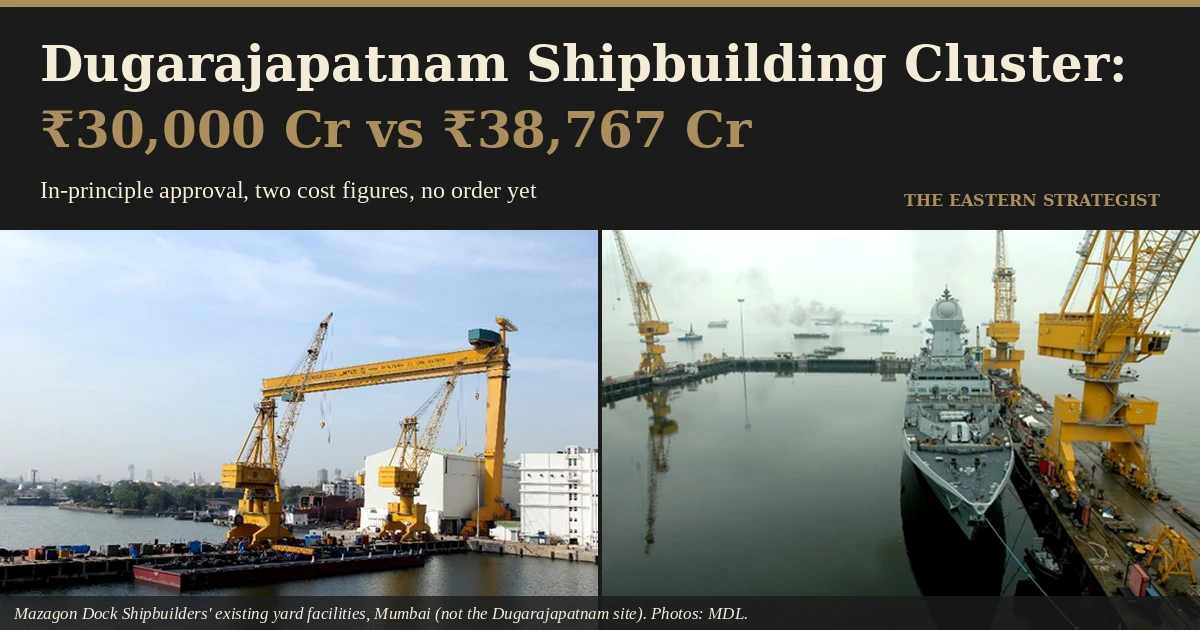
The Ministry of Ports, Shipping and Waterways has cleared the Dugarajapatnam shipbuilding cluster in Andhra Pradesh in principle at about ₹30,000 crore. The feasibility figures Mazagon Dock has published add up to ₹38,767 crore, and the detailed project report is still to come.
The Dugarajapatnam shipbuilding cluster in Andhra Pradesh has the Centre’s in-principle approval under the National Shipbuilding Mission, at an estimated investment of about ₹30,000 crore, the Ministry of Ports, Shipping and Waterways (MoPSW) said on 12 November 2026. Mazagon Dock Shipbuilders Limited (MDL), the anchor yard, has published the feasibility figures behind the project: about ₹29,254 crore for the shipyard and ₹9,513 crore for a port the Government of India would develop. Together they come to ₹38,767 crore.
Both numbers are on the official record, and neither source says what the ₹30,000 crore covers. TES reads the headline as close to the yard component alone. That is an assessment, and the ministry has not said so. The sections below set out what has been approved, who is paying for what, what MDL has signed, and what still has to happen before steel is cut.
Key takeaways
- Stage: the Dugarajapatnam shipbuilding cluster has in-principle approval under the National Shipbuilding Mission. The Directorate General of Maritime Administration (DGMA) says the revised feasibility report is under its review.
- Money: about ₹30,000 crore is the ministry’s headline. The feasibility figures published by MDL are ₹29,254 crore for the yard and ₹9,513 crore for the port, ₹38,767 crore in all.
- Anchor yard: MDL anticipates about ₹15,000 crore over five to seven years, subject to approvals. Its June 2026 order book stood at ₹18,218 crore, mostly naval work.
- Scale: 1.2 million gross tonnes (GT) a year is both the cluster’s target and MDL’s yard design capacity.
The Dugarajapatnam Shipbuilding Cluster Has In-Principle Approval, Not Final Sanction
Union Minister Sarbananda Sonowal told the 31st CII Partnership Summit in Visakhapatnam on 12 November 2026 that the cluster has in-principle approval under the National Shipbuilding Mission, with a targeted annual capacity of 1.2 million GT. The DGMA cluster page lists the status as “IPA Granted” and says the revised Techno-Economic Feasibility Report (TEFR) is under its review.
The approval for the Dugarajapatnam shipbuilding cluster sits inside a larger push. In the same address, according to the Press Information Bureau (PIB), Sonowal said four greenfield ports are under construction in Andhra Pradesh and that the Centre had allocated ₹70,000 crore in financing support for shipbuilding and other maritime activities. “If Hyderabad became Cyberabad, Andhra Pradesh today has the opportunity to become India’s Maritime Gateway to the East,” he said, as quoted in the PIB release of 12 November.
A Centre-State special-purpose vehicle, National Shipbuilding and Heavy Industries Park Andhra Pradesh Limited (NSHIP-AP), will develop the Andhra Pradesh shipbuilding cluster. It was formed jointly by the Andhra Pradesh Maritime Board (APMB) and the Visakhapatnam Port Authority (VPA), a 50:50 arrangement according to DGMA. On DGMA’s listing the site is 3,488 acres, the largest of the five greenfield clusters; the next, Thoothukudi in Tamil Nadu, is shown at 2,050 acres, and the Gujarat, Maharashtra and Odisha sites at 2,000 acres each. DGMA gives the waterfront as about 2.1 km, with planned depths of 13 to 15 metres after dredging.
The Dugarajapatnam shipbuilding cluster is one of five Shipbuilding Development Scheme greenfield clusters, alongside Kuchhadi in Gujarat, Dighi in Maharashtra, Kendrapada in Odisha and Thoothukudi in Tamil Nadu, in the spellings PIB uses. At the India Shipbuilding Investment Conclave on 16 November, Sonowal put projected investment across the five clusters at nearly $10 billion, according to PIB, and described identified domestic demand of more than 400 vessels worth nearly $24 billion. The ministry’s stated goal is a place among the world’s top ten shipbuilding nations by 2030 and the top five by 2047. For context on how warship orders are shifting yard capacity, see TES on the Next Generation Corvette contract.
Why the Dugarajapatnam Shipbuilding Cluster Cost Is Quoted at ₹30,000 Crore and ₹38,767 Crore
MoPSW’s ₹30,000 crore is an “estimated investment” with no stated scope. MDL’s 18 September release quotes the TEFR at about ₹29,254 crore for the shipbuilding and ship-repair yard and ₹9,513 crore for the Dugarajapatnam port, which the Government of India is to develop. The two components sum to ₹38,767 crore.
| Item | Figure | Source | What it is |
|---|---|---|---|
| Headline investment | about ₹30,000 crore | MoPSW, 12 November 2026 | Official statement; scope not stated |
| Shipbuilding and ship-repair yard | about ₹29,254 crore | TEFR, as quoted in MDL release | Estimate under review |
| Dugarajapatnam port | ₹9,513 crore | TEFR, as quoted in MDL release | Proposed to be developed by the Government of India |
| Yard plus port | ₹38,767 crore | TES arithmetic | Sum of the two TEFR figures |
| MDL anchor-yard investment | about ₹15,000 crore over five to seven years | MDL release | Company claim, subject to approvals and clearances |
What the Dugarajapatnam shipbuilding cluster figures do not settle
MDL’s ₹15,000 crore is a little over half of the TEFR yard figure (51 per cent, on TES arithmetic). Neither the ministry nor MDL has said who funds the rest, how much would come as central support under the Shipbuilding Development Scheme (SbDS), or whether the headline includes the port. The figures themselves may also move. The tender NSHIP-AP issued in May 2026 asks its consultant to review the TEFR for “gaps, inconsistencies or shortcomings” and states that the earlier reports are for reference only. Readers should treat every rupee figure in the Dugarajapatnam shipbuilding cluster as an estimate until the detailed project report is public.
Mazagon Dock Anchors the Dugarajapatnam Shipbuilding Cluster With a Plan, Not Yet With Orders
The Mazagon Dock Dugarajapatnam memorandum of understanding (MoU), signed with NSHIP-AP on 18 September 2026 in Amaravati, covers a greenfield yard. MDL anticipates about ₹15,000 crore of investment over five to seven years, about 45,000 direct and indirect jobs, and a design capacity of 1.2 million GT a year, all subject to approvals and clearances.
The release lists the vessel types the yard “will cater to”: tankers, bulk carriers, container ships, LNG carriers and other large specialised vessels. MDL calls the project “a major step in MDL’s diversification into large-scale commercial shipbuilding”. The release names no customer and no order. The jobs figure is the company’s own projection.
The order book explains why that matters. MDL’s investor presentation of 30 July 2026 puts the total balance order book at ₹18,218 crore on 30 June 2026. The largest lines are P17A stealth frigates at ₹7,587 crore, ONGC work at ₹2,774 crore, coast guard vessels at ₹2,649 crore and P75 Kalvari submarines at ₹1,678 crore. Commercial work is not new to the yard at Mumbai: the book carries a hybrid multipurpose vessel for NAVI Merchants A/S (₹695 crore) and a platform supply vessel for the Shipping Corporation of India (₹367 crore). Large tankers and container ships would be a different scale. The ₹15,000 crore is a capital plan and the ₹18,218 crore is contracted work, so the two should not be set against each other.
South Korea’s experience shows the order of events that usually works. Hyundai signed supertanker orders with a Greek shipowner in 1971, before its Ulsan yard existed, and delivered the first ship in 1974. At Dugarajapatnam the yard is being planned first. The question for the anchor partner is how soon an order book follows. TES has covered how MDL’s finances meet its naval programmes in its analysis of Mazagon Dock and Project 75I.
Can 1.2 Million GT a Year Move India’s Under-1% Share of World Shipbuilding?
India accounts for “less than one percent of global shipbuilding output” and ranks about 18th worldwide, according to a March 2026 analysis by the Observer Research Foundation. A cluster that reaches 1.2 million GT a year would be a large step from that base, but the documents do not yet say how much of the 1.2 million GT is MDL’s yard and how much is other tenants.
PIB’s 12 November release calls 1.2 million GT the cluster’s “targeted annual capacity”. MDL’s release calls the same number its yard’s “design capacity”, with “provision for further expansion based on market requirements”. Either the cluster target is the anchor yard, or other yards would add to it. TES has not found a document that answers this, and NSHIP-AP is the body to ask. The distinction decides how much capacity the Dugarajapatnam shipbuilding cluster adds beyond MDL’s own plan.
Demand is the other half. PIB’s 16 November release reports an active pipeline of more than 150 vessels worth over $1.7 billion, with exports above 80 per cent of that value, and identified domestic demand of more than 400 vessels. Thirty foreign shipyards, including HD KSOE, Samsung Heavy Industries and Hanwha Ocean, attended the conclave, and ten delegations were to visit cluster sites on 17 November. How many of them commit capital to the Dugarajapatnam shipbuilding cluster, and how many to the four other sites, is not known. TES’s earlier piece on why the Indian shipbuilding industry lags sets out the structural gap this scheme is meant to close.
What Still Stands Between the Dugarajapatnam Shipbuilding Cluster and a Working Yard
NSHIP-AP’s tender of 22 May 2026 asks a consultant to review the feasibility study, prepare a detailed project report within nine months of award, and secure environmental and Coastal Regulation Zone clearances within fifteen months of award. The documents TES holds do not show the award date, so the clock has no confirmed start.
The tender describes the site as lying near Sriharikota, Pulicat Lake and the ports of Krishnapatnam and Ennore, and says “given the ecological sensitivity of the region” VPA commissioned RITES Limited to model littoral drift, wave dynamics and shoreline change. The detailed project report must follow the MoPSW greenfield cluster guidelines of 26 December 2025 and be fit for appraisal by an independent evaluation agency appointed by the Directorate General of Shipping. A separate tender from the Visakhapatnam Port Authority seeks a project monitoring unit for the cluster; the status page TES saw showed no outcome.
None of this is unusual for a greenfield port and yard. It does mean that the 1.2 million GT target belongs to the next decade, not the next budget. The nearer test is whether the consultant is appointed, the report is delivered on schedule and the environmental case is accepted on a coast the project’s own tender calls sensitive. The ministry and the state have both shown they want the cluster to move quickly, and the eastern seaboard has strategic weight of its own, as TES’s India maritime security hub sets out. The approvals pipeline will show how quickly it can.
Dugarajapatnam shipbuilding cluster: dates and decisions to watch
- Award of the project report consultancy. Starts the nine-month and fifteen-month clocks. No award date found in the documents TES holds.
- DGMA’s review of the revised TEFR. The costs and capacity in this piece come from that report.
- Environmental and Coastal Regulation Zone clearances. The site is described as ecologically sensitive in NSHIP-AP’s own tender.
- First order or customer for the MDL yard. None is named in MDL’s release.
- Foreign yard partners. Which of the 30 shipyards at the November conclave commit to which cluster.
On the record today, India has a cleared idea, a named anchor yard and a ministry that has put the cluster in front of foreign shipbuilders. It does not yet have a final cost, a detailed project report or a signed order. The sequence in which those three arrive will decide whether the Dugarajapatnam shipbuilding cluster is remembered as the yard that lifted India’s share of world shipbuilding or as one more large announcement. The better guide to that outcome is the first contract, not the next summit.
Source note: PIB releases of the Ministry of Ports, Shipping and Waterways (12 and 16 November 2026), Mazagon Dock Shipbuilders Limited press release (18 September 2026) and investor presentation (30 July 2026), DGMA greenfield-cluster pages, NSHIP-AP expression of interest (May 2026), and the Observer Research Foundation (March 2026). Assessments are TES’s own.
Disclaimer: This article is for information and analysis. It is not investment advice or a recommendation to buy, sell or hold any security. Order-book and investment figures are company disclosures as of the dates stated. Readers should consult a SEBI-registered adviser before acting.