
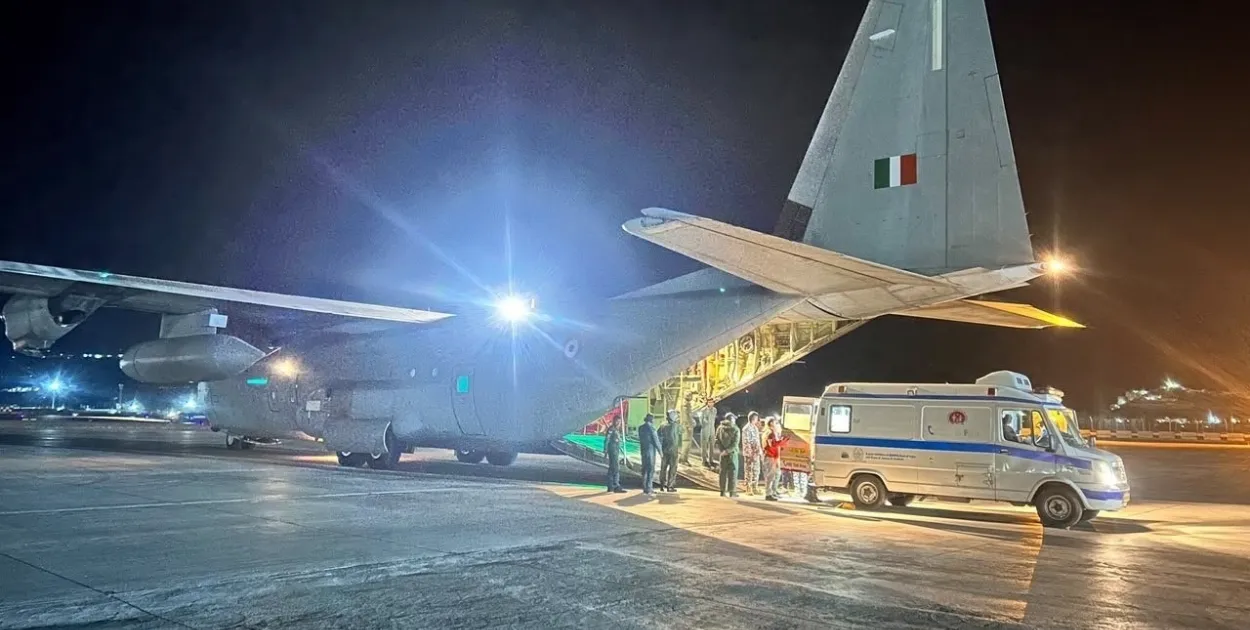
The Ministry of Defence announced on 18 October 2026 that an Indian Air Force C-130J had flown a critically ill 30-year-old civilian from Leh to Palam, late at night, in darkness and challenging weather. The patient was then moved to the All India Institute of Medical Sciences (AIIMS). The flight is routine by IAF standards, yet every part of it depends on IAF high altitude operations: a 3,256-metre airfield, thin air, and a Union Territory whose road links close under snow.
What Did the IAF Do on the Night of the Leh Evacuation?
The release presents the mission as proof of the IAF’s readiness to respond to critical humanitarian requests, including medical evacuation under challenging conditions. A similar September flight took a 70-year-old patient from Leh to Chandigarh at night, on a request from the Ladakh administration, using night-vision goggles, a defence spokesperson said.
Such flights are a pattern in IAF high altitude operations. In 2025 the IAF airlifted a civilian patient from Leh to Chandigarh on 22 April and flew 19 helicopter casualty evacuations at the Jammu and Kashmir government’s request. A subsidised IAF IL service for Ladakhi civilians, flying on Tuesdays and Thursdays under the UT’s Air Maintenance Service, resumed in October 2023.
Why Is Flying Out of Leh So Demanding?
For IAF high altitude operations, the ground matters as much as the aircraft. Ladakh is the highest plateau region in India, lying between 32° and 36° North, with extreme cold and a very short summer. Road access is the binding constraint. In 2020 the 425-kilometre Srinagar–Leh highway reopened in April, after heavy snow at Zojila pass, at about 11,500 feet, had kept it shut since December. Closure periods vary by year, but the example shows why air links carry the load in winter.
The IAF’s record shows the same constraints in earlier emergencies. After the August 2010 cloudburst, the runway at Leh, covered by more than six inches of slush, was made operational in a day, and Cheetah helicopters flew 60 sorties from the Zanskar valley on 9 August, evacuating 90 of 130 stranded people. In February 2023, with roads blocked by snow, IAF helicopters from almost all fleets, Chinook included, flew 287 sorties and airlifted 205 tonnes, bringing stranded passengers from Zanskar to Leh, the Ministry’s year-end review records.
How Do IAF High Altitude Operations Evacuate Patients From Ladakh?
That 2014 mission is the most detailed account on record. The IAF’s Siachen Pioneers helicopter unit at Leh flew to a village without road access, in turbulence, with little room to manoeuvre and a dusty, unprepared landing surface. The crew communicated with the family by sign language, and the patients were taken to Sonam Norbu hospital in Leh. The request chain is visible in it: the civil administration asks, and the IAF tasks the aircraft. The September 2026 flight followed the same pattern, on a request from the Ladakh administration.
The Siachen Glacier is where the helicopter side of the system was built. Chetak helicopters landed there in October 1978, and helicopters later ferried men and material to heights far above the limits set by their manufacturers. IAF helicopters remain the troops’ link with the outside world, responding to emergencies, supplying logistics and evacuating the sick and wounded from the 78-kilometre glacier.
What Do IAF High Altitude Operations Rest On?
| Year | Development |
|---|---|
| 1978 | A Chetak becomes the first IAF helicopter to land on the Siachen Glacier |
| 1984 | Operation Meghdoot. Hunters begin fighter operations from Leh in September and fly more than 700 sorties over the following years; live firing at Kar Tso, south of Leh |
| 2009 | Cheetal helicopters, a Cheetah re-engined for reliability and load-carrying at altitude, enter service |
| 2013 | A C-130J lands at Daulat Beg Oldie, the world’s highest airstrip, on 20 August |
| 2019 | Chinook heavy-lift helicopters inducted at Chandigarh on 25 March; contract signed September 2015 for 15 helicopters, for the Northern and Eastern regions |
| 2023 | Nyoma works sanctioned on 31 March at ₹219.39 crore; foundation stone laid on 12 September, with Raksha Mantri calling it one of the world’s highest airfields |
| 2025 | Nyoma operationalised on 12 November, with the Chief of the Air Staff landing in a C-130J; fourth IAF base in Ladakh |
| 2026 | Civil aviation infrastructure project at Air Force Station Leh inaugurated on 28 January |
Heavy lift anchors IAF high altitude operations on the glacier. The Chinook can airlift diverse military and non-military loads into remote locations. Transport aircraft add reach: in January 2024 a C-130J made the first night landing of a fixed-wing aircraft at the Kargil advanced landing ground, using its own night landing aids, the Tribune reported. The 2013 landing at Daulat Beg Oldie was described by the Ministry as a significant show of capability.
Nyoma is the newest layer. At 13,700 feet, it is among the highest airfields in the world, and the Chief of the Air Staff landed there in a C-130J when it was operationalised in November 2025. The January 2026 project at Leh covers the civil side: smoother ground movement, quicker civil departures, and a stronger ability to respond to humanitarian and disaster relief needs. TES has covered the wider mountain build-up in its report on India’s high-altitude combat ecosystem and the logistics problem in its analysis of whether military robots can protect Siachen.
What Remains Outside the Public Record?
Some details that readers will want are not part of the public record, which is normal for operational flying. Sortie rates for Ladakh medical flights, aircraft performance limits at Leh, patient outcomes and the request chain between the Ladakh administration and Air Force Station Leh have not been published. The 18 October release is brief: it names the aircraft, the route and the destination hospital. This article has stayed within that record on IAF high altitude operations.
The pattern in the record points one way. Each stage, from Chetak landings in 1978 to Nyoma in 2025, has widened what the force can do at height, and the Leh evacuations are the civilian face of that growth. In TES’s assessment, the test is the coming winter, when road closures push more of Ladakh’s needs onto aircraft. Readers can follow it through:
- Winter airlift tempo: how often the IAF and the Ladakh administration report evacuations once snow closes the highways.
- Official disclosures: whether PIB releases begin to carry request details and flight data.
- Nyoma: how quickly it moves from an inaugural landing to routine fighter and transport operations. The Tarang Shakti 2026 wargames offer a gauge of the IAF’s wider operating tempo.
- Civil use of Leh: whether the January 2026 infrastructure project shortens turnaround times as promised.