Defence & Space Industry — India-U.S. Cooperation
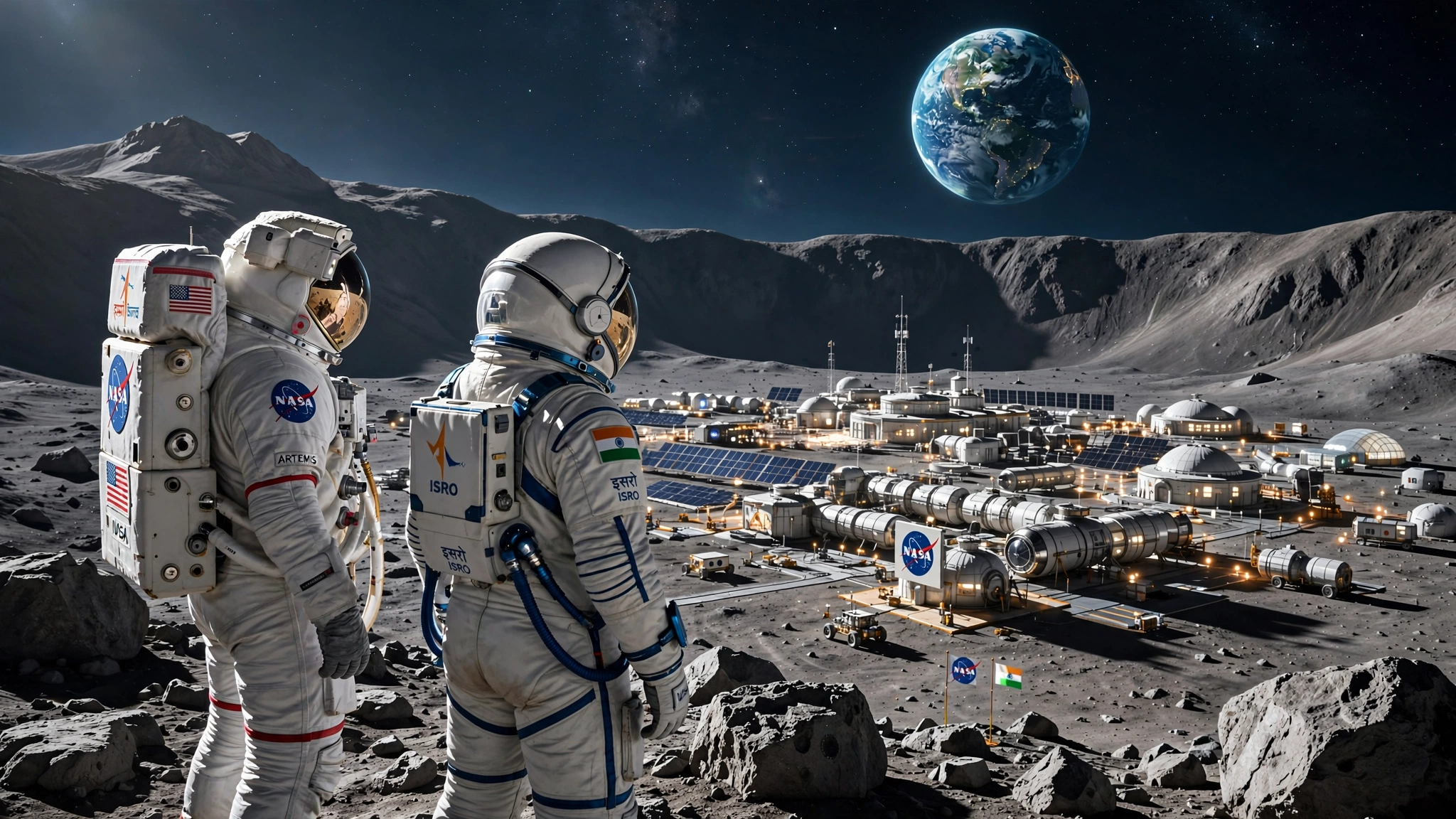
On 5 August 2026, inside the Indian Space Research Organisation’s own headquarters in Bengaluru, American officials sat across the table from their Indian counterparts and extended an offer the Cold War space race never had reason to make: not who reaches the Moon first, but who stays. The NASA ISRO Moon Base invitation, delivered at that meeting, is the clearest signal yet of where that offer leads. Fifty-one years earlier, an American commander and a Soviet cosmonaut had reached through an open hatch in orbit and shaken hands, ending a rivalry with a gesture. This time the gesture was an invitation to help build something permanent — a base at the Moon’s South Pole — and Washington wants New Delhi at the table for it.
Inside the NASA ISRO Moon Base Invitation
NASA has formally invited ISRO to join its Moon Base programme near the lunar South Pole. The invitation was extended during the 9th India-U.S. Civil Space Joint Working Group (CSJWG), hosted by India at ISRO headquarters in Bengaluru on 5–6 August 2026, and announced by the U.S. Embassy in New Delhi on 11 August.
The choice of venue was itself a signal. Previous rounds of the CSJWG — a forum that has quietly run since 2005 — have shuttled between Washington and Delhi discussing satellites, data-sharing protocols, and the occasional joint mission. This one happened on ISRO’s own campus, with Dr V. Narayanan, ISRO’s Chairman and Secretary of the Department of Space, and Sergio Gor, the U.S. Ambassador to India, addressing the opening session together. The meeting was co-chaired on the Indian side by M. Sankaran, Director of ISRO’s U R Rao Satellite Centre, and on the American side by Dr Wesley Brooks, Assistant Secretary of State for Oceans and International Environmental and Scientific Affairs, and Kathleen Karika, NASA’s Associate Administrator for International and Interagency Relations.
None of this happened in isolation. It builds on the TRUST Initiative — Transforming the Relationship Utilizing Strategic Technology — which traces back to the February 2025 Joint Leaders’ Statement issued by Prime Minister Narendra Modi and President Donald Trump. And it follows the successful launch of NISAR, the NASA-ISRO Synthetic Aperture Radar satellite, which lifted off aboard ISRO’s GSLV-F16 from Sriharikota on 30 July 2025 — the first satellite mission to collect radar data across two separate microwave frequencies. Both sides also reaffirmed their commitment to the UN Committee on the Peaceful Uses of Outer Space (COPUOS) guidelines on long-term sustainability, building on ground TES has covered before in its work on space situational awareness and the COPUOS framework, and agreed to advance discussions on open scientific data-sharing under the Artemis Accords.
What the meeting did not produce is a signed Indian commitment. The invitation is exactly that — an invitation. The scope of India’s eventual role, the cost-sharing arrangement, and which hardware ISRO might contribute all remain subjects for negotiations that have not yet concluded.
Two Coalitions, One Moon
India’s decision now sits inside a larger contest for the lunar South Pole, where permanently shadowed craters are believed to hold water ice — a resource that can be split into breathable oxygen and rocket propellant. Two rival coalitions have formed around access to that geography: the U.S.-led Artemis Accords, with 70 signatory nations as of July 2026, and the China-Russia-led International Lunar Research Station (ILRS), with 13 national partners.
The Artemis Accords began small. Eight founding nations — Australia, Canada, Italy, Japan, Luxembourg, the UAE, the UK and the United States — signed on 13 October 2020. India joined later and is now counted among the 70 signatories the U.S. State Department listed as of July 2026, close to a nine-fold expansion in under six years. This is the same coalition arithmetic TES traced when Artemis II signalled the opening of a new Moon race. The rival ILRS, co-founded by China’s national space administration and Russia’s Roscosmos in 2021, counts a smaller but strategically pointed roster: Pakistan, Belarus, Egypt, South Africa, Azerbaijan, Venezuela, Nicaragua, Thailand, Serbia, Kazakhstan and Senegal.
That Pakistan sits inside the rival coalition is not incidental to how New Delhi will read this invitation. It does not, by itself, force India’s hand — but it removes any illusion that lunar governance, spectrum allocation and surface access rules will be settled in a room India isn’t in.
Signatory counts as of July 2026. Sources: U.S. State Department; Payload Space / SpaceNews ILRS tracking.
What India Already Brings to the Table
India is not arriving at this negotiation with empty hands. Hindustan Aeronautics Limited (HAL) has supplied critical structures and propellant tankage for ISRO’s PSLV and GSLV launch vehicles for more than four decades and manufactures the crew module for the Gaganyaan human spaceflight programme, while ISRO builds the service module — a division of labour TES examined in its earlier reporting on HAL’s aerospace manufacturing programme.
That industrial base sits alongside a genuinely full domestic pipeline. Chandrayaan-4, a Cabinet-approved lunar sample-return mission carrying a budget of ₹2,104.06 crore, is designed around a four-module architecture — transfer, lander, ascender and re-entry — that will require two separate launches and orbital docking, a technical first for ISRO. The Bharatiya Antariksha Station, also Cabinet-approved as an extension of the Gaganyaan programme, is targeted for 2035. And Chandrayaan-5, better known by its working name LUPEX (Lunar Polar Exploration), is a joint mission with Japan’s space agency JAXA, with the implementing arrangement already exchanged and a launch window targeted for 2028–2029.
Seen against that backdrop, NASA’s invitation reads less like an entry ticket and more like a merger conversation between two parties that already have overlapping lunar ambitions — one with deeper pockets and an established base-building programme, the other with a working sample-return architecture and a fast-maturing human spaceflight capability of its own.
Why a Moon Base Is Also a Defence Conversation
TES Analysis: A permanent lunar outpost cannot run on Earth-orbit infrastructure alone. Tracking, navigation and communications assets built for cislunar space — the volume between Earth’s geostationary orbit and the Moon — have an obvious second life in what defence planners call cislunar domain awareness: the discipline of knowing what is operating in that same volume.
This is where caution is warranted rather than certainty. No official statement from the 5–6 August CSJWG meeting, and no verifiable source reviewed for this piece, ties a specific Indian defence public sector undertaking to a named role in NASA’s Moon Base architecture. What can be said, as reasoned assessment rather than fact, is narrower: India’s existing industrial base — HAL’s structural and propulsion manufacturing experience chief among it — gives Indian industry a plausible starting point if NASA’s Moon Base procurement eventually opens to allied-nation suppliers, the way it already has for Japan’s, Italy’s and Canada’s space agencies on other segments of the programme. Whether that translates into confirmed contracts is a question for the Cabinet Committee on Security’s review and IN-SPACe’s procurement rules still ahead — not one this meeting has answered.
What to Watch
Has India formally committed to the NASA ISRO Moon Base programme?
No. The CSJWG meeting recorded a NASA invitation and continued bilateral discussion, not a binding Indian commitment. The scope of participation, cost-sharing and any hardware contribution remain open for future negotiation.
What is the TRUST Initiative?
The Transforming the Relationship Utilizing Strategic Technology (TRUST) Initiative is the umbrella framework under which the U.S. and India are advancing this and other space and technology cooperation, tracing back to the February 2025 Joint Leaders’ Statement issued by Prime Minister Modi and President Trump.
How does this connect to the Artemis Accords?
India is already among the Accords’ 70 signatory nations. NASA’s Moon Base invitation builds on that existing framework rather than creating a separate one, and both sides have agreed to advance discussions on open scientific data-sharing under it.
Fifty-one years after Thomas Stafford and Alexei Leonov shook hands through an open hatch in Earth orbit — two commanders from opposing systems, momentarily on the same side — Bengaluru hosted a quieter version of the same instinct. No hatch opened this time, no cameras rolling on a handshake. Just a working group, a co-chair list, and an invitation whose answer hasn’t been written yet. What India decides between now and the next CSJWG meeting will determine whether this was a turning point or a footnote.
Sources & Transparency Note
This article separates verified fact from editorial analysis throughout. Meeting details, official titles, and mission data are drawn from U.S. Embassy and ANI/Tribune reporting, NASA, ISRO, the U.S. Department of State, and Payload Space/SpaceNews ILRS tracking, linked inline above. The industrial-opportunity assessment in “Why a Moon Base Is Also a Defence Conversation” is explicitly labelled as TES editorial analysis, not an official claim, as no primary source confirms specific defence-PSU roles in NASA’s Moon Base programme at the time of publication.
- U.S. Embassy New Delhi press release, 11 August 2026 (via ANI/Tribune)
- NASA — Moon Base & NISAR mission pages
- U.S. Department of State — Artemis Accords signatory list, July 2026
- Payload Space / SpaceNews — ILRS partner tracking
- Cabinet approval reporting — Chandrayaan-4 and Bharatiya Antariksha Station