
Key Takeaways
- Three US carrier strike groups are set to overlap in the Middle East by late November 2026 — the USS Theodore Roosevelt joining the USS George H.W. Bush and USS George Washington — the second such concentration this year, after April, and the first in the region since 2003 before that. The overlap is contingent on the George Washington staying on station until the Roosevelt arrives.
- The binding constraint is not hulls but magazines: the 39-day Operation Epic Fury campaign against Iran consumed more than 1,000 Tomahawks and about half the THAAD interceptor inventory, systems that take one to four years to replace.
- The cost exchange is inverted. A Standard Missile-6 interceptor costs roughly $4.3 million; the Shahed one-way attack drones it is sometimes fired against are estimated by CSIS at $20,000–$50,000.
- Pulling the Japan-based George Washington west has left the western Pacific without a US carrier — the third such gap since 2000.
- The 3 November midterm elections are the pivot point: the White House has signalled heavier strikes could resume after the vote, while talks over reopening the Strait of Hormuz remain stalled.
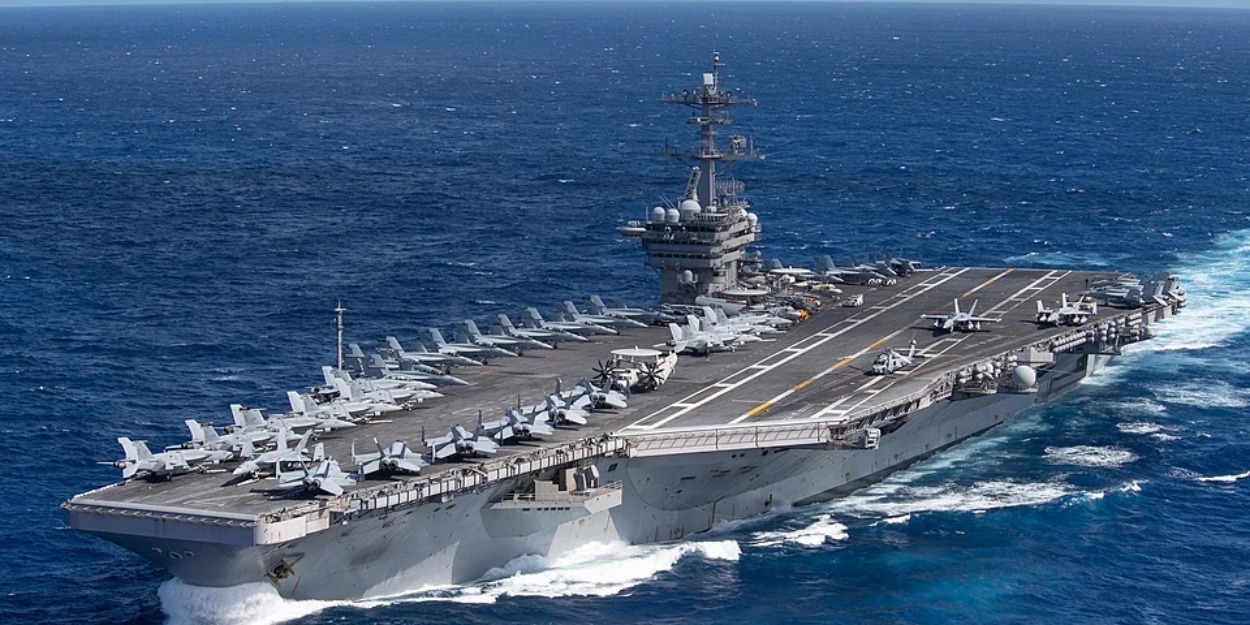
By the end of November, the United States is set to briefly concentrate three US carrier strike group in the Middle East — the second time this year — if the Japan-based USS George Washington stays on station long enough for the USS Theodore Roosevelt to arrive. The Roosevelt left San Diego on 27 September 2026 with Carrier Air Wing 11, bound for US Central Command to relieve the George Washington; the USS George H.W. Bush is already on station in the Arabian Sea.
The USS Makin Island Amphibious Ready Group, carrying the 13th Marine Expeditionary Unit and roughly 2,000 Marines, sailed from California a day later. Together they move about 9,000 additional sailors and Marines toward a command that already holds more than 50,000 personnel, deepening the US carrier strike group Middle East presence that has been building since spring.
The concentration, if it holds, is rare: three flattops, on the order of 200 embarked aircraft and roughly a dozen escorts — a posture last seen in the region in April, and before that during the 2003 invasion of Iraq. But the campaign behind it has already consumed munitions faster than American industry can replace them. The same move that makes the surge possible — drawing the George Washington out of Japan — leaves the western Pacific with no US carrier for the third time since 2000.
This analysis makes a narrow claim. Massing three US carrier strike groups in the Middle East — part of the wider Iran war and West Asia crisis — produces tactical air superiority and a visible signal of intent. But it does not repair the two structural weaknesses the deployment exposes: a ship-launched interceptor inventory that takes years to rebuild, and an Indo-Pacific deterrence posture that thins each time the Middle East claims another hull.
Against Tehran’s low-cost, deniable friction — drones, sabotage and shipping attacks — a supercarrier is a costly instrument aimed at the wrong problem.
The US carrier strike group Middle East surge is a fragile peak, not a sustainable posture
The three-carrier posture is a transit artefact, not a standing force. Because the Roosevelt must cross the Pacific and Indian Oceans to reach the region, and because the George Washington is due to rotate home to Japan, the overlap lasts only as long as the Navy chooses to hold two carriers in place. The US carrier strike group Middle East presence is a snapshot of a rotation, not a fixed garrison.
An 11-carrier fleet sustains about two carriers on continuous deployment without burning out crews; concentrating three in one theatre borrows from every other.
The pattern is now familiar. In April 2026, the Gerald R. Ford, Abraham Lincoln and George H.W. Bush became the first three US carriers to operate in the Middle East together since 2003, in support of the opening phase of Operation Epic Fury. That concentration came at a cost visible in the deployment logs.
The Ford returned to Norfolk in May after a 326-day deployment — the longest for a US carrier since the Cold War era. The Abraham Lincoln spent more than 300 days at sea, much of it without a port call, and the acting Navy secretary disclosed in September that eight service members in its strike group had attempted suicide during the deployment. The George Washington was surged from Japan in August specifically to relieve that ship.
That relief created the Pacific vacancy. The George Washington is the Navy’s only forward-deployed carrier, homeported at Yokosuka and assigned to the Seventh Fleet. When it transited the Strait of Malacca in mid-August and arrived in the region, it left the western Pacific without a US flattop — a gap that has recurred only twice since 2000, after the 11 September attacks and in August 2024.
Bryan Clark, a former submariner now at the Hudson Institute, told Axios the consequence is strategic as much as operational: “If you are Taiwan or the Philippines or Japan, you’re looking at this and saying the U.S. is basically not here, and the Chinese are.”
Three carriers in one theatre also impose a maintenance bill that comes due later. Hulls pushed through back-to-back extended deployments queue for repair at the Navy’s two carrier shipyards, which has the effect of reducing availability in the years that follow. As Clark put it, the result is “a maintenance debt that needs to be paid for the next few years.”
The magazine-depth deficit that flattops cannot conceal
The bottleneck is not hull numbers but interceptor burn rate. Carriers are protected by their escorts’ Standard Missiles — the SM-2, SM-6 and Evolved Sea Sparrow — and by the wider air-defence magazine that the Iran war has already drawn down. Those interceptors are produced in the hundreds a year and take two years or more to deliver, so every salvo fired at a cheap drone is a round unavailable for a Pacific contingency.
The drawdown is documented. The Center for Strategic and International Studies found that US forces used between one-third and one-half of their reserves of seven critical munitions during the opening campaign, including more than 100 SM-3 and SM-6 ship-based interceptors and more than 200 THAAD interceptors — roughly half that system’s inventory. More than 1,000 Tomahawks were fired from a stock of about 3,100.
CSIS estimates that rebuilding to pre-war levels will take one to four years, with Tomahawk stocks not fully restored until around 2030. The Pentagon has responded with large multiyear awards, including a contract worth up to $24.4 billion for SM-6 production announced on 1 October 2026, but industry executives have warned that Congress has not yet appropriated the funding.
Production cannot close the gap quickly. RTX builds roughly 125 to 200 SM-6 interceptors a year, a rate the Navy plans to lift to about 300 by FY 2028. The mismatch with the threat is stark. A Shahed-136 one-way attack drone is estimated by CSIS at $20,000–$50,000; the Navy’s own reverse-engineered equivalent, the LUCAS drone, costs about $35,000.
Iran fired more than 1,000 drones in the first week of the war and is assessed to have the capacity to build around 10,000 a month. Intercepting that volume with million-dollar missiles is a losing exchange at scale — and it consumes precisely the interceptors that US war plans reserve for a conflict with China.
President Trump acknowledged the constraint obliquely in a Time magazine interview published on 1 October. Asked about renewed strikes, he said it was “possible” after the 3 November elections and added that the United States is “stocking up at levels we’ve never done before.” The admission is telling: the decision to pause or resume the air campaign now runs through the munitions ledger as much as the map.
Why supercarriers cannot stop grey-zone sabotage
A US carrier strike group in the Middle East controls the sea and the air above it. It cannot garrison a 1,200-km pipeline, screen the cockpit of a civil airliner, or prevent a drone launched from a neighbouring country’s territory. The war’s most consequential blows have landed on distributed infrastructure and civilian targets that no flattop can shield — and against those, the three-carrier force is largely irrelevant.
On 10 and 11 September 2026, drones launched from Iraqi territory struck three pumping stations on Saudi Arabia’s East-West pipeline, the 1,200-km conduit that carries four to five million barrels a day to the Red Sea port of Yanbu and serves as Riyadh’s main bypass around the Strait of Hormuz. Saudi Arabia shut the pipeline as a precaution; it restarted on 22 September.
Saudi officials said the drones came from Iraq, Iraq dismissed a provincial commander over the launch, and Iran-aligned militias denied involvement. No US carrier intercepted the drones, because none could reach the launch point.
The downstream damage is economic. Refined-product flows through Hormuz — the diesel and jet fuel that actually move economies — collapsed to roughly 677,000 barrels a day against a pre-war 3.6 million, even as crude exports recovered to near pre-war levels.
The International Energy Agency has recorded around three million barrels a day of Middle Eastern refining capacity offline, and EU diesel pump prices hit record levels in early October. This is the global fuel shock that a carrier surge does not address: the ships protect crude transit, not the refineries that turn crude into the products markets are short of.
The same mismatch shows in the air. On 30 September 2026, a flydubai flight from Dubai to Tel Aviv diverted to Tabuk in north-western Saudi Arabia after an altercation in the cockpit left its captain seriously injured and the aircraft plunging more than 14,000 feet in under 30 seconds. Israeli officials described the co-pilot as having stabbed the captain and tried to crash the aircraft, and President Trump said “early indications” suggested an Iranian link.
That link is not established: the UAE and Saudi investigations have made no finding of state direction, Israeli officials have identified the suspect as an Omani national, and Tehran denies involvement. Whatever the outcome, the episode illustrates how quickly a deniable, non-naval flashpoint can absorb attention that a carrier strike group is powerless to resolve.
The 3 November pivot and the narrowing escalation window
Washington has signalled that the political constraint on escalation lifts after the 3 November midterm elections. Trump told Time that heavier strikes on Iran are “possible” once the vote concludes, and Reuters reported that senior aides have pushed to keep the war quiet before it to limit Republican losses. The signal is not a decision — US officials have stressed that no new campaign is ordered — but it is a timetable, and Tehran is reading it as one.
Diplomacy has hardened on both sides. Iran proposed a seven-day ceasefire and a phased reopening of the Strait of Hormuz, conveyed through a Qatari intermediary, in exchange for sanctions relief and the release of frozen assets. Washington rejected it.
The United States maintains a naval blockade of Iranian ports, under which CENTCOM reported redirecting 122 commercial vessels by late September, while facilitating more than a billion barrels of crude through the strait since spring. The gap between the two positions — Iran wants its oil and money back, the US wants Hormuz open and Iran’s nuclear programme curtailed — shows no sign of closing.
Analysts at Foreign Policy argue that Trump’s political incentive to restrain the war weakens once the vote is past, and that pressure from Gulf partners and Israeli hawks to “finish the job” may then weigh more heavily. The risk cuts both ways: an escalation that strikes Iranian energy infrastructure invites retaliation against Gulf oil sites, which is why the same analysts note that no option applies pressure to Iran without imposing reciprocal costs on the global economy.
Where this breaks
Two failure modes would expose the fragility fastest. The first is a saturation attack on a single Aegis destroyer or a carrier’s escort screen — a multi-vector salvo of drones, cruise missiles and ballistic missiles that forces the expenditure of more interceptors in hours than industry can replace in a year. Iran is assessed by US intelligence to retain around 70 percent of its pre-war missile stockpile, so the volume exists.
The second is an asymmetric strike that shuts the Red Sea bypass itself — a successful attack on Yanbu’s loadings or the terminals beyond it. With Hormuz constrained and the East-West pipeline already proven vulnerable, the loss of Yanbu’s export capacity would remove Saudi Arabia’s principal alternative route at the moment markets depend on it. Neither failure requires Iran to win a naval battle. Both bypass the carriers entirely.
What to watch
- Munitions accounting. Any CENTCOM disclosure of SM-6, SM-3 or Tomahawk expenditure rates — and whether Congress appropriates funds for the multiyear interceptor contracts already signed.
- The George Washington‘s station time. Whether it rotates home before the Roosevelt arrives, preserving a two-carrier posture, or remains for a sustained three-carrier overlap that further thins the Pacific.
- Yanbu loadings and Gulf of Oman ship-to-ship transfers. Whether the bypass routes hold, and whether diesel and jet-fuel flows recover from their current collapse.
- The UAE and Saudi investigations into flight FZ1073. Whether either finds evidence of external state direction — the difference between a domestic incident and a new grey-zone front.
The US carrier strike group Middle East surge is best understood as a photograph, not a strategy. It captures a genuine concentration of American air power and signals resolve to Tehran at a moment of stalled diplomacy.
But the same deployment empties the western Pacific of a flattop, spends interceptors that will not be replaced this decade, and leaves untouched the cheap, deniable attacks — on pipelines, refineries and airliners — that are actually setting the war’s terms. The honest caveat is that a three-carrier posture may still deter a large-scale Iranian naval move; that is not nothing. It is simply not the problem the surge is being sold to solve.
For India, the stakes are direct and economic rather than naval. India sources a large share of its crude and refined products from the Gulf, and the diesel squeeze that has driven European pump prices to records reaches Indian refiners and freight costs through the same chokepoint. A carrier concentration that stabilises crude transit while leaving refined-product flows constrained offers Delhi limited relief — and the Pacific vacancy it creates is the same one that underwrites India’s own Indo-Pacific assumptions.
Source transparency. This analysis draws on official statements (US Central Command, the US Navy, Saudi and Iraqi authorities, the UAE and Saudi investigation statements), the International Energy Agency, and reporting by Reuters, the Associated Press, USNI News, Breaking Defense, Stars and Stripes, Axios, Foreign Policy and CSIS.
Cost and inventory figures are public estimates, attributed to their publishers and current as of 2 October 2026. Claims of Iranian involvement in the flydubai flight FZ1073 and the RAF Fairford plot remain unproven and are reported here as allegations under investigation, not as established fact.
Editorial note. This piece is strategic analysis, not investment or trading guidance. References to defence-industrial production and procurement are contextual; they are not recommendations.