
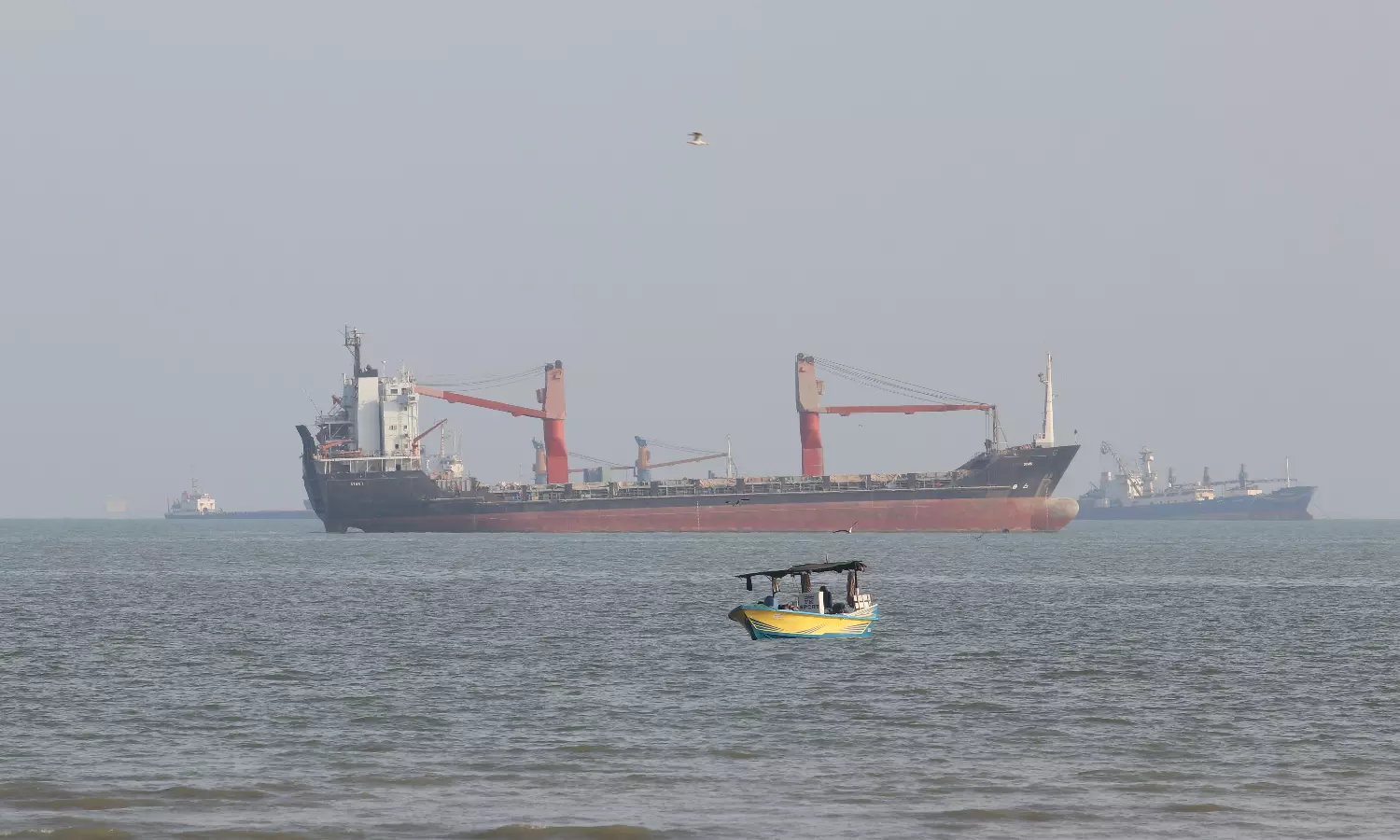
Indian Navy minesweepers are the missing piece in India’s answer to the mine claim now coming out of the Strait of Hormuz. On Saturday, Iran’s Islamic Revolutionary Guard Corps (IRGC) said a supertanker had hit a mine there. The Navy, according to defence reporting, has no dedicated mine countermeasure vessel in service, and the 12 it plans to buy remain at the tender stage after the Defence Acquisition Council (DAC) cleared them in July 2025.
The claim is Iran’s, and TES reports it as such. In its statement as reported, the IRGC Navy said the tanker carried more than two million barrels, took an “unauthorised” route, and exploded and caught fire after striking a naval mine. It also alleged the vessel had switched off its positioning systems and acted with US military support. CENTCOM and the UK Maritime Trade Operations (UKMTO) had not commented in the first reports, the vessel was not named, and the extent of the fire and the condition of the crew were unclear.
| Point | Who says it | Status |
|---|---|---|
| Supertanker hit a mine, exploded and caught fire | IRGC Navy | Not independently confirmed |
| Cargo of more than two million barrels | IRGC Navy | Not confirmed |
| Positioning switched off, US military support, “unauthorised” route | IRGC Navy allegation | Not confirmed |
| Vessel name and flag | Not given | Unknown |
| Damage and crew condition | Not given | Unknown |
| Earlier container-ship sinking attributed to a mine | IRGC Navy | Disputed: CENTCOM reportedly cites an Iranian projectile |
Whether the claim holds or not, the threat is not new. The IRGC has been accused of laying mines in the waterway during this war, which began in late February, and UKMTO logged at least 12 attacks on ships in the week to 16 October, ten of them in the Strait. For India the question is Indian Navy minesweepers and the capability they supply, because the Navy would face the same problem whichever weapon investigators eventually name.
Why Indian Navy Minesweepers Matter When India Imports Nearly 90 Per Cent of Its Oil
India imports nearly 90 per cent of its oil and energy needs, and the cargoes ride sea lanes through the Gulf and the wider Indian Ocean Region. Mines can be laid covertly, lie dormant, and fire on acoustic, magnetic or pressure triggers, which makes them slow to find and clear. A mine countermeasure vessel (MCMV) is built for that task, with a low-magnetic hull, high-resolution sonar and remote disposal systems, according to defence reporting by The Wire.
Surface escorts, including those the Navy has deployed under Operation Sankalp, are designed to counter missiles and aircraft. A mine is a different problem, and history is specific about it. In July 1987 the escorted tanker Bridgeton struck an Iranian mine near Farsi Island in the Gulf while under US Navy protection, and the escort did not prevent it. TES draws the lesson that warships do not substitute for mine clearance, which is why the Indian Navy minesweepers question sits next to the chokepoint analysis TES published in September.
The 12-Vessel Indian Navy Minesweepers Programme Cleared the DAC in July 2025 but Is Still at Tender Stage
On 3 July 2025, the DAC accorded Acceptance of Necessity (AoN) for 10 capital proposals worth about ₹1.05 lakh crore, all under the Buy (Indian-IDDM) category. They included Mine Counter Measure Vessels, Moored Mines, Super Rapid Gun Mounts and Submersible Autonomous Vessels. The Ministry of Defence said the purchases would help mitigate risks to naval and merchant vessels.
The MCMV line is reported at about ₹44,000 crore for 12 vessels, and defence reporting puts the Navy’s total requirement at 24. An AoN is the first of roughly a dozen procedural stages before a contract, as The Wire notes. Earlier attempts did not get that far: a ₹2,300-crore proposal for eight vessels from 2010–11 was terminated in 2015, and a ₹32,000-crore plan to build 12 at Goa Shipyard Limited with South Korea’s Kangnam Corporation collapsed in January 2018 over price and technology transfer, as contemporary reports noted.
The gap in Indian Navy minesweepers is stated plainly in that reporting. According to that reporting, the last of the Navy’s 12 Soviet-built Pondicherry-class minesweepers, INS Kozhikode, retired in April 2019, leaving no dedicated MCMV in service. The Navy has reportedly relied on interim measures since 2012, including 24 clip-on influence sweeps imported from Thales Australia, remotely operated vehicles and diver teams.
The response is now visible on the industrial side. On 14 May 2026, Larsen & Toubro (L&T) announced that, as prime contractor, it will offer an unmanned mine countermeasure suite, developed with France’s Exail, to every shipyard taking part in the Navy’s upcoming 12-vessel programme. L&T describes the suite as able to detect, classify, identify and neutralise mines from a stand-off distance. That is a company claim about a proposal and not a contract.
Figure: Indian Navy minesweepers programme, 2015 to May 2026. Source: Ministry of Defence (PIB), L&T press release, defence reporting.
Unmanned Mine Countermeasure Kit Could Reach the Fleet Before the Indian Navy Minesweepers Do
The 12 hulls will take years, and TES has not seen a delivery timeline for the 2025 programme. An earlier request for information, reported by a defence outlet, anticipated deliveries between 2030 and 2037. The unmanned suite is the nearer-term lever, since it keeps crews at a distance from the mine and can in principle be bought on a faster track than a new class of ships. TES assesses that whether the Navy fields such kit ahead of the hulls is the decision that will shape how exposed Indian cargoes are in the years before the hulls arrive.
The limits are real. A stand-off system finds and neutralises mines one by one, and clearing a busy lane still takes time. The Navy’s own stopgaps, according to the reporting above, lack the sensors and endurance of purpose-built vessels. Indian Navy minesweepers, once delivered, would give Indian-flagged shipping a sustained capability. Until then, the kit and its trained crews matter more than the hull count.
Brent Near $110 Already Prices the Attacks, and the Mine Claim Reaches Markets on Monday
Brent settled near $110 a barrel on Friday, up about 3.7 per cent, on reports of attacks on shipping around Hormuz, according to market reports. Hormuz oil flows were 11.6 million barrels per day in the seven days to 13 October, about 68 per cent of the 17.1 million pre-war baseline, according to Kpler figures, though trackers and the US government give different numbers. The IRGC statement was published on Saturday, after Friday’s close, so its effect on prices is untested.
For Indian refiners, a Gulf cargo that becomes riskier or costlier raises the weight of alternatives. TES assesses that Russian crude is the largest of them. Kpler expects India to keep buying 1.8 to 1.9 million barrels per day in October, and the US waiver of the Graham Act duties on 16 October removes one cost from that route for now, as TES set out in its analysis of the Russia sanctions waiver. The waiver can be withdrawn, so the arithmetic is provisional.
TES has also tracked how Gulf crude transfers off Gujarat are being used to reduce exposure, and how Hormuz oil flows have been measured.
What to Watch After the IRGC Mine Claim
- Whether CENTCOM or UKMTO name the vessel and the weapon, and whether crew casualties are reported.
- Whether the Ministry of Defence and the Navy issue the request for proposals for the 12 Indian Navy minesweepers, and which shipyards enter.
- Whether the Navy announces any interim unmanned or clip-on mine countermeasure deployment for Gulf of Oman escorts.
- How crude opens on Monday after a weekend of ship attacks and the mine claim.
Whatever Saturday’s investigation finds, the Ministry’s own wording from July 2025 already states the need: the vessels were cleared to mitigate risk to naval and merchant ships. The open decision is how fast the Indian Navy minesweepers tender becomes a contract, and whether unmanned systems are bought ahead of the hulls. The Bridgeton kept sailing in 1987. Indian cargoes have no guarantee of the same outcome.
Source note: Ministry of Defence (PIB) release of 3 July 2025, L&T press release of 14 May 2026, IRGC statements as reported by news agencies, UKMTO and CENTCOM information as reported, Kpler estimates and defence reporting on the Navy’s fleet. IRGC statements are presented as claims; assessments are marked as TES analysis.