
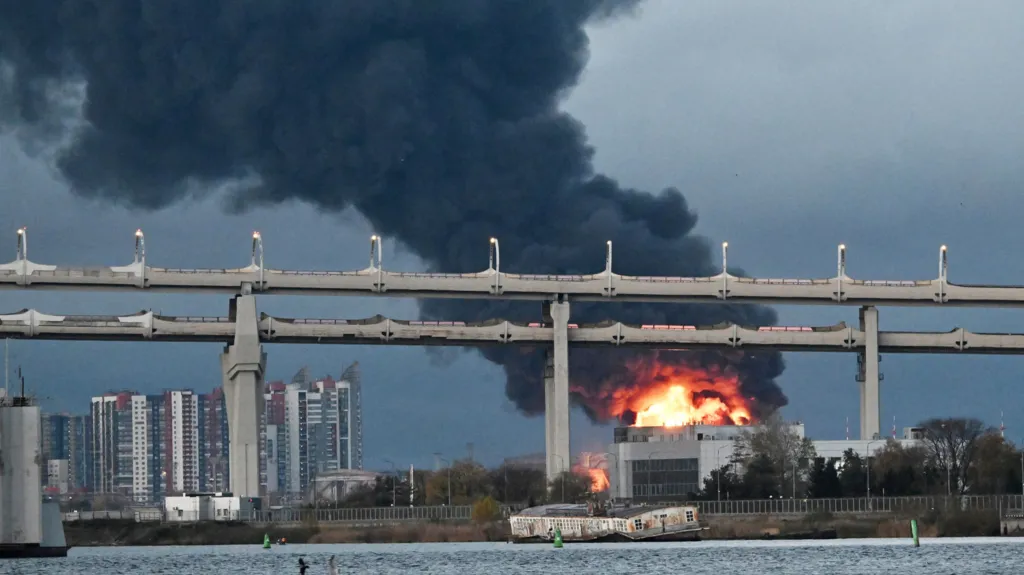
India averaged about 1.8 million barrels a day of Russian seaborne crude this year, ahead of China at 1.2 million, according to Kpler data reported in Indian media. On 16 October, Washington suspended the penalties under a US sanctions law that threatened that trade. Two days later, the St Petersburg oil terminal attack set fire to a Baltic fuel port. For Indian refiners the fires matter less than they look, because the port handles petroleum products rather than crude. The data centre hit on the same night is the part South Block should read closely.
What Did the St Petersburg Oil Terminal Attack Hit?
Russian authorities blamed Ukraine for the raid. Leningrad Oblast Governor Alexander Drozdenko said 126 drones were shot down over the region, a count the Kyiv Independent reported as 127. Fire Point, a Ukrainian drone maker, claimed its FP-1 was used against the terminal. TES found no official Ukrainian statement on this raid at the time of writing.
| Item | Source | Status |
|---|---|---|
| Fires at terminal, Ruchyi depot, Kolpinsky warehouses | Governor Beglov | Official statement |
| 126 drones shot down (127 per Kyiv Independent) | Governor Drozdenko | Official statement; counts differ |
| VK data centre in Leningrad Oblast attacked | VK | Company statement; damage undisclosed |
| FP-1 drones used on the terminal | Fire Point | Company claim |
| Fire at an Ozon logistics centre | Ozon, as reported by Mezha | Company report |
The terminal is a repeat target. President Volodymyr Zelensky confirmed a strike on it on 3 June, the opening day of the St Petersburg International Economic Forum, and Ukraine’s General Staff reported another on 4 July. In that July statement, published by Censor.NET, it put the tank farm at about 441,000 cubic metres. A fresh fire at the same site means the St Petersburg oil terminal attack of 18 October does not by itself mark a new phase of the campaign.
Why the Terminal’s Role Limits the Damage to India’s Crude Supply
The trade itself is under policy pressure and market pressure at once. Trump’s executive order of 16 October suspended provisions of the Lindsey O. Graham Sanctioning Russia and Iran Act of 2026 that could have imposed tariffs of up to 100 per cent on the five largest buyers of Russian energy, Swarajya reported. Kpler expects India’s October imports at 1.8 to 1.9 million barrels a day, with Urals trading at an average $23 below Brent in September. At roughly ₹95.5 to the dollar, that discount is about ₹2,200 ($23) a barrel. TES covered the waiver’s consequences in its analysis of the Russia sanctions waiver and India.
Volumes were already softening. The Centre for Research on Energy and Clean Air (CREA) said India’s Russian crude imports fell 13 per cent in September, and Kpler attributed part of the fall to tighter supply and stronger Chinese competition for Russian barrels, ETV Bharat reported. Exposure also differs by refiner. Nayara Energy, 49.13 per cent owned by Rosneft, has been under EU sanctions since July 2025, which separates its position from that of state-run refiners. The earlier effects of US tariff pressure on refiners are set out in TES’s report on India’s Russian oil tariff exposure.
The sharper risk for Indian buyers sits at crude loading ports. Primorsk, Russia’s largest oil-loading terminal, was struck in September 2025 and operations were temporarily suspended, and Reuters reported that Baltic ports halted oil loadings after a heavy raid on Ust-Luga on 25 March 2026. The historical comparison is Abqaiq on 14 September 2019, when drone and missile strikes on Saudi processing plants knocked out about 5.7 million barrels a day, according to Saudi Arabia, and showed how quickly a single concentrated node reprices a market. TES’s earlier look at a Ukrainian strike on a Russian energy site is in its Surgut drone attack report.
Why the VK Data Centre Strike Is the New Element in This Raid
The St Petersburg oil terminal attack and the data centre strike are different kinds of target, and the distinction is useful. The terminal has been hit before and its role in Russian export revenue is well documented. A data centre belonging to a private technology company is a different category of civilian infrastructure, and the open sources do not yet say how badly it was damaged or whether services were restored.
How Ready Is India’s Counter-Drone Cover Around Critical Sites?
Hard-kill capacity is being added. A ₹2.38 lakh crore procurement package cleared in March 2026 included the 2K22 Tunguska, a gun-and-missile system for low-altitude threats, according to BonV Aero, quoted by CXOToday. The same firm argues that gaps persist in urban areas and near sensitive infrastructure, where lethal systems risk collateral damage. That is the data-centre problem in one sentence: the sites that need protection most sit in or beside cities. DRDO’s directed-energy work, covered in TES’s piece on the DRDO Durga II laser weapon, addresses part of that gap.
Private suppliers are moving to fill the rest. Zen Technologies launched ZEN CITADEL on 31 August 2026, a system it designed for data centres and semiconductor fabs, and says it offers detection up to 5 km and jamming up to 3 km. Those are company claims. Central Industrial Security Force Director General Praveer Ranjan said in March that drone and anti-drone training would be a major element of the force’s next modernisation plan, citing drone attacks seen during Operation Sindoor and the Iran conflict. As India expands the facilities covered in TES’s guide to India’s AI infrastructure build-out, the protection question moves from procurement to law and licensing.
What Should Indian Refiners and South Block Watch Next?
- Crude ports: after the St Petersburg oil terminal attack, a repeat strike on Primorsk or Ust-Luga would affect Indian supply more than anything at the Petersburg terminal.
- Freight and insurance: quotes for Baltic loadings are the first place a real effect would appear.
- The waiver: whether the 16 October suspension holds will shape Kpler’s November intake numbers.
- VK’s disclosure: confirmation of damage, and any Ukrainian statement on why the data centre was a target.
- Indian guidance: any Home Ministry or Defence Ministry direction on counter-drone cover for private data centres.
In TES’s assessment, the likelier Indian consequence of the St Petersburg oil terminal attack is on policy and not on barrels. Refiners can absorb a products terminal going dark for some days, as the St Petersburg oil terminal attack shows. A government that has now watched a private data centre come under drone attack in a large European city has less room to treat civilian compute as outside its vital-installations list, and the first decisions will fall to the ministries that authorise jamming.