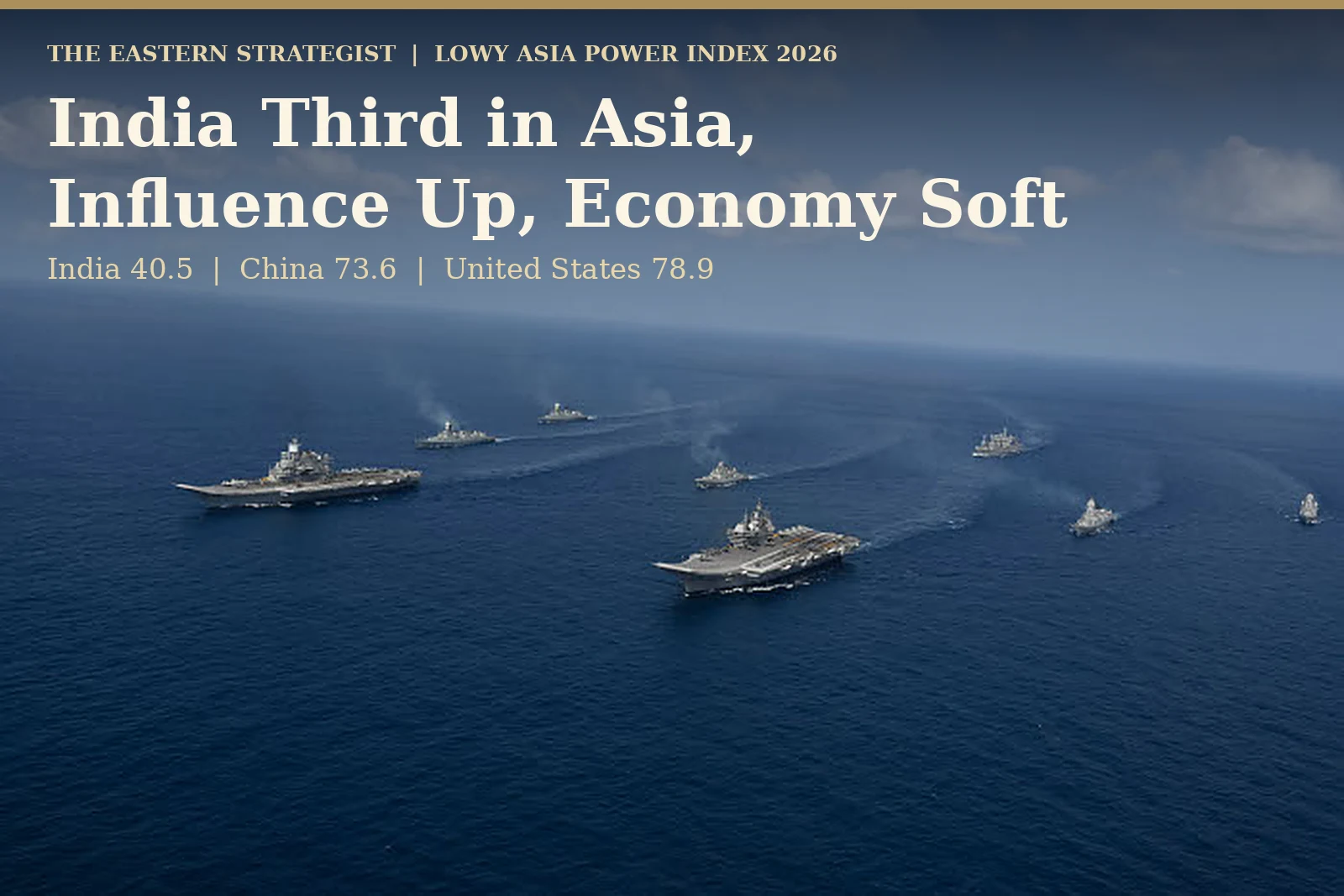
The Lowy Institute’s Asia Power Index puts India third in Asia on 40.5 points, with most of its influence scores up and its economic score down. New Delhi’s task now is to turn a better standing into leverage.
India holds third place in the Asia Power Index 2026 on 40.5 points, and the Lowy Institute, the Sydney think tank that publishes it, says India “played a much more influential role in Asia” this year. Its Economic Capability score slipped to 26.4. The United States recorded the largest fall of any country, 1.5 points to 78.9.
The result sets New Delhi a narrow test: can a rising influence score become leverage while the economy behind it is measured as softer? By TES’s reading of Lowy’s tables, India trails the United States on all eight measures of power and China on seven. The exception is Defence Networks, where India ranks ninth on 18.6 and China does not appear in the top ten. That measure counts alliances, exercises, defence dialogues and arms transfers, so it rewards a country with many partners.
What the Asia Power Index 2026 Says About India’s Influence
India scored 40.5, third behind the United States (78.9) and China (73.6), and is the only country outside the two superpowers above the 40-point “major power” line. Lowy says the India-China gap is the narrowest since 2018, though China’s power remains 80 per cent higher.
| Measure (Lowy) | India score | Rank | Lowy’s finding |
|---|---|---|---|
| Economic Capability | 26.4 | 3rd | Dipped slightly |
| Future Resources | 56.2 | 3rd | Rose on a better economic forecast |
| Economic Relationships | 19.9 | 7th | Up two places |
| Defence Networks | 18.6 | 9th | Up two places |
| Diplomatic Influence | 70.3 | 4th | Slipped slightly in a year most countries fell |
| Cultural Influence | 43.8 | 4th | Rose on all three dimensions |
Power Yield, a secondary analysis in the Asia Power Index, compares the power a country’s resources predict with the power it exercises. India’s is minus 3.3, so its resources run ahead of its influence, but it narrowed for the first time since 2023. Lowy says that, combined with the higher Future Resources score, this suggests India “can sustain its growing influence.” Japan’s plus 10.9 shows how far a country can outperform its resources. TES reads India’s negative yield as headroom.
India’s Economic Capability Score Is the Weak Link in the Asia Power Index
Lowy attributes the dip to a weaker rupee, a change in how the International Monetary Fund (IMF) measures economies, and a drop of nearly $20 billion in outbound investment. India stays third, just ahead of Japan (25.6), but far behind the United States (86.7) and China (86.1).
Lowy weights Economic Capability at 17.5 per cent and Economic Relationships at 15 per cent, so a third of the Index rests on the two measures where India is weakest against the leaders. India’s Economic Relationships score of 19.9 compares with 58.0 for the United States and 91.8 for China.
Lowy’s explanation concerns how India’s size is counted: the weaker rupee and the IMF change “dragged down” its relative GDP standing. That is a statement about measurement and exchange rates, not a finding that output fell. Future Resources, which looks to 2035 and 2050, rose to 56.2, third behind the two superpowers.
How BrahMos Exports Lifted India’s Defence Networks Score
Lowy says greater regional defence engagement and BrahMos sales to Southeast Asia lifted India’s Defence Networks score two places. Defence Secretary Rajesh Kumar Singh told ANI in an interview published on 1 October that India has “contracts or agreements” with three Southeast Asian countries: the Philippines, Indonesia and Vietnam.
Only the Philippine contract has a widely reported value: about $375 million, signed in 2022, according to Reuters as cited by Business Standard. TES has tracked India’s BrahMos deliveries to Manila. On Vietnam, Singh told the Shangri-La Dialogue that the deal had “already been signed, probably not publicly announced,” as India Today reported. Reuters, citing a source, put its value near $629 million; neither government has confirmed that. Indonesia announced an agreement in March and, in Singh’s May remarks, was in the “final stages.” TES’s report on the India-Vietnam BrahMos deal covers the Vietnam track.
Scale keeps the number in perspective. The United States scores 77.3 on Defence Networks and Japan 56.9. India’s 18.6 sits just below the Philippines at 19.2. TES’s assessment is that exports are one input, and the measure rewards sustained engagement: a first sale builds a customer, and a repeat order builds a network.
India’s Gulf Response: What Lowy Marked Down and What MEA Has Said
Lowy says perceptions of Narendra Modi’s global leadership and strategic ambition both diminished, reflecting a lower diplomatic profile during the Gulf conflict, and cites India’s “muted response” when a US submarine sank an Iranian naval vessel returning from an exercise India hosted. Lowy also rates Modi the second most effective regional leader, behind Xi Jinping.
The vessel was the frigate IRIS Dena. According to Associated Press reporting of 5 March, it had taken part in MILAN 2026 and the International Fleet Review hosted by the Indian Navy at Visakhapatnam, and sank in international waters off Sri Lanka. Sri Lanka’s navy recovered 87 bodies and rescued 32 sailors, AP said, and the Indian government had not then commented publicly.
The Ministry of External Affairs (MEA) has stated its position. External Affairs Minister S. Jaishankar told Parliament in a suo motu statement on West Asia on 9 March, “We believed and we continue to believe that dialogue and diplomacy should be pursued to de-escalate tensions and address underlying issues.” After the July escalation, MEA urged all parties to “exercise restraint, avoid escalation, and prioritise the safety of civilians,” as Republic World reported.
The two readings measure different things. In the Asia Power Index, Lowy scores how experts perceive ambition. MEA’s line reflects strategic autonomy, India’s exposure to Gulf energy, which TES tracks in its maritime security hub, and the safety of Indians in the region. The cost shows up as a perception score, while India’s Diplomatic Influence slipped only slightly to 70.3, fourth overall, in a year when nearly every country lost ground.
A Weaker US Opens Room for India in Asia, but Not the Top Rank
In the Asia Power Index the United States lost 6 points of Diplomatic Influence, the largest single fall on record, and 4.2 points of Defence Networks, the lowest since 2018. Lowy puts the US-China gap at 5.3 points, the narrowest recorded, and says the Iran war has depleted US long-range missile stocks.
Lowy expects Southeast Asian states to diversify trade and security partnerships as a hedge against US unpredictability if Washington keeps relying on tariffs. India’s offer is already visible there: BrahMos, and Su-30 maintenance offers to Malaysia and Vietnam. India is not the only taker of the opening. Lowy records US allies tightening ties with each other, including Australia’s agreement to buy Mogami-class frigates from Japan, which Lowy calls Japan’s largest defence export since the Second World War.
Lowy still calls the regional balance “markedly bipolar,” and India stands 33.1 points behind China. The Asia Power Index records a rising India, not a third pole.
India has faced this order of events before. In July 1991 a foreign exchange crisis forced New Delhi to pledge gold, and the liberalisation that followed made the Look East policy of 1992 possible. Economic repair came first and regional reach followed.
What to watch after the Asia Power Index 2026
- Economic Capability. Whether the rupee and IMF effects reverse and outbound investment recovers.
- BrahMos contract detail. Official values and schedules for Vietnam and Indonesia.
- Power Yield. Whether India’s minus 3.3 narrows again next year.
A stronger Economic Relationships score would do more for India’s leverage than another rank in Defence Networks. If the economic numbers recover alongside the defence and diplomatic networks, the next Asia Power Index could show influence backed by weight. If they do not, it will keep recording a country whose standing in Asia has risen faster than the economic weight behind it.
Source note: Lowy Institute Asia Power Index 2026 Key Findings report; Associated Press reporting on IRIS Dena; External Affairs Minister’s statement to Parliament of 9 March (Ministry of External Affairs text) and later MEA statements as reported by news outlets; Defence Secretary’s remarks as reported by ANI and India Today; Reuters reporting cited by Business Standard. Assessments are TES’s own.