
Defence & Geopolitics · Independence Day Special
Outranking Beijing in the sky, holding the chokepoint China fears in the Indian Ocean, and exporting to 80+ nations — told through the sky, the land, the water, and the economy underneath all three.
Pakistan’s own officials have now confirmed most of what India spent decades trying to prove about India’s military power. A former Indian high commissioner’s memoir revealed Islamabad’s panic over nine unlaunched missiles after the Balakot strikes. A Pakistani prime ministerial adviser admitted, on record, that his military had thirty seconds to decide whether an incoming BrahMos was nuclear-armed. Even Beijing has effectively conceded the same pattern from a different angle — its own strategists coined the term “Malacca Dilemma” to describe the exact chokepoint vulnerability India now sits astride. A raiding force in October 1947 made the identical misjudgment, assuming a nine-week-old country had nothing with which to defend Srinagar. Each time, the assumption was wrong, and each time, the correction has come from the other side, not from India’s own telling. Eighty years on, the pattern hasn’t changed — only where it is showing up now: not just on a battlefield, but in a shipyard delivering a new hull roughly every six weeks, an engine test cell, and a launch schedule.
Eight measures of India’s military power and the economy behind it, 2026
The Sky: India’s Military Power in the Air
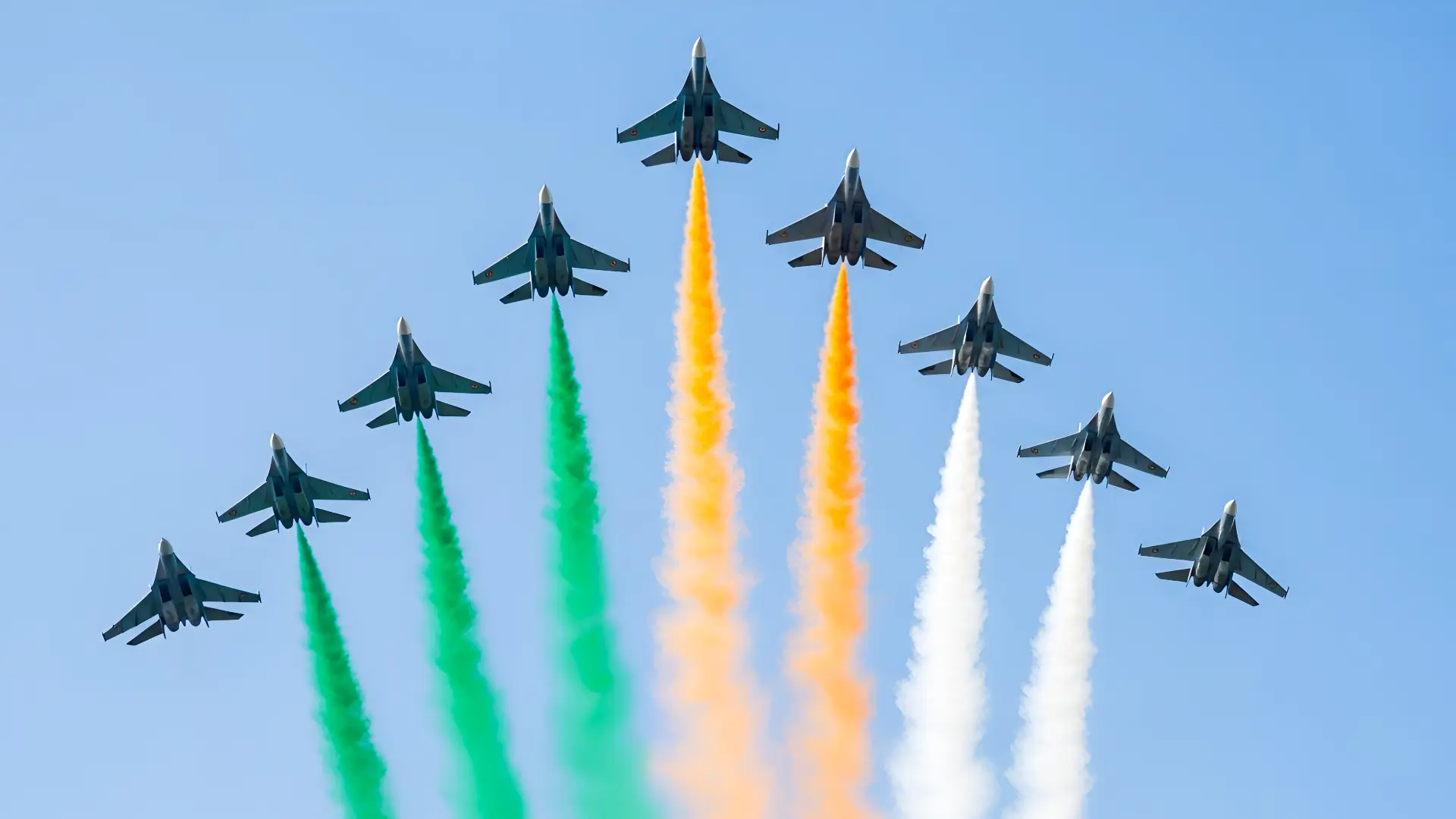
India’s military power in the air now outranks a much larger neighbour, on paper and in practice. The WDMMA’s 2026 Global Air Power Rankings place the Indian Air Force third in the world, behind only the United States and Russia, ahead of China’s PLAAF for the fifth consecutive year — a methodology that weights fleet balance and readiness over sheer numbers.
Behind that ranking sits real hardware. The Kaveri 2.0 engine, dead for two decades, has been revived this year at 81–83 kilonewtons of thrust with full afterburner, feeding directly into the AMCA, India’s fifth-generation stealth fighter, with a first prototype expected in 2028. The Netra airborne early warning system achieved Final Operational Clearance in 2026, putting India among just five nations that can build their own airborne surveillance aircraft. Higher still, ISRO is preparing an uncrewed test flight before the end of the year, ahead of Gaganyaan’s first crewed mission targeted for 2027 — the year India turns eighty, when three Indian astronauts could leave Earth on an Indian rocket for the first time.
The Land: India’s Military Power in Missiles and Exports
On the ground, capability that was once entirely imported now underpins India’s military power directly. In May 2026, India flight-tested a MIRV-capable Agni missile off the Odisha coast, striking multiple targets across the Indian Ocean from a single launch. In July, the Kusha long-range air defence system intercepted a simulated high-speed target on its maiden trial, validating an entire indigenous shield — radar, guidance, command — in one attempt.
These sit alongside the platforms already proven in combat: BrahMos, Akash, and Akashteer, the same systems that turned Pakistan’s Nur Khan airbase into a thirty-second decision for its own high command during Operation Sindoor in May 2025 — an episode Pakistan’s own prime ministerial adviser later described in strikingly candid terms. That combat record is now a sales pitch: defence exports hit an all-time high of ₹38,424 crore in FY 2025-26, up 62.66 percent in a single year, reaching more than 80 countries through 145 registered Indian exporters — a nation that spent most of its independent history importing arms now supplies them.
The Water: India’s Military Power at Sea
China’s own strategists have a name for their vulnerability here: the Malacca Dilemma. Nearly 80 percent of China’s oil imports pass through a channel barely three kilometres wide at its narrowest point — directly past India’s Andaman and Nicobar Command, the country’s first tri-service theatre command, where six Kalvari-class submarines now patrol.
The fleet built to hold that position is being assembled faster than at any point in Indian naval history. The Navy is commissioning a new warship or submarine roughly every six weeks in 2026, a record 19 vessels for the year, up from 14 in 2025. Construction timelines that once stretched eight to nine years per hull have been cut to about six, through modular blocks built to micron tolerances across Mazagon Dock, Garden Reach, and a growing bench of private shipyards.
India Rules: The Economic Power Behind It All
None of this runs on borrowed time. India is the third-largest economy on earth by purchasing power — behind only the United States and China — and the fastest-growing major economy in the world, at roughly 6.5 percent a year. That is the economic engine behind India’s military power today: the ships, the engines, the missiles, and the exports are not a government programme running on hope. They are what an economy this size, growing this fast, spends its returns building.
Every adversary in this country’s history has, at some point, mistaken India’s patience for weakness. The correction keeps arriving the same way — not as a claim India makes about itself, but as an admission someone else eventually has to make. The sky, the land, and the water all point the same way now. The rest of the world is still catching up to hearing it.
Frequently Asked Questions
Is India’s Air Force really ranked above China’s in 2026?
Yes, according to one specific index: the WDMMA’s 2026 Global Air Power Rankings place the IAF third globally, ahead of China’s PLAAF, based on a methodology that weights fleet balance, readiness, and technology over raw aircraft numbers.
How much are India’s defence exports in FY 2025-26?
An all-time high of ₹38,424 crore, a 62.66 percent increase over the previous year, reaching more than 80 countries.
What happened at Nur Khan airbase during Operation Sindoor?
A BrahMos missile struck Nur Khan airbase near Rawalpindi on 9–10 May 2025. Pakistan’s own officials, including a prime ministerial adviser, later confirmed the military had only 30–45 seconds to determine whether the incoming missile was nuclear-armed.
Is India the fourth-largest economy in the world?
Not currently by nominal GDP — India ranks sixth as of the IMF’s April 2026 World Economic Outlook, behind the US, China, Germany, Japan and the UK. By purchasing power parity, however, India is the third-largest economy in the world, and remains the fastest-growing major economy at roughly 6.5 percent annually.

4 thoughts on “India’s Military Power in 2026: The Global Scale That Can No Longer Be Ignored”