India has chaired BRICS three times before, but none of those hostings looked like what is coming this September, when New Delhi hosts the BRICS Summit 2026.
Why the BRICS Summit 2026 Is Different
When leaders gather in New Delhi on 12 and 13 September for the 18th BRICS Summit, it will be the first in-person leaders’ summit India has hosted since 2016 — the 2021 edition, held during the pandemic, was conducted virtually. It will also be the first time India hosts the bloc in its expanded form. What began in 2009 as five founding members — Brazil, Russia, India, China and South Africa — has grown to eleven full members, with Egypt, Ethiopia, Iran, the United Arab Emirates and Indonesia added since 2024. India assumed the rotating chairship from Brazil on 1 January 2026, under the theme “Building for Resilience, Innovation, Cooperation and Sustainability.”
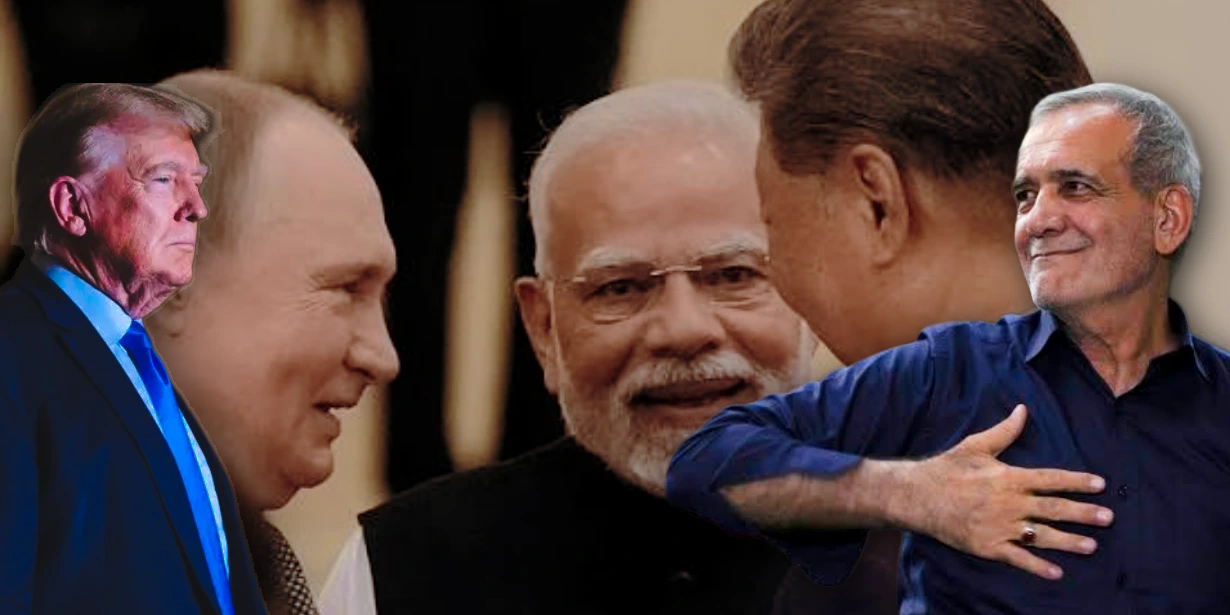
Structural firsts alone would make this a notable hosting. What makes this particular hosting unusually consequential is the guest list. Russian President Vladimir Putin has been confirmed by the Kremlin. Chinese President Xi Jinping is widely expected, though not yet formally confirmed by Beijing, in what would be his first visit to India since 2019. And Iranian President Masoud Pezeshkian will attend as the head of a state currently at war — the first time a wartime BRICS member’s leader has sat at the table under those conditions. Individually, any one of these three would be a lead story. Together, in one room, they turn a routine multilateral summit into the most closely watched diplomatic event India has hosted in years.
They also turn it into a story about photographs — because this will not be the first time this particular cast, or pieces of it, has appeared together on camera. And each previous time, the pictures caused trouble in Washington.
TES ANALYSIS — TIMELINE COMPILED FROM SOURCES CITED IN THIS ARTICLE
A Year of Photographs Washington Didn’t Like
Tianjin, August–September 2025
The first flashpoint came on 31 August and 1 September 2025, when Modi travelled to China for the first time in seven years to attend the Shanghai Cooperation Organisation summit in Tianjin. Photographs and video of Modi clasping Putin’s hand, laughing, and sharing a nearly hour-long car ride with him circulated widely. Trump’s trade adviser, Peter Navarro, called the display a “shame” and said India was “getting in bed” with Xi and Putin. Trump himself posted on Truth Social offering sarcastic “warmest regards” to Xi, Putin and North Korea’s Kim Jong Un, accusing them of conspiring against the United States.
Beijing’s Victory Day Parade
The second came two days later, on 3 September, when Beijing staged its largest-ever military parade to mark 80 years since the end of the Second World War. Xi, Putin, Kim and Pezeshkian stood together at the event — a grouping Western commentary quickly labelled the “axis of upheaval.” Modi was not present. CNN’s Van Jones told viewers the image of “Xi with Putin, with Modi from India, with the leader of Iran, with the leader of North Korea” should “send a chill down the spine of every American,” calling it “a dagger aimed at the heart of the West.”
Putin’s Return Visit, and Congress Notices
The third came on 4 and 5 December, when Putin made a state visit to India — Modi hosted a private dinner at his residence and presented Putin with a Russian-language copy of the Bhagavad Gita. The car selfie from that visit was still circulating five days later when Congresswoman Sydney Kamlager-Dove, Democratic ranking member of the House Foreign Affairs Subcommittee on South and Central Asia, held up a poster in a hearing room carrying that photograph alongside the Tianjin image of Modi with Putin and Xi together. “This poster is worth a thousand words,” she said. “You do not get a Nobel Peace Prize by driving US strategic partners into the arms of our adversaries.”
Three flashpoints in just over three months, each involving a different subset of the same cast: Modi with Xi and Putin in Tianjin; Xi, Putin, Kim and Pezeshkian in Beijing; Modi and Putin in New Delhi. On 12 and 13 September, all three threads are positioned to converge for the first time in a single frame — with Modi as host rather than guest, and with Pezeshkian, absent from the Tianjin and December photographs, now in the room as well.
Can Eleven Members Agree on Anything?
Whether that produces a viral image or not, the structural question underneath it is real: can an eleven-member bloc this internally varied — spanning states with sharply different relationships to the United States, Israel and each other — actually agree on anything at the table. India has its own red lines here, including safe-passage guarantees for the Indian seafarers who crew much of Gulf shipping, and a determination not to let any joint text jeopardise defence and technology relationships with Washington, such as the pending transfer of GE F414 jet engine technology. Whether the summit produces a full joint declaration, a watered-down compromise, or a unilateral chair’s statement from India remains an open question rather than a settled one.
Two Balancing Acts, Not One
The story that follows from all this is usually told as India’s balancing act alone — New Delhi trying to keep Washington, Moscow and Beijing simultaneously satisfied. That framing is incomplete. Washington has a balancing act of its own to manage in the weeks around this summit, and the choices it is making suggest real uncertainty inside the administration about which instinct should win.
India’s Side of the Ledger
India’s side is already well documented. At the same 10 December hearing where Kamlager-Dove displayed her poster, she noted that cumulative US tariffs on Indian goods had reached 50 percent — among the highest imposed on any country, and higher than the rate applied to China — while, in her words, Moscow and Beijing were “getting pretty good deals” by comparison. She also criticised a $100,000 fee imposed on H-1B visa applications, roughly 70 percent of which are held by Indian nationals, and warned that Trump risked being remembered as the president “that lost India… while revitalising the Russian empire.” Representative Pramila Jayapal told the same hearing that a fifth-generation family business in her district described the tariffs as the greatest threat to its operations “in over 120 years.” The same hearing noted that the annual Quad Leaders’ Summit, which India is expected to host, has been indefinitely postponed. Subcommittee chairman Bill Huizenga, a Republican, struck a different note — calling the relationship “a defining relationship of the 21st century” — while also relaying that Latvian lawmakers had pressed him to get India to stop buying Russian oil. Expert witnesses from the Heritage Foundation, the Observer Research Foundation America and the Special Competitive Studies Project were unanimous, despite the partisan disagreement, that the relationship remains indispensable to countering China’s regional influence.
Washington’s Parallel Backchannels
Washington’s side is less discussed, and considerably more complicated than a simple choice between pressuring India economically and courting it diplomatically. Over the four months before the BRICS Summit 2026, the Trump administration has run parallel, and not obviously coordinated, tracks with nearly every power due to sit in New Delhi in September.
In May 2026, Trump himself travelled to Beijing for his second state visit to China and the first of his second term — a trip delayed from March because of the Iran war, which then dominated the conversation once the visit went ahead, given China’s position as the largest buyer of Iranian oil amid the ongoing US blockade of the Strait of Hormuz. Xi announced the two sides had agreed to pursue “a constructive China-US relationship of strategic stability.” That summit came eight months after Trump had mocked Xi, Putin and Kim Jong Un on Truth Social for “conspiring” against the United States following the Tianjin photographs — a reminder that Washington’s own China posture has swung between confrontation and summitry within the same year it has criticised India for standing too close to Beijing.
Then, on 25 August — the day before this piece went to press — CIA Director John Ratcliffe arrived in Moscow, according to reporting by CNN, CBS News, Axios and The Washington Post, all citing people familiar with his travel; neither government has officially confirmed the visit or its purpose. It is the first known trip to Russia by a sitting CIA director since William Burns travelled there in November 2021 to warn the Kremlin against invading Ukraine, and reportedly the highest-level visit by a Trump administration official to Moscow since envoys Steve Witkoff and Jared Kushner met Putin in January. It came one day after Treasury Secretary Scott Bessent announced “Operation Economic Outcast,” a new campaign to isolate Iran by penalising entities that continue trading with it — meaning Washington tightened the economic screws on Tehran and opened a quiet channel to Moscow within roughly a day of each other.
Set against that backdrop, Sergio Gor’s Kashmir outreach to India on 19 and 20 August looks less like an isolated goodwill gesture and more like one thread in a wider pattern. Gor made the first standalone visit by a US envoy to Jammu and Kashmir since the abrogation of Article 370 and last year’s Pahalgam attack. Meeting Chief Minister Omar Abdullah in Srinagar, he described Kashmir as “an important part of India” and said Washington was reconsidering its long-standing “do not travel” advisory, citing improved security. The remarks were read in Islamabad as a real shift: Pakistan’s foreign ministry summoned the top American diplomat in the country within hours, called Gor’s language “factually incorrect,” and said it “negated Washington’s longstanding position” of treating Kashmir as disputed territory. Gor’s visit is not, on its own, a formal declaration of new US policy — the State Department has issued no accompanying policy statement — but it fits a pattern rather than standing apart from one.
Washington sought “strategic stability” with Beijing in public, quietly re-engaged Moscow while squeezing Tehran economically, and courted New Delhi on Kashmir — all within the same four months, and without ever reconciling the tariffs and H-1B fees still weighing on India.
What This Means Heading Into 12–13 September
Read together, the four months before the BRICS Summit 2026 show an administration running separate, largely uncoordinated backchannels with China, Russia, Iran and India all at once. These are not obviously reconcilable postures, and nothing in the public record suggests Washington has resolved which of them should govern its approach heading into a summit where the leaders on the other end of all four backchannels will be sitting at the same table.
For India, the balancing act is choosing which partner to disappoint least. For Washington, it may not be a single choice at all — it may be several simultaneous, uncoordinated ones, tested all together on 12 and 13 September, when the people on the other end of those backchannels sit down in New Delhi, in front of the cameras, for the first time.
Source Transparency Note
Verified fact (multiple independent sources): BRICS Summit 2026 dates, host, chairship history and membership expansion; Putin’s Kremlin-confirmed attendance and Xi’s expected-but-Beijing-unconfirmed attendance; Pezeshkian’s confirmed attendance; the Tianjin SCO summit events and reactions (Navarro, Trump); the Beijing Victory Day parade attendees and Van Jones’s quoted remarks; Putin’s December 2025 state visit; the Kamlager-Dove hearing, her exact quotes, and the poster’s contents; Jayapal’s and Huizenga’s hearing remarks; Sergio Gor’s Kashmir visit dates, remarks, and Pakistan’s formal protest; Trump’s 13–15 May 2026 state visit to Beijing and Xi’s “strategic stability” remark; Bessent’s 24 August announcement of “Operation Economic Outcast.”
Reported but not officially confirmed by either government: CIA Director John Ratcliffe’s 25 August visit to Moscow — sourced to CNN, CBS News, Axios and The Washington Post, each citing people familiar with his travel, but without an on-record confirmation from Washington or Moscow of his presence or purpose.
TES Analysis / open question: whether the summit produces a full joint declaration; whether Washington’s various backchannels reflect a coordinated strategy or genuinely uncoordinated parallel tracks; the characterisation of Gor’s remarks as reflecting a possible policy drift rather than a declared change.
Not included due to insufficient sourcing: claims regarding a “BRICS Pay” operational rollout timed to this summit, and reports of intra-bloc ministerial divisions between Iran and the UAE at preparatory meetings.

3 thoughts on “BRICS Summit 2026: Modi’s Photo Test and Washington’s Balancing Act”