
Defence Analysis
Fifty major components. Roughly 180 sub-components. Close to 120 manufacturing processes. Those are the numbers behind the sentence Major General S.K. Sharma posted this week: that the Indo-Russian Rifles Private Limited (IRRPL) had test-fired the first AK-203 “Sher” rifle built with 100% Indian components and input materials, at its plant in Korwa, Amethi.
Most coverage of the AK-203 test-fire stopped at that headline. The more interesting story is what those numbers, and the programme’s own account of how it got there, actually reveal — about what “indigenisation” costs, who builds it, and how long it takes even after the hard part is supposedly done.
There is also a tidy symmetry buried in the dates. The first AK-203 to roll off IRRPL’s line, assembled largely from imported kits, appeared in August 2023. The first genuinely 100% Indian-made Sher was test-fired in August 2026. Three years, same month, opposite ends of the same production line.
From INSAS to AK-203: why the rifle changed
The AK-203 exists to replace the INSAS, the 5.56mm rifle that has armed Indian infantry since the mid-1990s. INSAS was never fully trusted in the field — magazine cracking and jamming at high altitude, particularly in the Himalayas, were persistent complaints, and the design was flagged as operationally inadequate as early as 2010. India signed an inter-governmental agreement with Russia to manufacture a Kalashnikov-pattern replacement domestically, and IRRPL was incorporated in 2019, with the Korwa facility inaugurated the same year.
There is a quieter link in this story that connects the rifle being replaced to the one replacing it. India’s oldest firearms factory, the Rifle Factory Ishapore in West Bengal — which built the Lee-Enfield from 1904, designed the indigenous 7.62mm Ishapore rifle after the 1962 Sino-Indian War, and later manufactured the INSAS itself — was corporatised in 2021 under Advanced Weapons and Equipment India Limited (AWEIL). AWEIL is also the lead Indian shareholder in IRRPL. India’s oldest rifle-making establishment and its newest now answer to the same parent company.
The contract that followed was substantial: signed on 6 December 2021, for 6,01,427 rifles, with India holding 50.5% of IRRPL (through AWEIL and Munitions India Limited) against 49.5% held by Russia’s Concern Kalashnikov and Rosoboronexport. Its value is reported as Rs 5,200 crore by Business Standard and Rs 5,124 crore by other secondary sources; the Ministry of Defence’s own Rajya Sabha reply confirming the deal specifies no rupee figure at all. The first 70,000 Russia-made rifles reached the Indian Air Force in January 2022; India-based assembly began in 2023.
Timeline: From Kalashnikov’s Workbench to Korwa
Army user trials follow — September per Business Standard’s 23 August report, October per IRRPL’s own statement to Sputnik India on 20 August. Full delivery of 6,01,427 rifles is now targeted for December 2030, against an original October 2032 deadline.
What “100% indigenous” actually required
IRRPL received full technology transfer from Russia in 2023-24 — the design was never in question. What took another two years was converting that design into something India could build without Russian sign-off at any stage: sourcing every one of the roughly 180 sub-components domestically, converting material specifications from Russian GOST standards to Indian Standards (IS), and building the testing and quality-validation capability in-house at Amethi, work that previously required Russian approval.
In an exclusive interview with Sputnik India, Sharma described the approach as a structured, component-by-component localisation programme built on vendor development and rigorous quality assurance, rather than simply substituting Indian parts into an imported process. IRRPL says it has also ensured that all 180 sub-components now have an alternate Indian source — a deliberate hedge against single-vendor failure, and the kind of supply-chain resilience measure that rarely makes it into wire coverage of a rifle test-fire.
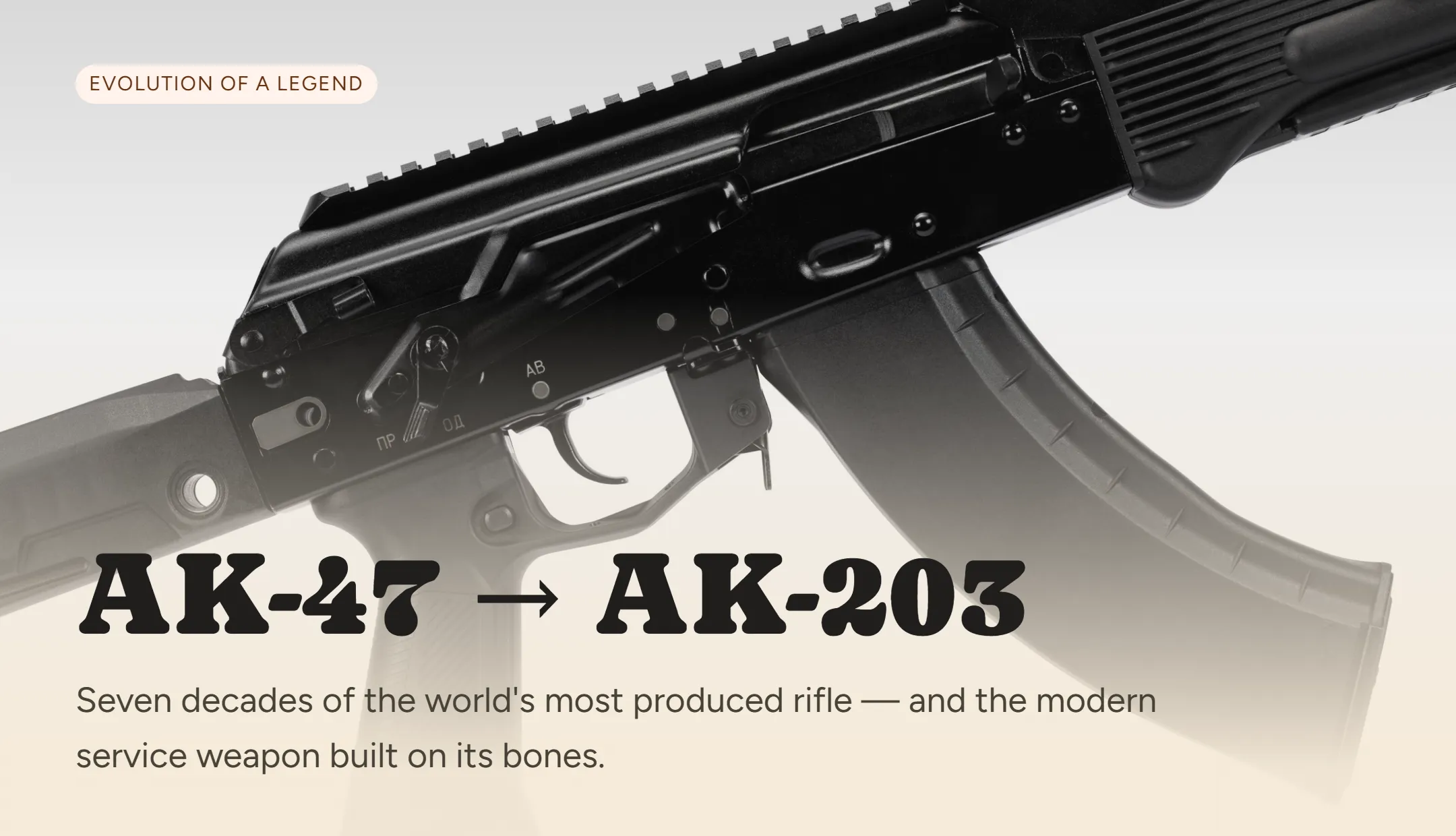
AK-47 vs AK-203: Same DNA, Different Rifle
What IRRPL indigenised in Amethi was not a new rifle concept. It was the manufacturing DNA of the world’s most-copied weapon, rebuilt in Indian steel, three-quarters of a century after Kalashnikov’s original design.
The MSME backbone
The programme’s vendor base has grown to nearly 100 MSMEs, and IRRPL’s own account of the process is that these firms did not simply supply parts — many had to build entirely new capability in precision manufacturing, specialised materials, heat treatment, surface treatment and tooling to meet defence-grade quality standards. That is a familiar pattern in India’s broader defence-indigenisation push, and one TES has tracked across the wider MSME ecosystem feeding into larger platforms.
It also points to a gap in the standard “market angle” for a story like this. AWEIL and Munitions India, IRRPL’s Indian shareholders, are unlisted defence PSUs; there is no single tradable stock that captures AK-203 exposure the way, say, Mazagon Dock captures submarine-building exposure. The investable story here, if there is one, sits diffused across the MSME vendor base and the broader indigenisation list the Ministry of Defence has been publishing — most recently its sixth positive indigenisation list — rather than in any single listed name.
The economics, and a preponed deadline
Run the numbers on the headline contract and a rough per-unit cost emerges: across 6,01,427 rifles, the reported contract values work out to approximately Rs 85,200–86,500 per rifle, depending on which figure is used — a TES calculation, not an official IRRPL figure, but a useful anchor against the roughly $1,100 (about Rs 90,000 at contemporaneous rates) per-rifle cost quoted when the original deal was being negotiated.
IRRPL says capacity gains — production is being pushed toward one rifle every 100 seconds, up from roughly 300 a day in mid-2025 — have let it preponed the delivery schedule by close to a year, with full delivery now targeted for December 2030 rather than October 2032. Army user trials of the fully indigenous AK-203 Sher come next; here the public record is not perfectly aligned. Business Standard’s 23 August report cites “next month,” implying September, while Sharma told Sputnik India directly on 20 August that trials would begin in October. Both are IRRPL-linked statements within days of each other; TES has not found a reconciling source and treats the trial date as September or October 2026 pending Army confirmation.
Beyond the Army
The AK-203’s domestic buyer base was never going to stop at the Army’s 6.01 lakh rifles. IRRPL’s own account, as of mid-2025, was that close to 15 forces — central armed police, ten state police forces and elements of the special forces — had shown interest, and IRRPL won a tender to supply Kerala Police, reported in May 2025, which would make it the second Indian law-enforcement agency to acquire the rifle. That domestic diversification matters more than it looks: it gives IRRPL a demand base that does not depend entirely on the Army’s delivery timeline, and echoes a pattern TES has flagged elsewhere in India’s wider defence-export push under Rajnath Singh’s tenure.
The unmet target, and what comes next
Not every part of this story is a straightforward win. In July 2025, IRRPL publicly targeted its first AK-203 export order by mid-2026, citing strong interest from the Middle East and North Africa and some interest from Southeast and South Asia. That window has now passed with no confirmed export deal reported. Sharma’s most recent public comments, on 20 August, still describe export enquiries as active rather than converted, and are explicit that IRRPL’s priority for now remains finishing the Army’s 6.01 lakh rifles before chasing exports — a reasonable sequencing decision, but a missed self-set deadline nonetheless.
The Sher is also not intended as IRRPL’s last product. The company’s stated next phase is domestic manufacture of the AK-19 and PPK-20, extending the same MSME-built supply chain to a wider family of small arms rather than treating the AK-203 programme as a one-off achievement.
Why it matters
The headline claim — “100% indigenous” — is the kind of language that invites scepticism, and on a strict design-versus-manufacture reading, it deserves some: the AK-203 remains a Russian design, transferred to India under a formal technology-transfer agreement, not an Indian invention. But manufacturing sovereignty is its own achievement, distinct from design sovereignty, and the 180-component supply chain IRRPL says it has built — with dual sourcing, in-house validation and a near-100-strong MSME base — is a more durable outcome than the headline number suggests. Three years after the first import-kit rifle left Korwa, the programme’s harder claim is not that it built a rifle, but that it built the capability to keep building one without Russia in the room.
Source transparency: Rifle count, shareholding and the 2021 signing date are drawn from a Ministry of Defence reply in the Rajya Sabha (PIB), which does not itself state a contract value; the Rs 5,200 crore and Rs 5,124 crore figures cited come from secondary reporting (Business Standard and other outlets respectively) and are presented as a range rather than a single confirmed number. Production figures, the componentry breakdown, MSME numbers and the GOST-to-IS detail are drawn from Major General S.K. Sharma’s on-record statements to Sputnik India and Business Standard between 20 and 23 August 2026. The per-rifle cost figures are a TES calculation based on the reported contract values and rifle count, not IRRPL-issued numbers. The Kerala Police procurement is reported as a won tender (May 2025), not a confirmed signed contract. Historical AK-family dates are drawn from standard reference sources. Where IRRPL’s own public statements conflict on the trials date, both versions are presented rather than resolved.