A submarine’s greatest advantage is that no one can find it — which is also, for the crew inside, its greatest danger. On 31 August 2026, the Indian Navy commissioned the second ship built to close that gap.
A submarine’s greatest advantage is that no one can find it. That is also, for the sailors inside, its greatest danger. When something goes wrong on the seabed, rescue depends entirely on whether a nation has a ship built for exactly that moment, sitting ready, somewhere on the right coast. On 31 August 2026, the Indian Navy closed a long-standing gap in that equation.
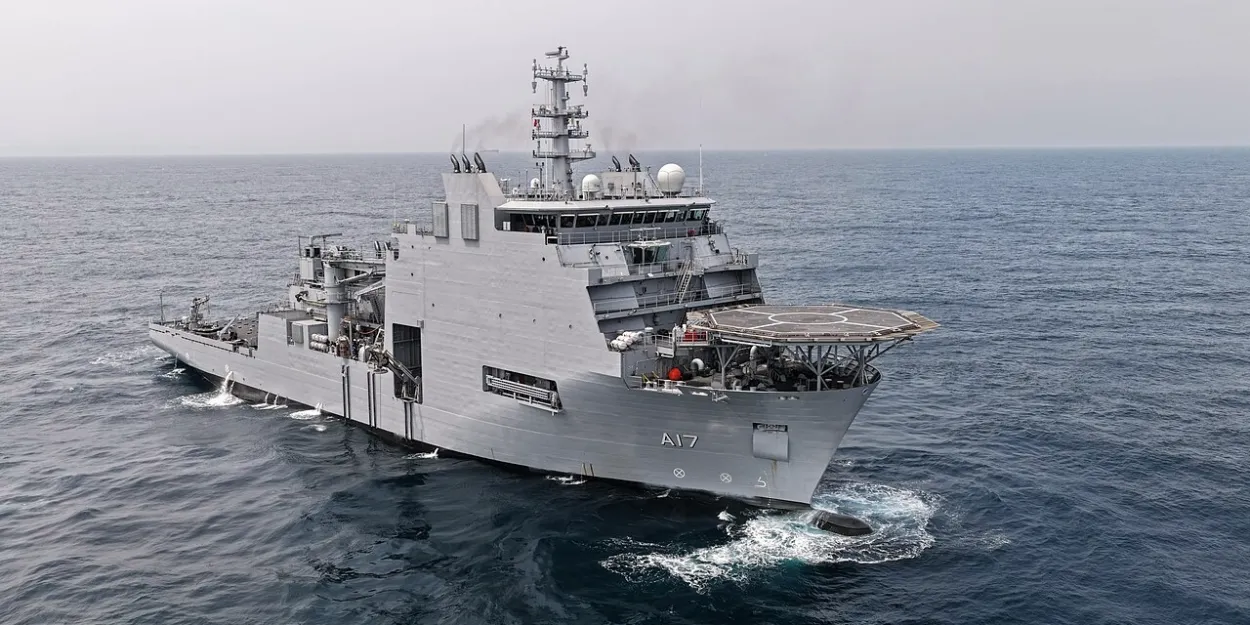
INS Nipun, the second Diving Support Vessel (DSV) of the Nistar class, was commissioned into the Indian Navy at Naval Dockyard, Mumbai, in a ceremony presided over by Admiral Krishna Swaminathan, Chief of the Naval Staff (CNS), in the presence of Vice Admiral Sanjay Vatsayan, Flag Officer Commanding-in-Chief, Western Naval Command, according to a Ministry of Defence statement. Senior naval officers, representatives of builder Hindustan Shipyard Limited (HSL), veterans and families of the commissioning crew attended.
Why a diving ship matters as much as a destroyer
Warships project power outward. INS Nipun exists for the opposite reason: to bring people back. Its primary task is deep-sea diving, underwater intervention and, critically, submarine rescue — a capability that, per the Ministry of Defence, only a handful of navies worldwide possess.
The stakes of that gap are not hypothetical. In 2021, the Indian Navy deployed one of its two Deep Submergence Rescue Vehicles (DSRVs) to assist the Indonesian Navy’s search for KRI Nanggala, a submarine that went missing during a training exercise near Bali with 53 crew aboard. The vessel was later found broken apart on the seabed; there were no survivors. The episode was a stark reminder that in a submarine emergency, the constraint is rarely equipment alone — it is how quickly a mothership can get a rescue vehicle to the right patch of ocean.
India’s two DSRVs, procured from the United Kingdom in 2018 and 2019 and rated to operate at depths of roughly 650 metres, previously lacked a purpose-built home on each seaboard.
INS Nistar, commissioned in July 2025 at Visakhapatnam, gave the Eastern Fleet that platform. INS Nipun now extends the same capability to the Western Fleet, meaning India’s submarine arm — spread across both coasts and increasingly built around indigenous boats — finally has dedicated rescue infrastructure within reach of its underwater assets on either seaboard.
What the new vessel can actually do
According to the Ministry of Defence, INS Nipun is designed to support saturation, air and heliox diving, and carries remotely operated vehicles (ROVs) for underwater inspection and intervention. It is fitted with a dedicated diving complex, dynamic positioning for holding station over a dive site in open water, and life-support and medical facilities intended to sustain complex operations at sea for extended periods.
News agency PTI reported the ship is 119.4 metres long with a displacement capacity of 10,500 tonnes and can support diving operations to depths of around 300 metres; other technical assessments place the class closer to 118 metres and roughly 9,350 tonnes, a variance typical of figures still being finalised around a newly commissioned platform. What is consistent across sources is the vessel’s role as a mothership for India’s DSRVs, its saturation-diving capability, and its secondary function in Humanitarian Assistance and Disaster Relief (HADR) and salvage operations — a versatility that matters as much in a cyclone response as in a submarine crisis.
The ship’s crest carries a whale, symbolising endurance in deep water, alongside a diving helmet representing the divers the vessel exists to support. Her motto, “Far Beneath, Few Beyond,” and the crew’s watchwords — Nischay, Nirbhay, Nipun (Resolve, Fearlessness, Professional Mastery) — reflect a mission defined less by firepower than by readiness under pressure.
Built entirely at home
INS Nipun was designed and constructed by Hindustan Shipyard Limited (HSL), a Visakhapatnam-based defence public sector undertaking, under a contract signed with the Navy in September 2018 covering two Nistar-class vessels. Her keel was laid in 2020 and she was launched in 2022, before being handed over to the Navy on 30 July 2026 following outfitting and sea trials. The Ministry of Defence has described the programme as incorporating a high proportion of indigenous content, with industry reporting figures near 75 percent — continuing a pattern set by INS Nistar, which involved roughly 120 Indian MSMEs and was delivered with more than 80 percent domestic content.
For HSL, a shipyard whose roots trace to the pre-Independence Scindia Shipyard, the Nistar class represents a step into a specialist category — saturation-diving and rescue vessels — that only a small number of global shipbuilders attempt. It sits alongside the yard’s other Aatmanirbhar Bharat-linked work, part of a broader indigenisation push that TES has tracked across India’s wider shipbuilding sector and the Navy’s growing use of domestic MSMEs, seen recently in the delivery of INS Samarthak.
The market angle: who actually benefits
HSL itself is a wholly government-owned, unlisted public sector undertaking — there is no direct equity play on the shipyard that built her. The investable story sits one layer out, in the listed shipbuilders and systems suppliers riding the same indigenisation cycle: Mazagon Dock Shipbuilders, Cochin Shipyard and Garden Reach Shipbuilders & Engineers (GRSE) all draw on an expanding Navy order book that now spans submarines, diving support vessels and auxiliary platforms, a pipeline TES has examined in the context of Project 75I and India’s submarine-industrial base. Specialist original equipment manufacturers supplying dynamic-positioning systems, diving compression chambers and ROVs — several of them MSMEs — stand to gain as the Navy potentially commissions further specialist vessels beyond the two-ship Nistar contract.
A regional signal, not just a domestic milestone
Admiral Swaminathan, addressing the commissioning, said combat readiness remains the Navy’s highest priority in an increasingly contested maritime environment, and noted that INS Nipun’s niche capabilities position India as a “Preferred Submarine Rescue Partner” in the region. That framing matters strategically: submarine rescue is one of the few military capabilities that functions as pure public good — a nation that can reach a stricken submarine, its own or an ally’s, earns a form of trust that weapons platforms cannot replicate. India demonstrated the value of that trust in 2021; it now has twice the dedicated infrastructure to offer it again.
What to Watch Next
Will India build more Nistar-class ships?
The original 2018 contract covered only two vessels. Whether the Navy orders further diving support ships — potentially for the Andaman and Nicobar Command, given its proximity to the Malacca Strait and rising submarine traffic in the Bay of Bengal — remains unconfirmed. This is a TES Analytical Assessment, not a reported programme decision.
What happens to INS Nipun next?
The ship moves into operational workup on the West Coast under Western Naval Command, integrating with the fleet’s submarine arm and existing DSRV assets before entering routine service.
Does this change India’s submarine rescue diplomacy?
With dedicated rescue ships now on both coasts, India is better positioned to offer rapid assistance to regional navies in a crisis, reinforcing the Navy’s stated role as first responder in the Indian Ocean Region.
The takeaway: INS Nipun carries no missiles and fires no torpedoes, yet it may do more for the credibility of India’s submarine fleet than either. A navy’s strength beneath the waves is measured not only by how well it can disappear, but by whether it can bring its people home when something goes wrong. With INS Nistar and INS Nipun now covering both coasts, India has quietly closed that gap — not with a weapon, but with a promise it can now actually keep.