
On 10 August 2026, Vietnamese officials gathered at Song Thu Corporation’s shipyard in Da Nang for a steel-cutting ceremony — the formal start of construction on what Vietnam’s Ministry of National Defence is calling the country’s largest and most advanced domestically built warship. State media framed it as proof of a genuinely self-reliant design. It is the clearest marker yet of Vietnam’s indigenous frigate ambitions, and the Vietnam indigenous frigate story deserves a closer look than the ceremony’s own language offers.
Look at what is actually going into the hull, though, and the picture gets more interesting. The frigate’s stern will carry RBU-6000-style anti-submarine rocket launchers, a Soviet design dating to the 1960s. Its main gun is an AK-176 derivative, built domestically by Vietnam’s Z173 and Z125 factories. Its flight deck is sized for a Kamov Ka-28, a Cold War-era Russian helicopter Vietnam has flown for years. “Indigenous” and “Russian-derived” are not opposites in this ship. They are describing the same object from two different angles.
That tension is worth sitting with, because it explains more about Vietnam’s defence-industrial ambitions than the ceremony’s headlines do.
Vietnam Indigenous Frigate: What It Is Meant to Replace
Vietnam’s surface fleet today rests overwhelmingly on Russian hardware — a dependency this frigate is designed to start correcting, even if it cannot end it in one build cycle.
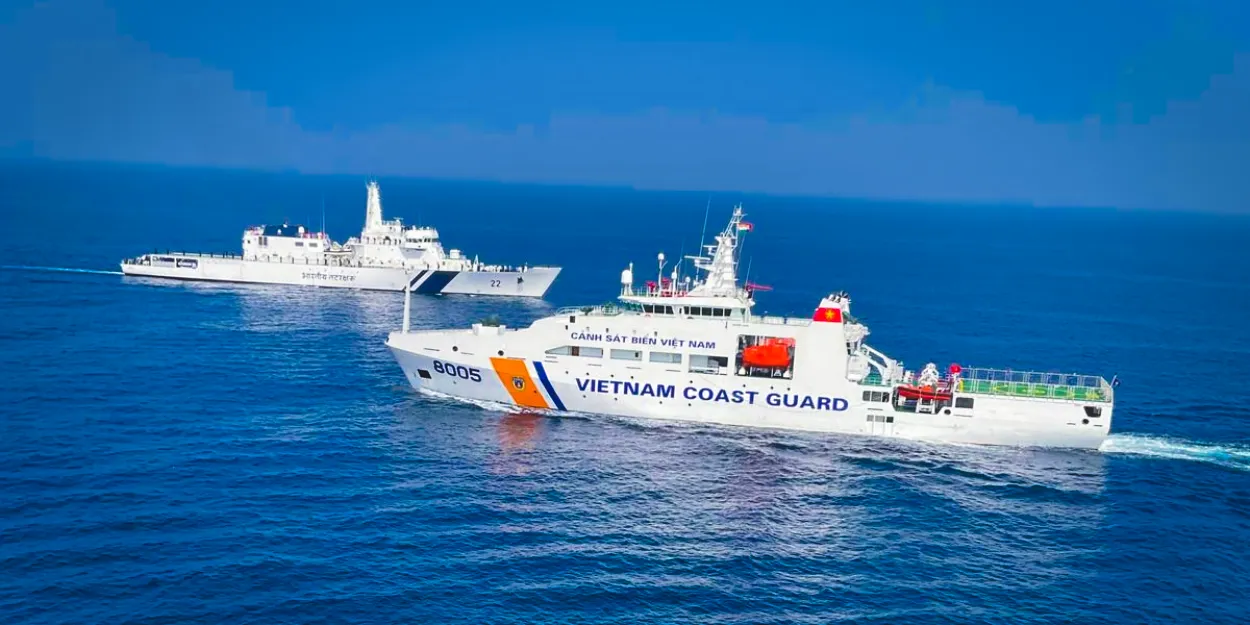
The Vietnam People’s Navy operates four Gepard-class frigates built at Zelenodolsk in the 2000s and 2010s: Đinh Tiên Hoàng, Lý Thái Tổ, Trần Hưng Đạo and Quang Trung. Only the latter two carry dedicated anti-submarine systems. Six Kilo-class submarines round out the fleet, also Russian-built, alongside older frigates and corvettes inherited from Russia, South Korea and India — including the missile corvette INS Kirpan, gifted by India in July 2023.
Decades of dependence on one supplier is the backdrop this frigate has to be read against — the same backdrop behind India’s BrahMos missile deal with Vietnam, signed earlier in 2026, another thread in Hanoi’s attempt to widen its supplier base beyond Moscow.
The 10 August Announcement
At the ceremony, Senior Lieutenant General Phạm Hoài Nam, Vietnam’s deputy minister of national defence, described the project as an important step for the country’s defence industry and shipbuilding sector, according to Vietnamese state media. The unnamed multipurpose anti-submarine frigate is being built by Song Thu Corporation under the oversight of the Vietnam People’s Navy, with a targeted 36-month build window — pointing toward delivery around mid-2029.
Most of the weapons and sensor systems trace back to Viettel Military Industry and Telecoms Group, the defence arm of Vietnam’s largest state-owned conglomerate. No official specifications have been released. Naval analysts examining the scale model shown at the ceremony describe a phased-array AESA radar with four fixed panels, a 12-cell vertical launch system split into two banks of six, twin eight-barrelled chaff launchers, and hull sonar, alongside the VCM-01 anti-ship cruise missile. VCM-01 has been in Vietnamese service since 2024, designed by the Viettel Aerospace Institute — the same lineage behind the Trường Sơn coastal defence system Vietnam unveiled at its first International Defence Expo in 2024, and a preview of what December’s third edition of that expo is likely to showcase next.
Three Different Claims Hiding Inside One Word
Coverage of this Vietnam indigenous frigate keeps using “indigenous” as if it means one thing. It doesn’t, and the gap matters.
There is indigenous design — Vietnamese engineers drew the hull and general arrangement. There is indigenous manufacture — domestic factories are producing the gun, the missile body, sections of the radar. And there is indigenous research and development, the slower and harder category: genuinely owning the underlying technology rather than assembling licensed, adapted or reverse-engineered components. Vietnamese state media has said the country has achieved self-reliance in the ship’s design and construction and mastered most of its weapons and equipment. That is an official claim, not yet an independently verified one — and a weapons fit still built around Soviet-lineage launchers and guns suggests the third category, real R&D depth, remains the furthest away of the three.
India went through a near-identical stage more than half a century ago. INS Nilgiri, the first frigate built at Mazagon Dock under a Leander-class licence from Yarrow Shipbuilders of Scotland, was laid down in October 1966 and commissioned into the Indian Navy on 3 June 1972 — celebrated then as India’s first major indigenously built warship. Its sonar came from Westinghouse. Its principal radars came from the Dutch firm Signaal. The hull was Indian; much of what made the ship fight was not. It took India several more ship classes and roughly four decades before something like today’s Mazagon Dock-built submarine and destroyer programmes could credibly claim system-level self-reliance rather than domestic assembly of imported design. Vietnam’s frigate looks like it is standing roughly where India stood in the Nilgiri era — a genuine first step, and a long way from a finished one.
The Viettel Question
The more unusual story here may be Viettel itself. Best known internationally as Vietnam’s dominant telecom operator, Viettel Military Industry and Telecoms Group is simultaneously the country’s largest state defence contractor — supplying the frigate’s missile, much of its sensor suite and its combat management system. That dual identity has no close Indian equivalent; it sits closer to how South Korea’s Hanwha or Israel’s Elbit built defence divisions inside diversified industrial groups. Song Thu Corporation, the shipbuilder, is one of Vietnam’s leading military yards but remains considerably smaller than India’s Mazagon Dock or Garden Reach Shipbuilders.
Whether this becomes a repeatable ecosystem, rather than a single showcase vessel, is the question regional analysts are already asking. A recent Asia Times assessment argued the frigate’s real significance won’t be measured against the PLA Navy’s scale, but against whether Vietnam can build a sustainable base without trading Russian dependence for a new external one.
The South China Sea Backdrop
None of this is happening in a vacuum. Bloomberg’s ship-tracking analysis found Chinese vessel transits within 10 nautical miles of three contested Spratly features — Sand Cay, Namyit Island and Petley Reef — rose to 89 in the twelve months to April 2026, up from 50 three years earlier, even as Hanoi and Beijing publicly describe warming ties. India’s own BrahMos supersonic missile has already entered this contest directly, reinforcing Vietnam’s push to diversify its arsenal beyond any single partner.
Vietnam has been widening its circle of partners in the very window this frigate was announced. On 5 August, Indian Air Force Chief Air Chief Marshal AP Singh was in Hanoi reaffirming the India-Vietnam Enhanced Comprehensive Strategic Partnership, with cooperation floated on maintenance and repair for the C-295 transport aircraft both air forces now operate. Five days later came the frigate. A week after that, on 12 August, Australia and Vietnam signed an updated joint vision statement on defence cooperation in Canberra. Read together, the pattern is less about any single partner and more about Hanoi hedging across several at once — India, Australia, and eventually whoever attends December’s Defence Expo — while trying to build enough of its own industrial base that it isn’t hedging forever.
What Comes Next
The frigate won’t reach the water until around 2029, and by Vietnam’s own admission it is still leaning on a Soviet-era weapons architecture to get there. What Song Thu and Viettel do with the next hull — whether the design matures, whether more of the radar and missile stack becomes genuinely domestic, whether Vietnam attracts a wider circle of technology partners at the December expo — will say more about the trajectory than this ceremony did. India’s own path from Nilgiri to system-level self-reliance took generations. Vietnam is only now laying the keel on its own indigenous frigate journey.
When will the Vietnam indigenous frigate be completed?
Vietnam’s Ministry of National Defence has set a targeted build window of around 36 months from the 10 August 2026 steel-cutting ceremony, pointing to delivery around mid-2029. No official completion date has been confirmed.
What weapons will Vietnam’s indigenous frigate carry?
Naval analysts assessing the scale model shown at the ceremony describe an AESA radar, a 12-cell vertical launch system, the VCM-01 anti-ship cruise missile, RBU-6000-style anti-submarine launchers, and an AK-176-derived main gun. Official specifications have not been released by Hanoi.
Is Vietnam’s new frigate fully indigenous?
Not entirely. While the hull design, general arrangement and several weapons are domestically produced by Viettel and Vietnamese factories, the ship retains Soviet-legacy systems such as RBU-6000 launchers and a Ka-28 helicopter deck, making it a hybrid of indigenous and Russian-derived technology rather than a fully self-reliant design.
Source transparency: Facts on the frigate’s construction, timeline and stated capabilities are drawn from Vietnamese state media, Naval News, Asia Times, Maritime Executive, Asian Military Review and Marine Insight. Weapon and sensor specifics not officially confirmed by Hanoi are attributed to naval analysts’ reading of the ceremony’s scale model, not stated as confirmed fact. South China Sea vessel-transit figures are drawn from Bloomberg’s AIS ship-tracking analysis. The India-Vietnam and Australia-Vietnam diplomatic developments are drawn from IANS and the Australian Department of Defence’s published joint statement. The INS Nilgiri historical account is drawn from Mazagon Dock Limited’s corporate history, GlobalSecurity.org and public naval records. Passages marked as editorial reading are TES Analysis, not official statements.