
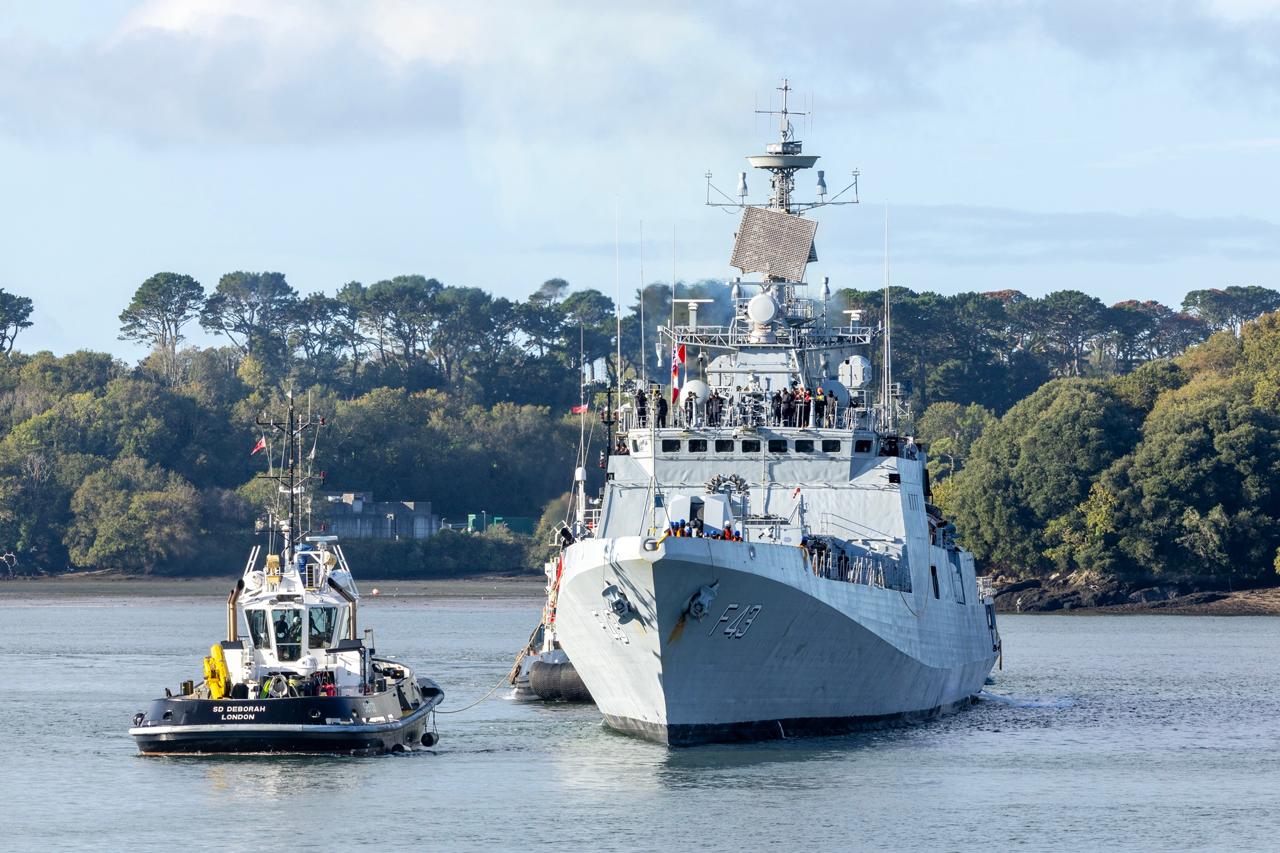
When the Indian Navy’s guided-missile stealth frigate INS Trishul entered Plymouth Sound on 10 October 2026, it brought New Delhi’s blue-water maritime deterrence directly into northern European waters. Ostensibly a scheduled bilateral engagement with the British Royal Navy, the operational scope of Exercise Konkan 2026 marks a decisive strategic transition from ceremonial diplomacy to contested multi-domain interoperability across the Atlantic and English Channel.
What Is the Strategic Objective of Exercise Konkan 2026?
Exercise Konkan 2026 is an intensive bilateral naval exercise conducted from 8 to 15 October 2026 off Plymouth, United Kingdom, designed to validate joint air defence, anti-submarine warfare, and cross-deck flight operations between the Indian Navy and the British Royal Navy. The exercise deepens interoperability in contested maritime corridors under the comprehensive India-UK Roadmap 2035 framework, reinforcing sovereign freedom of navigation across critical sea lines of communication.
The annual bilateral engagement, which has evolved over two decades, is structured in two distinct operational phases. The opening harbour phase in Plymouth focused on tactical planning conferences, damage-control simulations, cross-vessel specialist visits, and operational briefings between South Block mission planners and Royal Navy command. The subsequent sea phase in the English Channel and North Atlantic tests the two navies across all three combat dimensions: air, surface, and sub-surface warfare.
Tactical manoeuvres scheduled for the sea phase include coordinated live-firing serials, electronic warfare countermeasures, complex replenishment-at-sea approaches, and integrated anti-submarine warfare (ASW) hunts. As the Indian Navy expands forward deployments under its MAHASAGAR maritime doctrine, forward interoperability with Tier-1 naval powers validates that Indian warships can seamlessly execute high-tempo operations thousands of nautical miles from home ports.
How Does the Deployment Impact India-UK Naval Industrial Cooperation?
The presence of INS Trishul in Britain directly supports accelerated defence-industrial cooperation under the 2035 bilateral roadmap, specifically advancing joint electric propulsion systems and gas-turbine marine engineering. By deploying a Talwar-class frigate to Plymouth, New Delhi reinforces industrial negotiations with British engineering majors to co-develop advanced naval powerplants for next-generation Indian indigenous surface combatants.
Beyond tactical drills, the deployment reflects deep industrial stakes. INS Trishul—a 4,035-tonne guided-missile frigate armed with BrahMos supersonic cruise missiles and Shtil-1 surface-to-air systems—operates on advanced gas-turbine marine propulsion. As the Ministry of Defence accelerates naval modernisation, British propulsion giant Rolls-Royce and Indian public sector shipbuilders are collaborating on electric drive propulsion architectures for India’s future Landing Platform Docks (LPDs) and indigenous guided-missile destroyers.
This technical convergence directly touches domestic manufacturing ecosystems. Indian shipyards, including Mazagon Dock Shipbuilders and Garden Reach Shipbuilders & Engineers (GRSE), are managing expansive order books exceeding ₹1,20,000 crore ($14.4 billion). Co-development of marine gas turbines and full-electric propulsion architecture reduces foreign maintenance bottlenecks while augmenting domestic sub-tier supply chains.
What Are the Macroeconomic and Market Implications for Indian Defence?
The forward deployment of Indian naval assets to Europe accelerates capital expenditure allocation for long-range naval logistics, sensor suites, and domestic propulsion spares. Joint military drills reinforce international export confidence in Indian naval integration, directly benefiting domestic defence public sector undertakings like Bharat Electronics Limited (BEL) and private subsystem manufacturers through multi-year maintenance and electronics lifecycle contracts.
Long-range deployments also expose the absolute necessity of sustained fleet replenishment. As examined in our analysis of Fleet Support Ships and Indian Navy power projection, operating combatants in European seas requires robust auxiliary logistics and resilient critical component pipelines. The strategic reliance on specialized marine-grade alloys, titanium heat-exchangers, and radar-absorbent coatings creates sustained demand for Indian critical minerals and specialized metallurgy.
For strategic investors and industry observers, the continuous forward deployment tempo of the Western Fleet reinforces multi-year revenue visibility for naval electronics majors. Bharat Electronics Limited (BEL), which supplies the electronic support measures (ESM), sonar suites, and combat management systems integrated into Indian frontline frigates, benefits directly from ongoing modernization outlays. Operating in joint NATO-standard environments alongside the Royal Navy benchmarks Indian indigenous systems against the world’s most demanding maritime standards.
Investment Disclaimer: Analysis of defense public sector undertakings (PSUs), procurement order books, and corporate partnerships is published solely for geopolitical and strategic information purposes and does not constitute financial, investment, or stock trading advice.
What Changes for India’s Maritime Trajectory?
Exercise Konkan 2026 demonstrates that New Delhi no longer confines naval deterrence to the northern Indian Ocean, but exercises sovereign reciprocity across global blue-water chokepoints. By pairing forward naval presence with indigenous manufacturing depth, the Indian Navy establishes that strategic autonomy in international statecraft is underpinned by global operational reach.
Historically, extra-regional deployments were seen as defensive posturing. In 1971, when foreign naval task forces sailed into regional waters, New Delhi lacked reciprocal reach. Today, deployed stealth combatants like INS Trishul operate off European coasts with unassailable sovereign equality. Exercise Konkan 2026 confirms that India’s naval trajectory is no longer defined by geographic limits, but by technical self-reliance and geopolitical purpose.
Source Note: Reporting draws on official disclosures from the Ministry of Defence (PIB Delhi PRID 2321927), Indian Navy operational bulletins, bilateral statements under the India-UK Roadmap 2035, operational bulletins from the Royal Navy, and statutory disclosures by domestic defence shipbuilders.

2 thoughts on “Exercise Konkan 2026: Why INS Trishul in Plymouth Signals High-Stakes Naval Tech Shift”