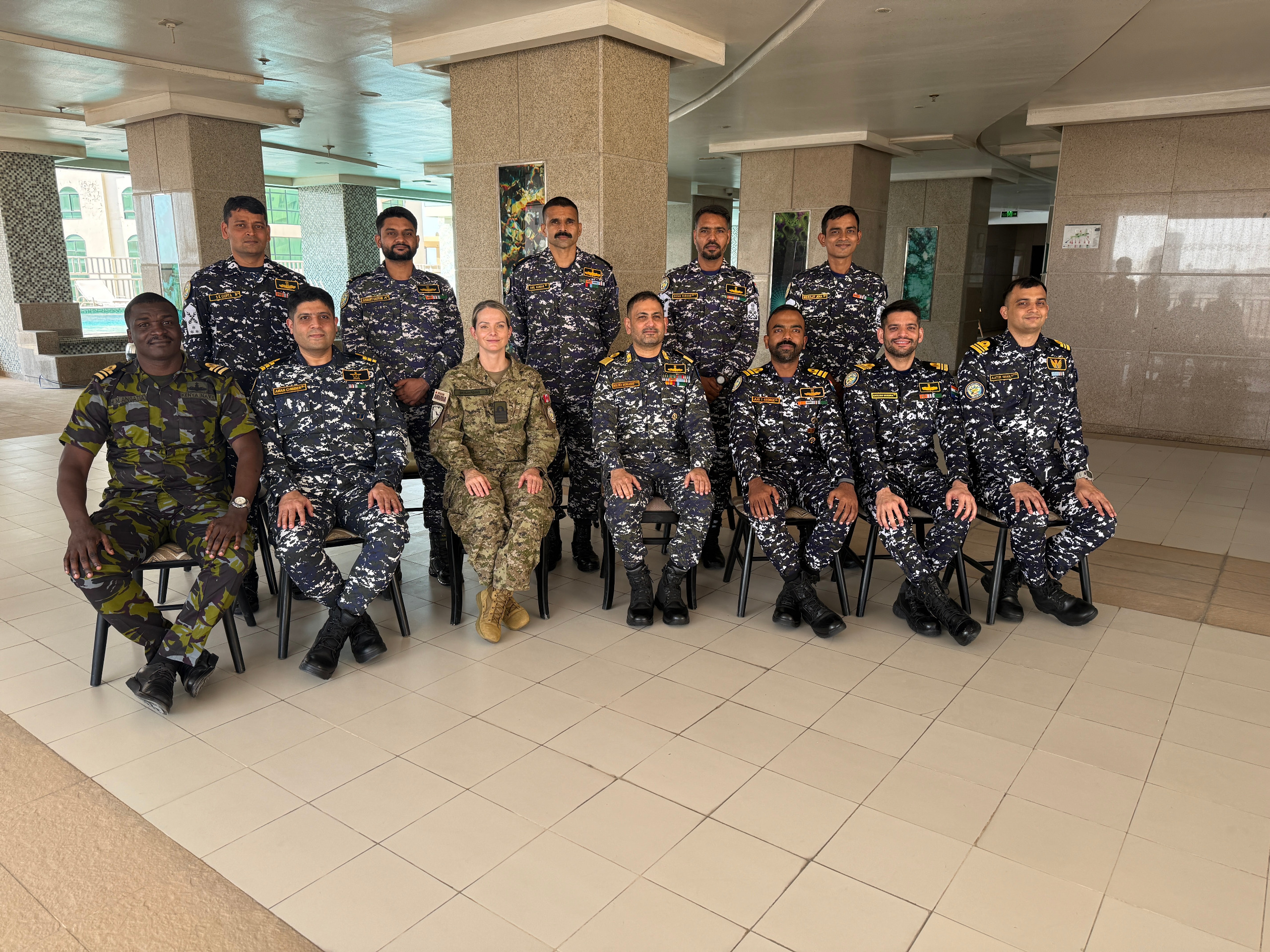
For decades, Western naval coalitions treated the Indian Navy as an autonomous loner in the northern Indian Ocean. New Delhi participated in information-sharing forums and coordinated counter-piracy patrols under Shared Awareness and Deconfliction (SHADE), yet it steadfastly refused to integrate its warships under foreign command structures. But on 14 October 2026 at Manama, Bahrain, the Indian Navy completed an inflection point in its modern maritime doctrine: it formally relinquished its maiden leadership of Combined Task Force 154, having directed multinational operational training across 39 partner nations throughout West Asian waters.
New Delhi did not compromise its long-standing principle of strategic autonomy. Instead, it reversed the polarity of maritime command.
What is Combined Task Force 154 and Why Did the Indian Navy Command It?
Combined Task Force 154 is the multinational training task force of the 47-nation Combined Maritime Forces (CMF), headquartered in Manama, Bahrain. Established to conduct Maritime Domain Enhancement Training, CTF 154 builds operational readiness in maritime interdiction, counter-piracy, search and rescue, and visit, board, search, and seizure (VBSS). The Indian Navy assumed command on 11 February 2026, marking its maiden leadership of a CMF task force after joining as an Associate Partner in 2022 and becoming a full member in 2023.
The tenure, executed under the auspices of the Ministry of Defence, delivered a demanding curriculum designed to bridge doctrinal differences between Western navies, Gulf partners, and Indian Ocean littoral states. Across an eight-month deployment, the Indian command team directed 20 Staff Enhancement Training engagements, Operation Compass Rose 26-1, Operation Southern Readiness 26-2, and the inaugural Subject Matter Expert Exchange on Piracy and Armed Robbery (SPAR 2026). In aggregate, the mission generated over 7,800 training hours, drawing naval professionals from 39 countries into unified exercises.
Rather than acting merely as an escort force, Indian naval officers formulated and executed operational training modules on boarding tactics, maritime domain awareness, and asymmetric drone counter-measures. This institutional shift reflected lessons refined during intensive high-seas deployments and multinational naval wargames.
How Does the Manama Command Shift Anchor India’s SAGAR Doctrine in West Asia?
The Indian Navy’s leadership of Combined Task Force 154 operationalises New Delhi’s Security and Growth for All in the Region (SAGAR) doctrine beyond the traditional boundaries of South Asia. By training personnel from 39 nations across the Red Sea, Bab-el-Mandeb, and Gulf of Oman corridors, India cemented its standing as a Preferred Security Partner. This strategic deployment balances multi-alignment autonomy with practical interoperability, securing vital sea lines of communication without subordinating naval operations to external command structures.
History offers a sharp contrast. In October 1990 during the eruption of the Gulf War, New Delhi found itself scrambling to coordinate emergency merchant airlifts and unilateral sealifts from Kuwait and Iraq, devoid of institutional maritime command linkages in the Persian Gulf. Contrast that vulnerability with June 2019, when the Indian Navy launched Operation Sankalp following tanker sabotage in the Gulf of Oman. Under Sankalp, Indian destroyers and frigates established permanent, independent escort patrols while liaising with multinational forces.
Commanding Combined Task Force 154 represents the evolutionary culmination of that posture. By steering the training task force in Bahrain, South Block proved that India can lead a 47-nation coalition’s human capability development without diluting its independent decision-making. Backstopped by massive home-base investments like Project Seabird in Karwar and long-range endurance assets such as upcoming fleet support ships, India’s naval umbrella in West Asia has shifted from episodic presence to enduring operational authority.
What Are the Equities, Defence PSUs, and Commodity Implications of West Asian Maritime Security?
Sustained Indian naval command across West Asian chokepoints directly influences energy security and maritime trade economics. Over 60% of India’s crude imports transit the Strait of Hormuz and Bab-el-Mandeb. Active naval presence suppresses war-risk insurance premia on commercial shipping while driving procurement for indigenous shipbuilders. Indian defence PSUs, including Mazagon Dock Shipbuilders, Cochin Shipyard, and Bharat Electronics Limited (BEL), benefit from multi-year fleet expansion and sensor modernisation programmes valued at over ₹1,40,000 crore ($16.8 billion).
Geopolitical turbulence along the Bab-el-Mandeb and Gulf of Aden has demonstrated how swiftly asymmetric drone strikes can spike war-risk insurance premia by up to 300%, threatening energy import bills and container freight rates. By taking the lead in anti-piracy wargames and visit-and-search training under Combined Task Force 154, India provides tangible stability to the global maritime commons.
This operational footprint feeds directly into India’s capital acquisition cycle. To sustain concurrent deployments across the Arabian Sea, Persian Gulf, and Bay of Bengal, the Defence Acquisition Council (DAC) has accelerated capital outlays. Major defence public sector undertakings (PSUs) are direct beneficiaries:
- Mazagon Dock Shipbuilders Limited (MDL) & Garden Reach Shipbuilders (GRSE): Anchoring next-generation frigate and destroyer construction under Project 17B and Next Generation Corvettes (NGC) contracts worth over ₹36,000 crore ($4.32 billion).
- Bharat Electronics Limited (BEL): Supplying indigenous combat management systems, radar suites, and advanced electronic warfare packages that equip Indian surface combatants deployed in multilateral task forces.
- Cochin Shipyard Limited (CSL) & L&T Shipbuilding: Executing fleet replenishment vessels and mid-life refits critical for sustained out-of-area task group endurance.
Investment Disclaimer: The equities, defence public sector undertakings, and order book valuations discussed in this analysis are presented solely for strategic and macroeconomic evaluation. This content does not constitute financial, investment, or equity trading advice.
What Lies Ahead for Indian Naval Power Projection in the Indian Ocean?
Following the relinquishment of Combined Task Force 154 command on 14 October 2026, the Indian Navy is set to transition from multinational training leadership to expanded operational presence across the wider Indo-Pacific. Drawing on 7,800 training hours and institutional bonds forged with 39 partner navies, New Delhi will leverage its enhanced interoperability to monitor high-density shipping lanes, deter asymmetric maritime threats, and assert sovereign deterrence across critical choke points from the Gulf of Aden to the Malacca Strait.
Systems, doctrine, and human interoperability win modern maritime confrontations. The Indian Navy’s eight-month command of Combined Task Force 154 proved that New Delhi does not need to accept subordinate alliance structures to project decisive regional influence. By teaching the tactics of boarding, deconfliction, and drone counter-action to navies across five continents, the Indian Navy has entrenched its role as the premier net security provider in the Indian Ocean.
Source Note: Primary operational data, training metrics, and timelines in this analysis are sourced directly from the Ministry of Defence Press Information Bureau release PRID 2323289 and official proceedings of the Combined Maritime Forces headquarters at Manama, Bahrain.