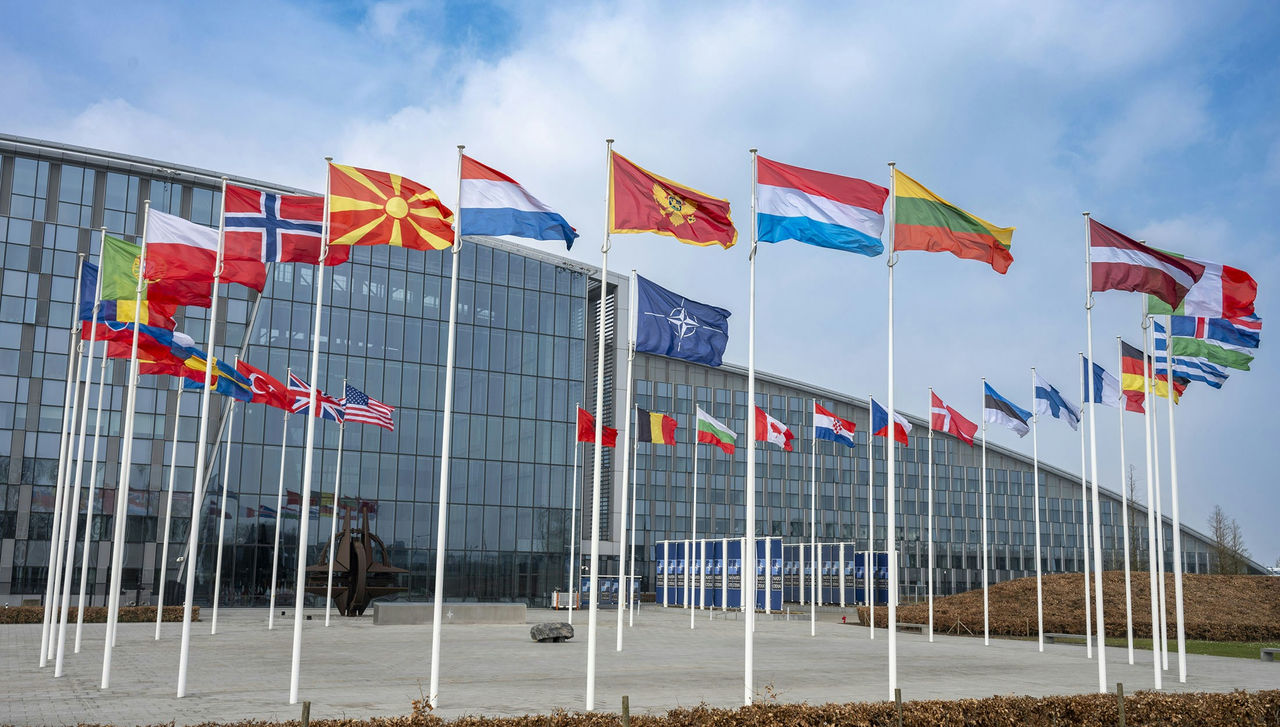
NATO’s top commander has described in public how the alliance would fight a land war in Europe, promising to destroy “anything and everything” that supports an attacking force. Three days earlier, Washington had licensed Russian diesel to move to world markets. Both events matter to New Delhi, and for different reasons.
For India the more immediate item is the diesel licence. It arrived three weeks after the United States signed a law that allows tariffs of up to 100 per cent on major buyers of Russian energy, and India is the second-largest buyer of Russian crude. The NATO speech, for its part, offers Indian strategists a worked example of how a nuclear-armed alliance tries to define the limits of its own conventional war before it begins.
Gen. Alexus Grynkewich, NATO’s Supreme Allied Commander Europe (SACEUR), presented what he calls a “Theory of Victory” at the Warsaw Security Forum on 12 October 2026. It sets out how NATO would deny Russia a quick land grab and then dismantle the system sustaining the attack. Its most consequential feature is a stated limit: NATO says it does not seek Russia’s strategic defeat.
Key takeaways
- Grynkewich described a three-stage concept: block an initial attack, blunt any advance and, if required, break the enemy’s forces and the operational system that supports them.
- He said NATO is not seeking a strategic defeat of its adversary, which he argued places the burden of escalation on the aggressor. Reuters reported that he also warned NATO would strike well beyond the forces directly engaged.
- Whether allies have formally endorsed the concept is reported differently. The forum’s organisers said it had so far been discussed at the NATO Military Committee. Newsweek reported that Grynkewich said all 32 allies had agreed a “common vision”. The full operational plans are not public.
- On 9 October the US Treasury issued General License 135, authorising transactions in Russian-origin diesel until 7 April 2027. On 11 October President Donald Trump announced an “energy ceasefire” between Russia and Ukraine. Moscow had not confirmed it, and Ukraine reported Russian strikes on its energy sites afterwards.
- For India, the exposure is the Sanctioning Russia and Iran Act signed on 18 September, not the diesel licence. Russia’s share of India’s crude imports fell to about 35 per cent in September from 56 per cent in July, according to Kpler.
What the “Theory of Victory” is, and what it is not
The concept was presented publicly for the first time at the Warsaw Security Forum on 12 October 2026. It describes how the 32-member alliance would respond to an attack on its territory. It is not a treaty commitment, and NATO has not published the underlying plans. Bloomberg reported that it had seen an unclassified version of the document.
Its formal status is unsettled in the reporting. The forum’s organisers said the concept had been discussed behind closed doors at the highest level of NATO’s Military Committee. Newsweek reported that Grynkewich told the audience all 32 allies had agreed to a common vision. Until NATO releases a text or a transcript settles the point, the safe description is a SACEUR-presented concept that the alliance’s military leadership has worked on.
The frame is what NATO calls a “denial defence”: stop an adversary from seizing and holding alliance territory, so that a fait accompli is never achieved. Grynkewich said he did not assess conflict as imminent or inevitable, and told TVP World that the risk of a major Russian attack was “relatively low” while Moscow’s forces remain committed in Ukraine. He added that NATO would be “ready to fight tonight” if attacked.
The concept borrows from Ukraine: cheap, scalable drones and sensors alongside expensive precision weapons. Our running account of that war is in the Russia–Ukraine ground situation tracker.
Block, blunt, break: the three stages
Grynkewich summarised the plan himself: block the initial attack; if it persists, blunt it and prevent any advance; if required, break the enemy’s forces and the war-fighting system arrayed against NATO.
Block. Forward land forces halt the assault at the point of contact and deny the seizure of territory, supported by air, naval, space and cyber capabilities. The aim here is physical and narrow.
Blunt. If the attack continues, NATO would add advanced sensors, autonomous systems and coordinated fires to deny the advance momentum. This stage leans on Ukraine’s central lesson, which is mass that is cheap and distributed, layered with precision.
Break. The last stage reaches past the attacking troops. Command structures, supply networks and logistics become targets for long-range precision strikes and unmanned systems. Grynkewich said this covers the attacking force and also “anything and everything that supports, sustains, and controls” it, in the wording Reuters reported.
A declared limit, and its limits
NATO is not seeking to impose a strategic defeat on its adversary, Grynkewich said, “nor do we need to do so”. The alliance only wants to stop an attack and deny the ability to seize and hold territory. He argued that this narrower objective leaves the burden of any further escalation with the aggressor.
Several outlets led with that restraint. Reuters led with the other half: a warning that NATO would strike far beyond the area under attack. Both are in the speech, and the tension between them is the analytical point. A promise to dismantle command and logistics sits uneasily beside a claim of limited aims, and Moscow decides which half it believes. TES assesses that the limited-aims language is built to keep a nuclear-armed adversary from reading the plan as an existential threat. That is an assessment of intent, not a stated NATO position.
Grynkewich also said that any Russian escalation would only strengthen NATO’s unity, and that the alliance could “match any enemy move up the escalation ladder”. Reuters noted that he did not name Russia in the speech, though the message was plainly aimed at Moscow.
Why NATO spoke now
Grynkewich said he wanted to reassure the alliance’s roughly one billion citizens, at a time when European governments accuse Moscow of stepping up sabotage, drone incursions and cyberattacks. Reporting on the speech cited an arson attack on an Estonian defence company and a failed attempt to attack a Ukrainian aircraft at a German airport. Russia has denied involvement in sabotage and hybrid operations, and has called the idea of attacking NATO “nonsense”.
Asked whether the plan accounts for a scenario in which US forces are engaged elsewhere, including the Indo-Pacific, Grynkewich said it does, and that it must. For allies on the eastern flank, that answer addresses a standing worry about American bandwidth.
The same week: a diesel licence and an unconfirmed ceasefire
On 9 October Trump announced, after a call with Vladimir Putin, that Russia would supply more than 300,000 tonnes of diesel to global markets immediately, 500,000 tonnes in November, 1 million tonnes after that and a further 3 million tonnes depending on the condition of Russian refineries. That sums to 4.8 million tonnes. The terms come from Trump’s own post. The one officially documented element is the Treasury’s General License 135, valid until 7 April 2027. Russian Deputy Prime Minister Alexander Novak said Moscow was lifting diesel export restrictions ahead of schedule.
The driver was fuel prices before the US midterm elections. AAA recorded a record national average diesel price of $6.53 a gallon on 22 September. The explanation offered in Washington centres on Ukrainian strikes on Russian refineries, which the International Energy Agency says cut Russian diesel output by nearly 30 per cent and led Moscow to ban exports in July. That is part of the picture. Forbes, analysing IEA data, attributes roughly two-thirds of the fall in combined Gulf and Russian diesel exports since February to the Gulf, which reflects the Iran war and disruption around the Strait of Hormuz. The scale also limits the effect: Forbes calculates that the full 4.8 million tonnes would cover about 23 days of the lost export volume.
On 11 October Trump announced an “energy ceasefire” between Russia and Ukraine. Moscow had not confirmed it. Zelensky said the announcement “was news for me”, Ukraine said Russia struck energy sites afterwards, and Kyiv said it would halt strikes on Russian refineries if Moscow did the same. Ukraine had earlier called the diesel arrangement a gift to Putin. Rep. Michael McCaul, a Republican, said the licence cuts against the sanctions law Congress passed.
Kaliningrad: the nuclear signal in the background
On 30 September Russia sent NATO members a written note warning it would use its full arsenal, including nuclear weapons, if the alliance tried to cut off Kaliningrad, the Baltic exclave between Poland and Lithuania. The note claimed Moscow had information that NATO was preparing an air and naval blockade, a claim NATO has not accepted. NATO spokesperson Allison Hart confirmed receipt and said none of the alliance’s activities or exercises pose a risk to Russia. Secretary-General Mark Rutte called on Moscow to stop the nuclear threats and told Euronews he did not take the warning seriously, since Moscow could never win a confrontation with NATO. Our Kaliningrad coverage has the background.
Grynkewich’s speech came less than two weeks later. Reports do not link his escalation-ladder remark to the note. What the two documents show together is that any NATO plan for fighting Russia now has to price in nuclear signalling from the outset.
What changes for India
Tariff exposure. The Lindsey O. Graham Sanctioning Russia and Iran Act of 2026, signed on 18 September, lets the US administration impose tariffs of up to 100 per cent on goods from major buyers of Russian energy. Kpler data cited by Bloomberg shows Russia’s share of India’s crude imports at about 35 per cent in September, down from as high as 56 per cent in July, as Urals crude priced close to Middle Eastern grades and refiners turned back to Gulf supply. Russia remains India’s largest single supplier. The diesel licence covers diesel only, and the reporting does not indicate that it changes the Act’s reach over crude buyers. The licence and the Act pull in different directions, and Indian refiners have to plan for both. TES has tracked this in its coverage of the tariff risk for Indian refiners and the diesel licence and India.
A deterrence precedent. NATO’s insistence on limited objectives under a nuclear shadow is a problem Indian planners know. India described its Operation Sindoor in May 2025 as measured and non-escalatory. The comparison is useful for what it shows about how a nuclear-armed state signals the ceiling of its own response. It is not an argument that India should copy NATO’s design, and NATO’s plan is a coalition construct with a large conventional force that India does not face in the same form.
US attention. Grynkewich’s statement that NATO must be ready while US forces are engaged elsewhere points to a Europe that plans to carry more of its own defence. TES assesses that this could free American attention for Asia over time, though European governments may also lobby Washington to stay. That is an assessment, and no source quoted here says so.
What to watch
A single commander’s concept becomes strategy only when allies fund it. Four indicators will show whether the speech was a turning point: whether NATO publishes or confirms an allied endorsement, and turns the concept into exercise and procurement commitments; whether General License 135 and the energy ceasefire survive Congress and Russian behaviour; whether the grey-zone campaign against Baltic and Nordic states rises or pauses; and whether India’s refiners change their Russian-crude volumes as the tariff authority and the diesel licence interact. For India, the third and fourth carry the more direct costs.